


Syllabus: GS3/Infrastructure
Context
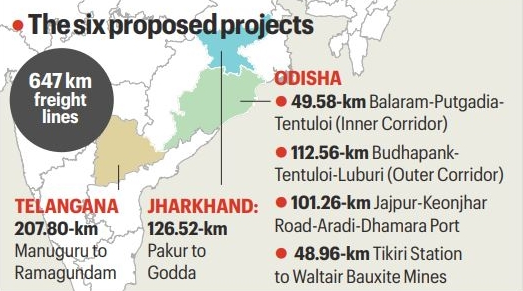
- The Public Private Partnership Appraisal Committee (PPPAC) approved six railway projects covering 647 km under the Hybrid Annuity Model (HAM), marking the Indian Railways’ first major adoption of HAM.
Key Features of the Projects
- Total capital cost over the 17–19 year concession period is estimated at ₹40,866 crore.
- Four projects are in Odisha, while one each is in Telangana and Jharkhand.
- The routes primarily cater to coal, iron ore, bauxite, coke, fertilisers, cement and food grains.
- Construction is proposed to begin from April 2028, subject to final approval and bidding.
PPP Appraisal Committee (PPPAC)
- It is an inter-ministerial appraisal mechanism for examining PPP projects before their approval.
- It functions under the Department of Economic Affairs (DEA), Ministry of Finance, and appraises major Central-sector PPP projects.
- Its broad purpose is to ensure that PPP projects are financially viable, appropriately structured, transparent and consistent with public interest.
About Investment Models
- Public Private Partnership models enable private participation in infrastructure while sharing responsibilities and risks.
- Major models include:
- Engineering, Procurement and Construction (EPC): Government finances the project; private entities mainly undertake construction.
- Design, Build, Finance, Operate and Transfer (DBFOT): Private party finances, develops and operates the asset before transferring it.
- Build, Operate and Transfer (BOT): Private entity builds and operates the project for a concession period.
- Hybrid Annuity Model (HAM): A hybrid of public funding and private financing, with government support through grants and annuity payments.
- Development Partner Model: Private/public entities participate in developing railway infrastructure associated with specific traffic or industrial requirements.
What is the Hybrid Annuity Model?
- HAM is a form of Public Private Partnership (PPP) that combines public funding with private financing.
- Under the proposed arrangement:
- Government contribution: Indian Railways will provide 40% of the bid project cost as grant during construction.
- Private financing: The concessionaire will finance the remaining 60%.
- Repayment: After commissioning, the Railways will repay the private investment through annuity payments along with interest.
- Operations: Indian Railways will operate trains and collect freight revenues.
- Risk sharing: Traffic and tariff risks remain with Indian Railways. Thus, lower-than-expected freight traffic would not directly penalise the private concessionaire.
- The private party will undertake maintenance of railway assets as specified in the concession agreement.
Why HAM for Railways?
- Earlier, the projects were considered under the Design, Build, Finance, Operate and Transfer (DBFOT) model. However, market feedback indicated greater private-sector interest under HAM.
- Significance:
- Mobilises long-term private capital for railway infrastructure.
- Reduces the Railways’ immediate financing burden.
- Transfers construction and maintenance responsibilities to the private sector while retaining strategic operations with Railways.
- Facilitates mineral and port connectivity, strengthening freight logistics.
- Can improve India’s multimodal transport efficiency and logistics competitiveness.
- Provides an alternative financing mechanism amid large infrastructure investment requirements.
Challenges
- Fiscal burden: Future annuity and interest payments create long-term government liabilities.
- Demand estimation: The government bears traffic and tariff risks.
- Contract management: Effective monitoring of construction and maintenance standards is essential.
- Land acquisition and clearances may cause delays.
- PPP projects require robust dispute-resolution and risk-allocation mechanisms.
Conclusion and Way Forward
- HAM should be implemented with transparent bidding, realistic traffic assessments, strong contract enforcement and independent performance monitoring.
- Lessons from highways-sector HAM projects can guide its application to railways.
- The shift towards HAM represents an important evolution in Indian Railways’ PPP strategy.
- If risks are allocated efficiently, it can combine public oversight with private capital and efficiency, accelerating freight-corridor development while preserving Railways’ operational control.
Previous article
India-Japan Economic Partnership
Next article
Aditya-L1: Indian Solar Mission’s New Findings
