


Govt. Plans to Conclude Trade Agreement with Chile
GS2/IR; GS1/Places in News
Context
- India is committed to concluding a “balanced and mutually beneficial” trade deal with Chile within this year.
About
- India and Chile started their CEPA negotiations in 2025, following the signing of the Terms of Reference.
- India’s exports to Chile stood at $1.2 billion in 2025-26, about 5.8% higher than in the previous year. Imports from Chile, on the other hand, stood at $5 billion — 93% higher than in 2024-25.
About Chile
- Chile is a long, narrow country on the west coast of South America.
- Its coastline stretches over 6,437 km but is only about 91 km wide.
- Cape Horn: Located at the southern tip of South America, Cape Horn is known for high winds and treacherous waves.
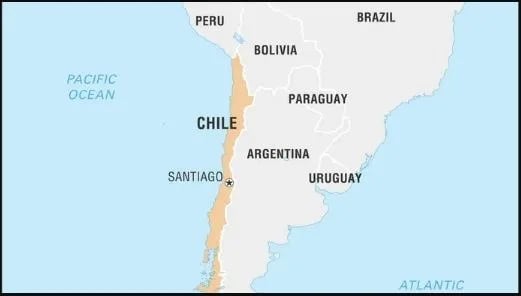
- The world’s driest non- polar desert is the Atacama Desert, located in northern Chile.
- Chile is located along a highly seismic and volcanic zone, part of the Pacific Ring of Fire, due to the subduction of the Nazca and Antarctic plates in the South American plate.
- Escondida is the largest copper mine in the world, it is located in the Atacama Desert of northern Chile producing over 5% of global supplies.
- Chile is also rich in mineral resources such as lithium.
- The “Lithium Triangle” refers to a region in South America that contains some of the world’s largest lithium reserves.
- This triangular-shaped region encompasses parts of Argentina, Bolivia, and Chile; they possess 58% of the world’s known lithium reserves.
Source: TH
Qualified Most-favoured Nation Rule
Syllabus: GS2/IR
Context
- India is reportedly considering a limited form of the Most-Favoured Nation (MFN) provision as part of the proposed overhaul of its bilateral investment treaty (BIT) framework.
About
- India excluded MFN from BIT in 2016, following the country’s experience with investment arbitration.
- The current move is seen as necessary not only to attract foreign investors, but also to enable Indian investors to get similar treatment in major economies like the US or EU.
- An open approach to granting qualified MFN status to foreign investors could also be a great leverage in bilateral negotiations.
MFN in an Investment Treaty
- In an investment treaty, it generally requires a country to provide investors from one treaty partner treatment no less favourable than that available to investors from another treaty partner.
- If India gives investors from one country a particular protection under a later treaty, an MFN clause can allow investors from another treaty partner to seek the same treatment.
- This is different from the MFN principle under the World Trade Organization (WTO), where the provision applies to trade relations between members. Last year, India opposed a US proposal to dilute the WTO’s MFN principle.
Source: BS
Per Drop More Crop (PDMC) Scheme
Syllabus: GS3/Agriculture
In Context
- Per Drop More Crop (PDMC) has been a game changer in the irrigation paradigm in India using micro irrigation technology, which ensures effective use of water.
Background of Per Drop More Crop (PDMC)
- The initiative originally began in January 2006 as the Centrally Sponsored Scheme (CSS) for Micro Irrigation.
- It was later upgraded to the National Mission on Micro Irrigation (NMMI) in 2010-11. During FY 2014-15, it became part of the National Mission on Sustainable Agriculture (NMSA) under the “On Farm Water Management” (OFWM) component.
- From FY 2015-16 to FY 2021-22, it was officially named Per Drop More Crop (PDMC) and implemented as a core component of the Pradhan Mantri Krishi Sinchayee Yojana (PMKSY).
- Since 2022-23, PDMC has been implemented under the Pradhan Mantri Rashtriya Krishi Vikas Yojana (PM-RKVY)
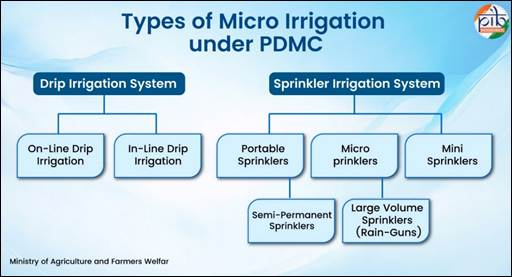
Types of Micro Irrigation Systems under PDMC
- Drip irrigation: It is a type of irrigation where water is delivered directly to the root zone of plants through emitters, reducing water loss and enhancing efficiency.
- There are two varieties:
- On-line drip: Drippers are laid as per the position of the plant, and it is suitable for unevenly spaced crops.
- In-line drip: Drippers are put in the pipes at regular intervals, and it is good for uniformly irrigated crops.
- There are two varieties:
- Sprinkler irrigation is the application of water through a system of pipes, usually by pumping, and then spraying the water through nozzles to form a uniform pattern of spray droplets to resemble natural rainfall. Up to this point, the irrigation is fairly uniform.
- It is ideal for high-density crops, grains, legumes, spices, seeds and
Features
- Financial assistance: The government provides financial assistance of up to five hectares per beneficiary to install micro irrigation systems. Small and marginal farmers receive 55%, and other farmers receive 45% financial assistance.
- Some state governments also provide additional subsidies from their own budgets.
- Water management: It advocates precision water management to maximise crop output and augment farmers’ revenue.
- The initiative also encourages fertigation to enhance the effectiveness of nutrient application and prioritises water-scarce and groundwater-stressed areas.
- Fertigation is the application of fertilisers through the irrigation water directly to the area where most of the plant’s roots develop
- The initiative also encourages fertigation to enhance the effectiveness of nutrient application and prioritises water-scarce and groundwater-stressed areas.
- Convergence: It also encourages the combination of micro-irrigation with tube wells, river-lift irrigation and solar-powered irrigation systems.
Progress
- The Pradhan Mantri Krishi Sinchayee Yojana – Per Drop More Crop (PDMC) initiative has enhanced water use efficiency, crop yield, employment and farmers’ incomes.
- A NITI Aayog review (2020-21) indicated income gains of 10-69% and improvements in water-use efficiency of 30-70%.
- The Economic Survey 2020–21 pointed out savings of 20–48% in water, 10–17% in energy, 30–40% reduction in labour expenses, 11–19% in fertiliser and 20–38% higher yields of crops by micro-irrigation.
Source : PIB
Pradhan Mantri Fasal Bima Yojana
Syllabus: GS3/Economy
In Context
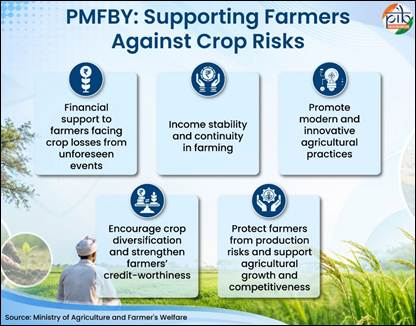
- Pradhan Mantri Fasal Bima Yojana (PMFBY) has evolved as one of the key pillars of India’s agricultural risk management system in the last 10 years.
Pradhan Mantri Fasal Bima Yojana (PMFBY)
- It was introduced in 2016 to cover the greatest number of farmers under crop insurance.
- It covers risks from pre-sowing, including prevented/failed sowing, broad-based mid-season adversity, localised calamities due to hailstorms, floods, landslip, etc. at specific land parcels, to post-harvest losses due to cyclones, unseasonal rainfall and other specified hazards.
- The Union Budget 2026-27 has earmarked Rs. 12,200 crore for PMFBY reiterating the Government’s sustained commitment toward farmer coverage through crop insurance.
Key Features PMFBY
- Premium: Farmers pay a maximum 2% premium for Kharif and 1.5% for Rabi foodgrain and oilseed crops.
- Maximum premium for commercial and horticultural crops shall be 5%.
- The balance premium is subsidised by the Central & State Governments in the ratio of 50:50. For Farmers in North-Eastern & Himalayan States/ UTs, the ratio of subsidy of Central & State Govt. is 90:10. “
- Eligible: The Pradhan Mantri Fasal Bima Yojana (PMFBY) offers crop insurance to eligible loanee and non-loanee farmers, including tenant farmers and sharecroppers. The documentation and eligibility criteria are state-specific.
- For non-loanee farmers, enrolment is voluntary. The premium is generally collected from the crop loan of loanee farmers by the institution from which they borrowed.
- Risks Covered
- Yield Losses (standing crops, on notified area basis): PMFBY provides area-based coverage against non-preventable risks such as drought, dry spells, floods, inundation, cyclones, hailstorms, lightning, pests and diseases.
- Prevented Sowing: Where insured farmers incur expenditure but are prevented from sowing due to adverse weather conditions, they shall be eligible for claims up to a maximum of 25% of the sum insured.
- Post-Harvest Losses: Crops kept in “cut-and-spread” condition for drying in the field are covered for up to 14 days after harvesting against specified cyclonic and unseasonal rain events.
- Localized Calamities: Individual farm-level losses caused by hailstorms, landslides, inundation, cloud bursts, and damage by natural fire are covered under specified conditions.
- Exclusions: PMFBY excludes losses from war, nuclear risks, riots, theft, specified post-harvest conditions, and other preventable risks.
- Numerous restrictions exclude losses that occur in locations not reported, outside of the covered crop lifetime or due to negligence, man-made or preventable causes.
Progress and Achievements Under PMFBY
- PMFBY is being implemented in 25 States & Union Territories as of Kharif 2026. Since the scheme’s launch, over 92.46 crore farmer applications have been insured and payments of over ₹ 2.06 lakh crore have been made on over 26.33 crore applications.
- As on 27 August 2026, 241.38 lakh farmers covering 278.12 lakh hectares were insured in Kharif 2026, which was higher than Kharif 2025 coverage of 229.77 lakh farmers and 269.38 lakh hectares.
- The growing confidence in the PMFBY is seen in the key states rejoining the scheme — Andhra Pradesh (2022), Jharkhand (2024), West Bengal (2026), while Bihar is slated to rejoin from Rabi 2026-27.
Source: PIB
Sardar Patel National Unity Award
Syllabus: Miscellaneous
In Context
- The Sardar Patel National Unity awards are expected to be announced on October 31, coinciding with the Sardar Vallabhbhai Patel’s 150th birth anniversary.
About
- The Sardar Patel National Unity Award was instituted by the Ministry of Home Affairs (MHA) in 2019 to recognise outstanding contributions towards national unity and integrity.
- The award is expected to be considered equivalent to the Padma Vibhushan.
- The award committee would be constituted by the Prime Minister, and would include the Cabinet Secretary, Principal Secretary to the Prime Minister, Secretary to the President, Home Secretary, as members, and three-four eminent persons selected by the Prime Minister.
- The award is set to comprise a medal and a citation, but no monetary grant or cash award would be attached to it.
- It would not be conferred posthumously, except in very rare and highly deserving cases.
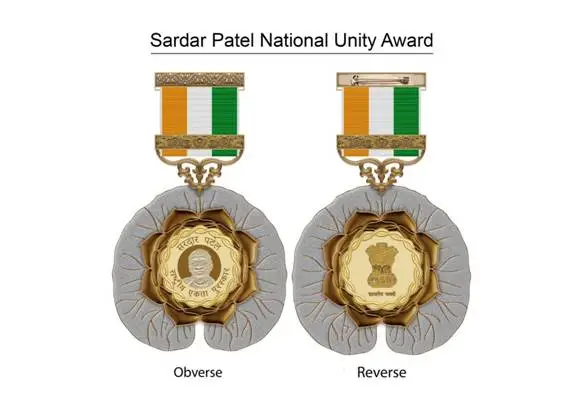
- The medal will be in the form of a lotus leaf, made of gold and silver, with Patel’s portrait embossed on one side and the national emblem on the other.
Source: IE
Vacuum Birefringence
Syllabus: GS3/ S&T
In Contex
- A study found strong evidence of vacuum birefringence around the magnetar 1E 1547.0−5408, with X-rays showing polarisation of up to 80%.
About vacuum birefringence
- It is a quantum effect predicted by Quantum Electrodynamics (QED) in which extremely strong magnetic fields make empty space and behave like a birefringent crystal.
- It was first formulated theoretically in the 1930s by Werner Heisenberg and Hans Heinrich Euler.
- It happens when virtual electron–positron pairs in the quantum vacuum are affected by a magnetar’s intense magnetic field, causing light passing through it to become strongly polarised.
- It provides a rare test of Quantum Electrodynamics (QED) under extreme conditions and helps scientists understand the nature of the quantum vacuum and magnetic fields of neutron stars.
Source: TH
Previous article
Aditya-L1: Indian Solar Mission’s New Findings
