


Syllabus: GS2/IR
Context
- PM Modi paid a state Visit to Uzbekistan.
Major Highlights
- India and Uzbekistan announced to elevate their mutual Strategic Partnership to Comprehensive Strategic Partnership level.
- Both Countries agreed to set a target of 5 billion dollars of bilateral trade by 2030, which is 5 times the current trade.
- Grant of USD 1 million for afforestation in the Aral Sea region.
- Uzbekistan has also agreed to establish a framework for long-term supply of uranium to India and discuss the sites of the mining for rare earth minerals.
- Commercial Agreement between NPCI International Payments Ltd (NIPL) with National Interbank Processing Centre JSC (NIPC) to enable UPI Apps of India to scan national QR – UZQR for making merchant payments in Uzbekistan.
- Cultural Exchange Programme between India and Uzbekistan for the years 2026-30.
- Letter of Intent for the conservation and restoration of ancient Buddhist sites of Fayaz Tepa and KaraTepa located in Termez, Uzbekistan.
- Prime Minister Narendra Modi also received the highest award of Uzbekistan for Foreign Leaders i.e. the “Oliy Darajali Do’stlik” Order.
Brief on India-Uzbekistan Ties
- Establishment of Ties: Both Nations established diplomatic ties in 1992. India and Uzbekistan declared their Strategic Partnership in 2011.
- Bilateral Trade and Investments: India is among top 10 trade partners of Uzbekistan with bilateral trade of USD 1.32 billion which is well below potential.
- Total Indian investments in Uzbekistan amount to US$ 451 million (approx). Indian investments by Indian companies include pharmaceuticals, healthcare, education and residential building.
- Defence & Security Cooperation: A Joint Working Group on defence was established in 2019. India & Uzbekistan regularly participate in joint military exercises “DUSTLIK”.
- The 3rd meeting of India–Central Asia NSAs/Secretaries of Security Councils was held in 2025, it reviewed regional security challenges, advanced counterterrorism and tech cooperation.
- Cultural Cooperation: Indian films, actors and songs have been extremely popular in Uzbekistan. Yoga is immensely popular with more than 2000 participants attending International Yoga Day.
- Diaspora & people-to-people ties: Indian community is estimated to be 21,000 which includes students, workers & business professionals.
- First ever India-Uzbekistan Consular Dialogue was held in 2025 during which discussions were held on visa processes, consular cooperation, and security matters.
- Multilateral engagement: India and Uzbekistan cooperate closely at several multilateral platforms such as the UN, G20, BRICS & SCO.
Significance of Uzbekistan for India
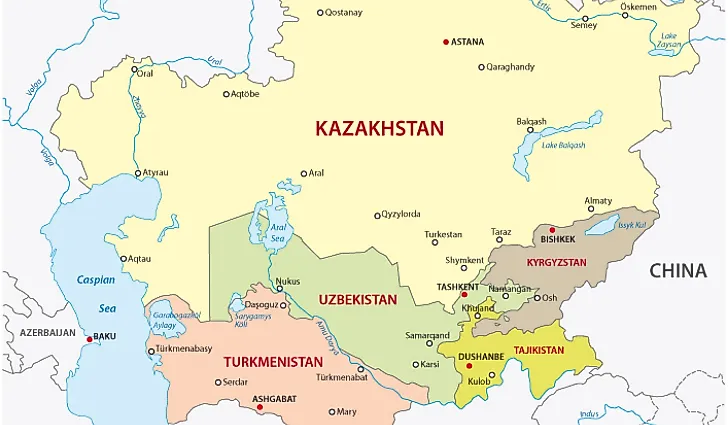
- Strategic location: Uzbekistan is strategically located in the heart of Central Asia, making it important for India’s engagement with the wider Eurasian region and for countering the influence of other major powers.
Central Asia
- Central Asia is the landlocked central region of Asia, extending from the Caspian Sea in the west to the border of western China in the east.
- It is bounded on the north by Russia and on the south by Iran, Afghanistan, and China.
- The region consists of the former Soviet republics of Kazakhstan, Uzbekistan, Tajikistan, Kyrgyzstan, and Turkmenistan.
- Central Asia’s unique geographical position is deeply rooted in its historical ties to the “Silk Trade Routes,” and has been pivotal in the region’s geopolitics and beyond.
- Connectivity: Uzbekistan is important for India’s efforts to develop alternative routes to Central Asia, particularly through Chabahar Port and the International North-South Transport Corridor (INSTC).
- Energy and critical minerals: Uzbekistan is a significant uranium producer, accounting for roughly 6.6% of global production in 2024. It creates opportunities for India to diversify its energy and critical-mineral supply chains.
- Security cooperation: Both countries share concerns over terrorism, extremism, drug trafficking and instability in Afghanistan. Defence cooperation, including joint military exercises, strengthens regional security coordination.
- Economic potential: Uzbekistan offers opportunities for Indian investments and trade in pharmaceuticals, IT, agriculture, textiles, mining, energy and infrastructure.
- Regional diplomacy: Uzbekistan is a key member of the Shanghai Cooperation Organisation (SCO) and an important partner in India’s Connect Central Asia policy.
Areas of Concern
- Limited bilateral trade: Despite significant potential, India–Uzbekistan trade remains relatively modest due to geographical distance, limited connectivity and high transportation costs.
- Connectivity constraints: India lacks direct land access to Central Asia because of Pakistan’s geographical position. Dependence on routes through Iran and Afghanistan makes connectivity vulnerable to geopolitical disruptions.
- China’s growing influence: China has emerged as a major economic and strategic partner of Uzbekistan through the Belt and Road Initiative (BRI), creating greater competition for India’s economic and strategic outreach in Central Asia.
Way Ahead
- Enhance Connectivity: Strengthen Chabahar Port and INSTC to establish reliable trade routes between India and Central Asia, overcoming geographical constraints.
- Strengthen security cooperation: Expand counter-terrorism, intelligence sharing and defence cooperation, with greater coordination on the security challenges emerging from Afghanistan.
- Build regional partnerships: Utilise platforms such as the SCO and India–Central Asia mechanism to coordinate on connectivity, terrorism, trade and regional stability.
Source: PMO
Previous article
News In Short 29-08-2026
Next article
India-Japan Economic Partnership
