


China Accelerates South China Sea build-up with New Installations
Syllabus: GS2/IR
Context
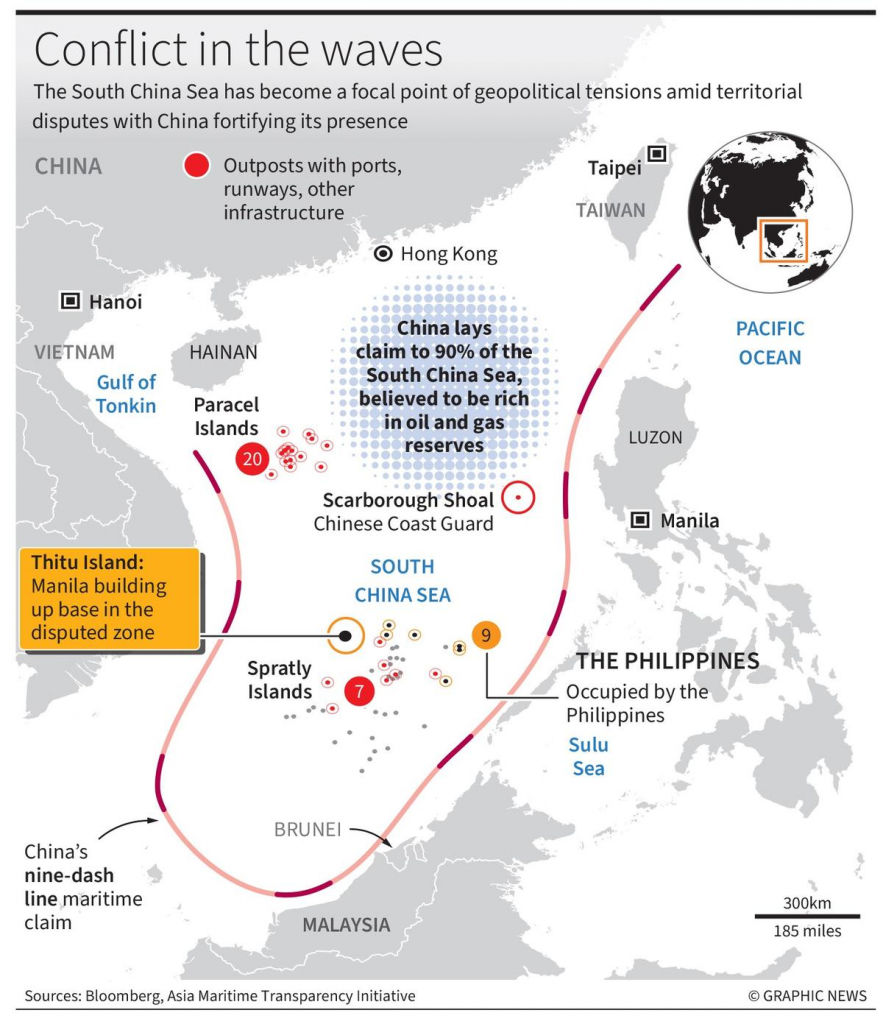
- Satellite images show that China has built an artificial island on the disputed Antelope Reef in the South China Sea and constructed infrastructure that expands its control over the region.
Paracel Islands
- Antelope Reef is located in the Paracel Islands in the northern part of the South China Sea.
- Paracel Islands are a group of about 130 small coral islands and reefs in the South China Sea.
- They lie about 250 miles (400 km) east of central Vietnam and about 220 miles (350 km) southeast of Hainan Island, China.
- While China has controlled the Paracels since the 1970s, the archipelago is also claimed by Vietnam.
- The dispute over the Paracels forms part of the broader South China Sea dispute in which China claims waters around almost every maritime nation in the region.
- China is engaged in territorial disputes with Vietnam, the Philippines, Malaysia, Brunei, and Indonesia.
Source: ET
UN Mission in South Sudan
Syllabus: GS2/IR
Context
- India has condemned the attack on peacekeepers deployed with the UN Mission in South Sudan (UNMISS).
Blue Helmets
- Blue Helmets are the military personnel of the UN forces.
- They wear distinctive light blue helmets or berets to remain visible and neutral while helping countries navigate conflict, monitor ceasefires, and protect civilians.
United Nations Peacekeeping Missions
- The United Nations Peacekeeping Missions are operations deployed by the United Nations to maintain international peace and security in conflict-affected regions.
- First peacekeeping mission was established in 1948, to monitor the armistice between Israel and its Arab neighbors.
- The United Nations Security Council establishes and defines UN peacekeeping missions by adopting formal Security Council Resolutions.
- It serves as an important instrument of collective security and aims to prevent conflicts, protect civilians, support political processes, and assist countries in transitioning from conflict to peace.
- Key UN Peacekeeping Missions:
- MINUSTAH (Haiti): Worked for political stabilisation, security and humanitarian assistance in Haiti (2004–2017).
- UNMISET (East Timor): Supported stability, governance and security in East Timor (2002–2005).
- UNMIL (Liberia): Assisted peacebuilding, disarmament and post-conflict recovery in Liberia (2003–2018).
- MINURCAT (Central African Republic & Chad): Focused on civilian protection and regional stability (2007–2010).
- UNMOGIP (India–Pakistan): Monitors the ceasefire situation between India and Pakistan in Jammu & Kashmir (since 1949).
- In 2026, Uganda is the top contributor of military personnel, followed by Nepal, Bangladesh and India.
- The United Nations Peacekeeping Forces were awarded the Nobel Peace Prize in 1988.
Principles of UN Peacekeeping
- Consent of the Parties: Peacekeeping operations require acceptance from major conflicting parties to operate effectively.
- Impartiality: Peacekeepers must remain neutral and unbiased among parties.
- Non-use of Force Except in Self-defence and Defence of Mandate: Force may be used only in self-defence, to protect civilians, and to implement the mission mandate.
Source: AIR
5 Years of e-Shram Portal
Syllabus: GS3/Economy
In News
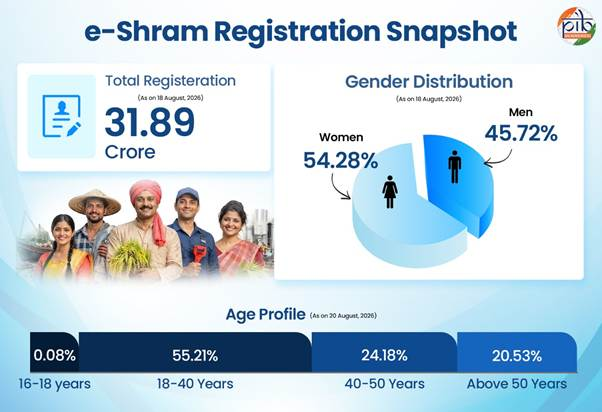
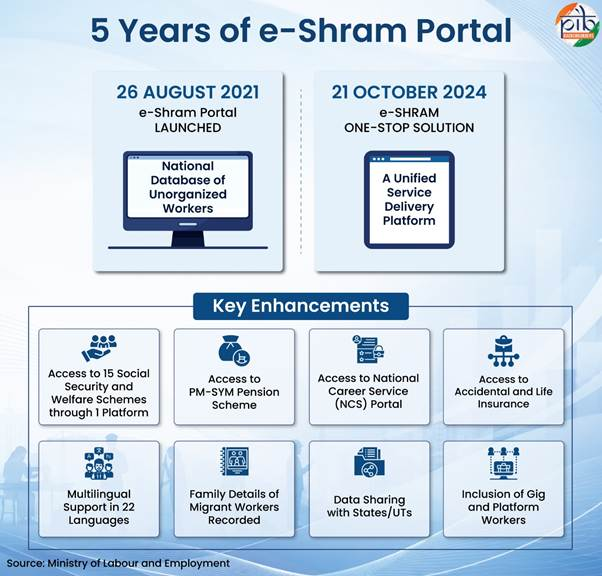
- The e-Shram Portal completed five years, marking a significant milestone in strengthening social security for India’s unorganised workforce.
e-Shram Portal
- It was launched in 2021 by the Ministry of Labour and Employment & developed by the National Informatics Centre (NIC).
- It created the country’s first-ever Aadhaar-seeded National Database of Unorganised Workers.
- It provides every registered worker with a unique 12-digit Universal Account Number (UAN).
- It has evolved into a one-stop digital platform integrating welfare, jobs, skilling, apprenticeship and pension services.
- Eligibility: Any worker aged 16 years and above, engaged in the unorganised sector, is eligible to register on the e-Shram Portal. A worker must not be an income tax-payer or a member of the Employees’ Provident Fund Organisation (EPFO) or the Employees’ State Insurance Corporation (ESIC).
- Coverage: The portal covers a wide range of unorganised workers. These include construction workers, migrant workers, gig and platform workers, street vendors, domestic workers, agricultural workers, and other unorganised workers.
Objectives
- Facilitate convergence of welfare schemes across the Ministries and Departments for better delivery of social security services.
- Securely share worker data with government agencies through APIs. This helps in effective execution of social services and data based policy making.
- Ensure the portability and national availability of social security and welfare benefits for construction and migrant workers.
- Build an extensive national database to enable prompt preparation and reaction in national emergencies and disasters.
Source: PIB
SEBI’s IT Resilience Index (ITRI)
Syllabus: GS3/ Economy
In News
- SEBI has introduced an IT Resilience Index framework for market infrastructure institutions to strengthen technology systems.
About
- It is a quantitative scorecard introduced by SEBI to measure the IT resilience, cybersecurity, reliability and disaster-recovery capabilities of Market Infrastructure Institutions (MIIs).
- It aims to ensure critical market systems can withstand cyberattacks, technical failures and sudden transaction surges, and quickly restore operations.
Key Features of SEBI’s IT Resilience Index (ITRI)
- Shifts from periodic compliance checks to measurable, real-time resilience assessment.
- Uses nine risk-based parameters, with Availability and Cybersecurity carrying the highest weight (20% each).
- Covers Business Continuity, Reliability and Scalability to ensure systems can recover quickly and handle market stress.
- Requires an Early Warning System (EWS) to detect performance issues before they trigger major outages.
- Follows a “resilience-first” approach—focuses not only on preventing failures but also on absorbing shocks and recovering quickly.
- Supports SEBI’s wider technology agenda, including AI/ML, SupTech/RegTech and quantum-safe cybersecurity.
Source: TH
Lithium Carbonate
Syllabus: GS3/Economy; Science and Tech
In News
- Lithium carbonate prices and energy storage cell costs continued to decline in recent months as the battery supply chain adjusts to expectations of stronger supply and a possible market surplus in 2027.
Lithium Carbonate
- Lithium carbonate is a lithium salt with the chemical formula Li2CO3.
- Battery-grade lithium carbonate is primarily used to produce Li-ion battery cathode materials, such as lithium cobalt oxide (LCO), lithium manganate oxide (LMO), lithium iron phosphate (LFP), NMC111, NMC442, NMC532, NMC622, as well as alkaline batteries.
- In the glass industry, lithium carbonate is used to reduce the melting point of silica used in ovenware glass.
- In the ceramics industry, lithium carbonate is used to render color and shine.
Source: DTE
Next article
Nepal Flash Flood Disaster
