


Syllabus: GS2/Education; GS3/Economy
Context
- NITI Aayog’s report, Reimagining Skilling for Viksit Bharat, has renewed the policy debate on educated unemployment and the urgent need to align India’s education and skilling ecosystem with labour-market demands.
Key Findings of Reimagining Skilling for Viksit Bharat By NITI Aayog
- Severe skill–job mismatch: Only about 8.25% of graduates are employed in jobs aligned with their qualifications, indicating widespread underemployment and qualification mismatch.
- High educated unemployment: The unemployment rate is 13% among graduates and 20.4% among graduate women, significantly higher than the national unemployment rate of 3.2%.
- Over-reliance on generic degrees: More than 2 crore of India’s 3.4 crore undergraduate students are enrolled in B.A., B.Sc. and B.Com. programmes, many of which have relatively weak direct linkages with employment.
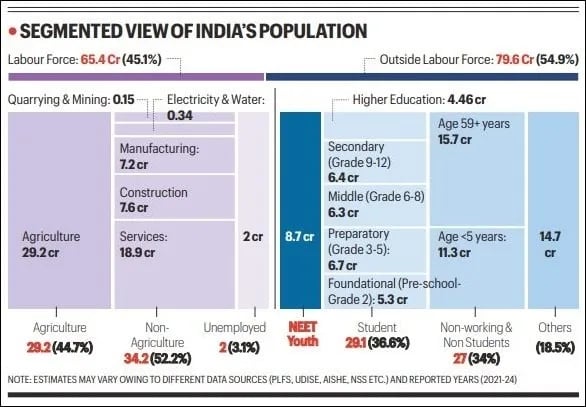
- Large Youth Disengagement: The report estimates a significant number of young people in the NEET (Not in Education, Employment or Training) category.
- However, NITI Aayog clarified that NEET figures should not be interpreted as unemployment figures.
- Skilling Improves Earnings: Graduates with additional skilling have better earning prospects. The report cites evidence of a ₹7,000 higher average monthly starting salary for skilled generic graduates compared to those without skilling.
- Social Stigma Against Vocational Education: ITIs, diploma courses and technical training are often perceived as ‘second-tier’ pathways, discouraging youth from pursuing vocational careers.
- Information and awareness gaps: Limited awareness of appropriate courses, apprenticeships, scholarships and government schemes prevents many potential beneficiaries from accessing skilling opportunities.
- Weak outcome orientation: Existing programmes often emphasise enrolment and certification rather than placement, income growth and long-term career progression.
Structural Barriers to Effective Skilling
- Information and Gender Gaps: Many learners lack reliable information about suitable courses and their economic returns.
- Women face additional barriers of mobility, safety, social permission and time constraints.
- Supply-Driven Architecture: A one-size-fits-all approach and weak industry participation prevent skilling programmes from responding effectively to local and sectoral demand.
Why Does Skilling Matter?
- According to survey data cited by NITI Aayog, a generic graduate with additional skills earns an average starting salary of ₹29,000 per month, compared to ₹22,000 for one without skilling.
- It can translate into a substantial cumulative income difference over time.
- Therefore, skilling is essential for securing jobs along with improving income mobility, entrepreneurship and workforce adaptability, especially amid technological disruption and the green transition.
Way Forward
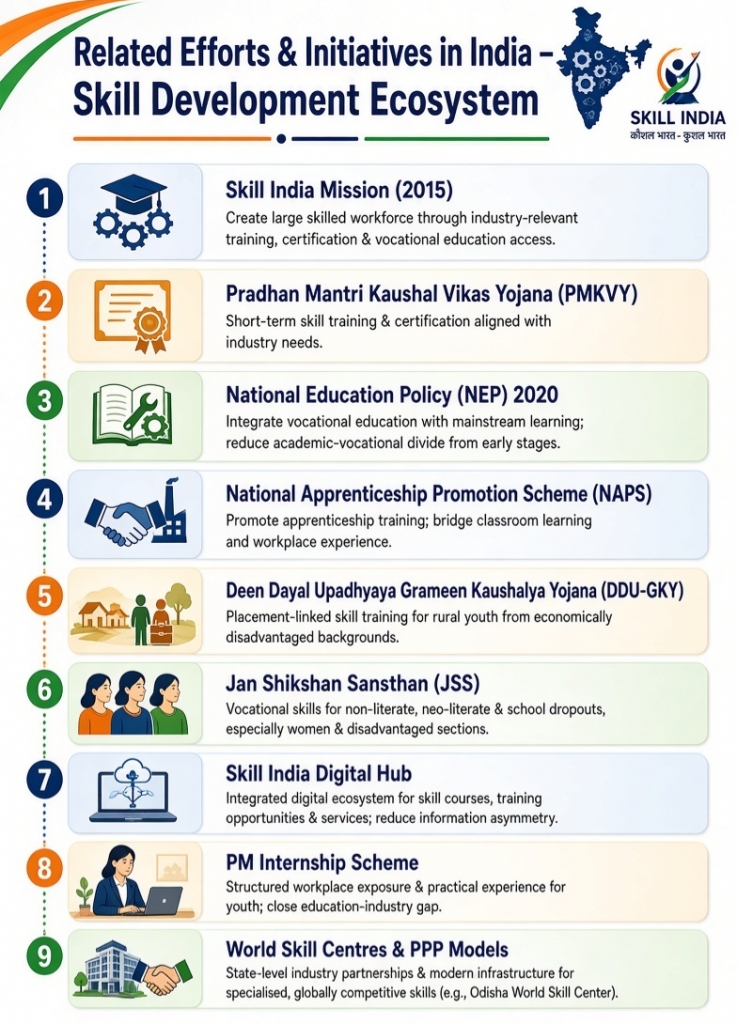
- India needs to move decisively towards demand-driven, industry-backed and outcome-linked skilling. Key reforms should include:
- Redesigning B.A., B.Sc. and B.Com. programmes into applied, industry-aligned specialisations.
- Scaling Apprenticeship Embedded Degree Programmes and work-integrated learning.
- Building skills for high-growth sectors such as green industries and electric vehicles.
- Strengthening PPP-based skilling universities and giving ITIs greater academic and administrative autonomy.
- Embedding digital literacy, financial literacy and workplace readiness in education.
- Expanding career counselling and targeted support for women and disadvantaged youth.
National Institution for Transforming India (NITI) Aayog:
- It is a premier public policy think tank, established on 1 January 2015, replacing the Planning Commission.
- Key Features:
- Nature: An executive body/non-constitutional institution, established through a Union Cabinet resolution.
- Chairperson: The Prime Minister of India.
- Vice-Chairperson: Appointed by the Prime Minister.
- Governing Council: Comprises Chief Ministers of States and Union Territory representatives, fostering cooperative and competitive federalism.
- Role: Provides strategic and technical policy advice to the Central and State Governments and promotes evidence-based policymaking.
- Major Objectives:
- Promote cooperative federalism by involving States in policy formulation.
- Develop a bottom-up approach to planning and development.
- Foster innovation, entrepreneurship and sustainable development.
- Act as a knowledge and advisory platform rather than allocating funds like the erstwhile Planning Commission.
Previous article
India’s Central Asia Strategy Needs More Realism
