


Syllabus: GS2/IR
Context
- Prime Minister Narendra Modi, will travel to Central Asia for a bilateral visit to Uzbekistan and the Shanghai Cooperation Organisation summit in Kyrgyzstan.
Central Asia
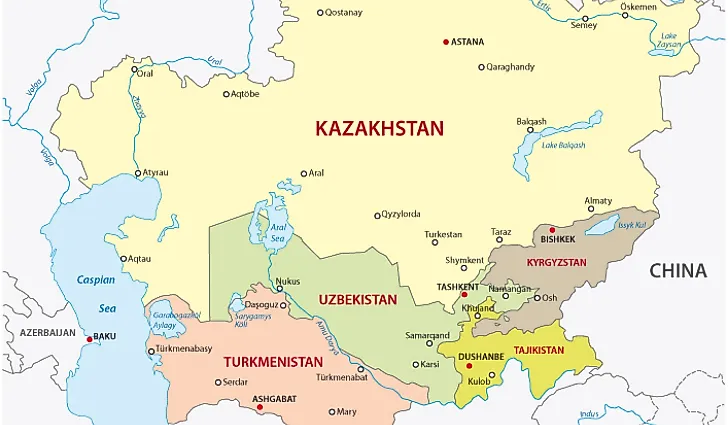
- Central Asia is the landlocked central region of Asia, extending from the Caspian Sea in the west to the border of western China in the east.
- It is bounded on the north by Russia and on the south by Iran, Afghanistan, and China.
- The region consists of the former Soviet republics of Kazakhstan, Uzbekistan, Tajikistan, Kyrgyzstan, and Turkmenistan.
- Central Asia’s unique geographical position is deeply rooted in its historical ties to the “Silk Trade Routes,” and has been pivotal in the region’s geopolitics and beyond.
Evolving Central Asian Diplomacy:
- Geopolitics of Central Asia: They were long viewed as five vulnerable landlocked states, they are acquiring greater internal coherence.
- Since 2018, the five have met regularly at the summit level in the consultative meetings of the heads of state of Central Asia.
- They have now signed a friendship treaty among themselves and plan to give it some organisational substance and turn the region into a genuine Central Asian community.
- The Central Asian Five invited Azerbaijan to form the C-6 that links Central Asia more closely to the Caucasus and Türkiye.
- Diversification of Relations: During 2025, Central Asian leaders held summits with the European Union, China, Russia, the United States and Japan.
- The U.S. has new emphasis on commerce, critical minerals and energy corridors. Europe, Japan and others are also expanding their engagement.
- Central Asia is observing a “multi-vector” strategy i.e. it engages all and commits exclusively to none.
- Entanglement with the Middle East: Kazakhstan has announced its accession to the Abraham Accords and Azerbaijan, Kazakhstan and Uzbekistan signed the charter Peace at Davos.
- The Iran war has complicated Central Asia’s traditional southern access to the open seas and increased the importance of alternative routes westward across the Caspian towards Azerbaijan, Türkiye and the Mediterranean.
Significance of Region for India
- Strategic and Geopolitical Significance: Central Asia lies at the crossroads of Europe, Asia and the Middle East, making it important for India’s engagement with the wider Eurasian region.
- Deeper engagement helps India maintain a strategic presence amid the growing influence of China, Russia, Turkey and other regional powers.
- Energy Security: The region possesses substantial reserves of oil, natural gas and uranium. Kazakhstan is particularly important for India’s nuclear-energy ambitions because it is a major uranium producer.
- Countering Terrorism and Extremism: Instability in Afghanistan directly affects Central Asia and India’s security interests. Cooperation with Central Asian states is important for combating terrorism, radicalisation, drug trafficking and organised crime.
- Balancing China’s Growing Influence: China’s Belt and Road Initiative (BRI) has created extensive economic and infrastructure linkages with Central Asian countries.
- Greater Indian engagement can provide the region with an alternative development and connectivity partner.
Way Ahead for India
- Constraints Faced by India: India enjoys considerable goodwill in Central Asia, but geography continues to constrain its ambitions.
- India has no direct land access to central Asia as Pakistan blocks the obvious overland route, while Afghanistan remains unstable.
- Chabahar and the International North-South Transport Corridor offered an alternative, but the growing conflict between Iran and the US has complicated their prospects.
- Realism Based Approach: The changing regional dynamic calls for a less romantic and more modest Indian approach.
- India cannot match China’s infrastructure spending, Russia’s geographic advantages, Europe’s financial resources or Türkiye’s direct access across the Caspian.
- Sustained political attention should be matched by a practical economic agenda focused on areas where India can contribute.
- Understanding New Central Asia: India must recognise the political character of the new Central Asia. Its states do not want another patron; they want multiple partnerships that expand their room for manoeuvre.
Source: IE
Previous article
News In Short 25-08-2026
Next article
Reimagining Skilling For Viksit Bharat: NITI Aayog
