


Vaishya Tekri
Syllabus: GS1/History
Context
- The Madhya Pradesh government has begun restoring Buddhist monuments linked to the Mauryan emperor Ashoka, starting with a fresh excavation at Vaishya Tekri in Ujjain.
About
- The largest stupa, popularly called Vaisya Tekri, is about 350 feet at its base and 100 feet high. Nearby is a smaller stupa, called Kumbhar (or Kumhar) Tekri.
- Initial excavations by the Department of Archaeology of the erstwhile Gwalior State in 1938–39 unveiled large bricks and punch-marked coins, prompting archaeologists to date the structures to the Mauryan period.
- A stupa is a dome-shaped structure traditionally used as a Buddhist religious monument, symbolizing the burial mound of the Buddha.
- The term “stupa” originates from Sanskrit, meaning “to heap” or “pile up,” reflecting the mounded design of these monuments.
Ashoka’s years in Ujjain
- Ujjayini (modern Ujjain), on the banks of the Sipra, a tributary of the Chambal, was the capital of Avanti and an important commercial centre.
- Historians note that Ujjain was a major crossroads, linking trade routes to western coastal ports such as Broach and Sopirà, as well as to Pataliputra.
- Ashoka was sent to Avanti as viceroy by his father, Bindusara.
- He is believed to have spent about a decade in Avanti, with Ujjain as his headquarters.
- He was then appointed to the viceroyalty at Ujjain in recognition of his work.
Source: IE
Right to Walk: Strengthening Pedestrian Safety in India
Syllabus: GS2/Governance
Context
- After the Supreme Court’s order recognising the right to walk on footpaths as a fundamental right, Andhra Pradesh became the first state in the country to formulate a dedicated Pedestrian Safety & Universal Accessibility Policy in 2026.
About the Policy
- The policy mandates a three-step system to address the issue — road safety audits, fixing footpath infrastructure (including removal of encroachments) and behavioural change.
- Footpath Audits: At least 15–20 pedestrian black spots with frequent injuries or deaths during the previous 2–3 years will be prioritised.
- Authorities must survey 20% of roads within one year to identify additional pedestrian-crossing requirements.
- The policy will apply to all local body areas, including urban fringes, peri-urban areas, satellite towns and rural areas.
- The policy invokes section 198A of the Motor Vehicles Act, 1988, under which officials, contractors, and consultants can be fined Rs 1 lakh if infrastructural or design failures cause pedestrian death or disability.
Status of Pedestrian Safety in India
- In 2024, pedestrians accounted for 36,526 of the 1.77 lakh road accident deaths in India, constituting around one-fifth of all road fatalities.
- Around 31% of pedestrian deaths occur on National Highways, highlighting the risks associated with high-speed corridors and inadequate pedestrian infrastructure.
- Two-wheelers accounted for more than 28% of pedestrian fatalities, followed by cars and taxis at around 25%, while trucks/lorries and buses also contributed significantly.
Right To Walk
- The Supreme Court of India formally declared the “right to walk” on safe, well-maintained, and demarcated footpaths a fundamental right in the case of Maniyar Iliyaz @ Shaik Riyaz v. P. Ayyappan & Ors.
- The right to walk flows from Article 19(1)(d) (freedom of movement) and Article 21 (right to life and personal liberty).
Source: IE
Garbhini Mitra Course
Syllabus: GS2/Governance
In News
- The All India Institute of Ayurveda (AIIA) has introduced the Garbhini Mitra Course for the 2026–2027 academic session.
Garbhini Mitra Course
- It is a structured healthcare skill-development programme aimed to create trained personnel to provide appropriate health education, lifestyle guidance, and community-level support to women during pregnancy and the postnatal period.
- It admits 20 students per batch.
- It is rooted in the traditional Ayurvedic concepts of Garbhini Paricharya (antenatal care), Sutika Paricharya (postnatal care), and Garbhadhana Vidhi (pre-conceptional care).
- It equips participants with practical skills in trimester-specific dietetics, lifestyle modifications, pregnancy-safe yoga, emotional support during labour, newborn massage, and basic life support protocols.
- It is offered at the AIIA campus in Sarita Vihar, New Delhi
Eligibility
- Candidates who have passed the Senior Secondary (10+2) examination from any recognized board in India and are at least 18 years of age are eligible to apply.
- Candidates currently awaiting their 12th-grade results may also submit provisional applications.
Source:PIB
Polysilicon Manufacturing in India
Syllabus: GS3/Science & Technology
Context
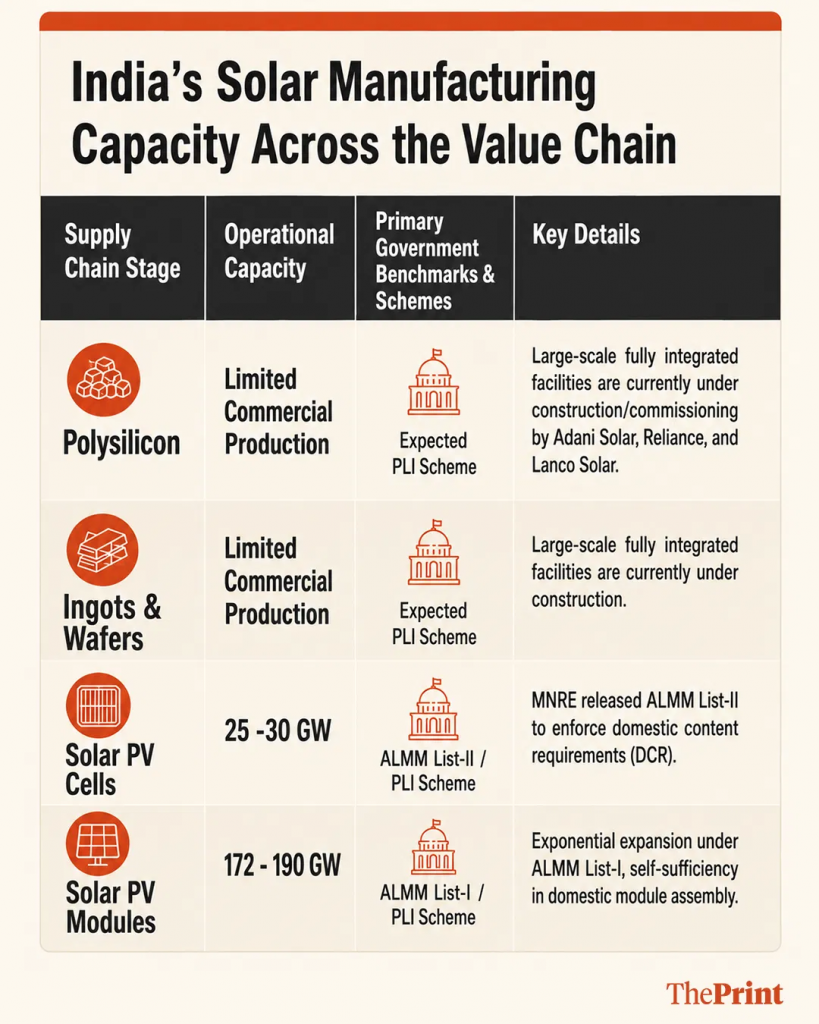
- The government is considering a new Production-Linked Incentive (PLI) scheme for polysilicon manufacturing to develop an integrated domestic solar PV supply chain.
India’s Solar Manufacturing Position
- India has around 163 GW of installed solar power capacity, making solar the country’s largest source of renewable energy.
- India has developed substantial downstream manufacturing capacity, with around 173 GW of solar module capacity and 25–30 GW of cell manufacturing capacity.
- However, domestic manufacturing remains incomplete because producers largely depend on imported polysilicon, ingots and wafers.
- China accounts for more than 85% of global PV supply capacity and has an integrated presence across the entire solar manufacturing chain.
What is Polysilicon?
- Polysilicon is a highly purified form of silicon used as the basic material for manufacturing crystalline silicon solar cells.
- It is produced from silicon-bearing raw materials such as quartz/silica through energy-intensive purification processes.
- Solar-grade polysilicon requires very high purity, as impurities can affect the performance of solar cells.

Source: The Print
INS Mangrol
Syllabus: GS3/Defence
Context
- ‘Mangrol’, the third Anti-Submarine Warfare Shallow Water Craft built by Cochin Shipyard Limited (CSL), Kochi, was delivered to the Indian Navy.
About
- Mangrol derives its name from the coastal town and minor port of ‘Mangrol’, located in Gujarat, which is a prominent harbour for the marine fishing industry.
- The ship also encapsulates the legacy of erstwhile INS Mangrol, an Indian Naval Minesweeper which remained in service till 2004.
- The ship comprises over 80% indigenous content and is equipped for underwater surveillance, Anti-Submarine Warfare (ASW) operations in coastal waters, Low-Intensity Maritime Operations (LIMO), along with mine warfare capabilities.
- The ship is propelled by waterjets and equipped with state-of-the-art Torpedoes, Anti-Submarine rockets, along with advanced radars and sonars.
- The delivery of Mangrol is yet another milestone in the Indian Navy’s indigenous shipbuilding journey and a reaffirmation of the Government’s vision of ‘Aatmanirbhar Bharat’.
Source: PIB
Previous article
Potential of Floating Solar systems in India
Next article
India’s Central Asia Strategy Needs More Realism
