


Syllabus: GS2/ Health/ Governance
Context
- The Union Health Ministry has proposed amendments to the Medical Devices Rules, 2017, to promote ease of doing business.
Key Proposed Amendments
- Simplification of Outsourced Sterilisation (Amendment to Rule 44): Manufacturers outsourcing sterilisation to a facility, holding a valid licence under the Medical Devices Rules, 2017, will no longer require a separate loan licence for the sterilisation activity.
- Traceability will be retained: manufacturers must mention the licence number of the sterilisation facility on the medical device label.
- A six-month transition period has been provided to allow companies to modify labels, packaging and related processes.
- Standardised Testing Fees: A Ninth Schedule is proposed to prescribe uniform fees for medical device testing laboratories. It will reduce variations and uncertainty in testing charges.
- Recognition of the European Union (Amendment to Rule 63): The European Union (EU) will be added to the list of recognised stringent regulatory jurisdictions for waiving clinical investigation requirements for certain medical devices without predicate devices in India.
- The existing list includes the US, UK, Australia, Canada and Japan.
- Medical devices approved in the EU that meet the eligibility conditions can benefit from the waiver provisions in India.
Significance
- Reduces unnecessary licensing and compliance requirements.
- Enables quicker availability of eligible and innovative medical devices.
- Standardised testing fees make compliance costs more predictable.
- Brings India’s regulatory framework closer to global practices.
- A simpler and more predictable regulatory environment can promote investment and innovation in India’s medical-device industry.
Medical Devices Sector in India
- The medical devices sector covers a wide range of products, including diagnostic equipment, imaging devices such as MRI and CT scanners, implants, surgical instruments, patient-monitoring equipment and in-vitro diagnostic (IVD) devices.
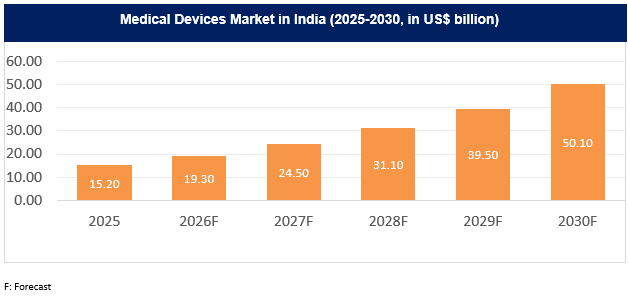
- India’s medical devices market is projected to grow steadily from US$ 15.2 billion in 2025 to US$ 50.1 billion by 2030.
- FDI inflow in the medical and surgical appliances sector between April 2000- December 2025 stood at US$ 4.24 billion.
Government Initiatives
- The National Medical Devices Policy 2023 supports India’s medical devices sector through regulatory streamlining, infrastructure, R&D, and investment promotion, boosting competitiveness and exports.
- 100% FDI is allowed in the medical devices sector in India. Categories such as equipment and instruments, consumables and implants attract the most FDI.
- The Scheme for Promotion of Medical Devices Parks aims to create common infrastructure and testing facilities for increased competitiveness and cost reduction of medical device units through optimisation of resources.
- Under the scheme, three parks have been approved and are at an advanced stage of development in Greater Noida (Uttar Pradesh), Ujjain (Madhya Pradesh) and Kanchipuram (Tamil Nadu).
- Regulatory Framework: The Drugs and Cosmetics Act, 1940, and the Medical Devices Rules, 2017, control the import, manufacture, sale, and distribution of medical devices.
- In 2026, the India–EU FTA unlocked access to a US$ 572.3 billion EU pharma and MedTech market, boosting export opportunities for Indian medical devices through liberalised tariffs and preferential market access
Challenges with Medical Devices Sector in India
- India still imports around 70–80% of its medical devices, particularly high-end and technologically advanced equipment.
- Limited domestic manufacturing of critical components and raw materials.
- High cost of R&D and clinical investigations, which can discourage innovation.
- Inadequate testing and manufacturing infrastructure in some segments.
- There is a shortage of specialised, industry-ready skilled manpower.
- Limited integration of Indian manufacturers into global value chains.
Way Ahead
- India should reduce its import dependence on medical devices by promoting domestic manufacturing, R&D, innovation and medical-device infrastructure.
- A predictable and streamlined regulatory framework, while ensuring quality, safety and traceability, can attract investment and position India as a global medical-device manufacturing hub.
Source: TH
