


Syllabus: GS3/Infrastructure
Context
- The Defence Minister said that a vacuum created by the declining capacities of traditional shipbuilding industries across the world presents a major opportunity for India to emerge as a global shipbuilding hub.
About Shipbuilding
- It refers to the construction, repair, and maintenance of vessels used for transportation, defense, and trade.
- Shipbuilding is carried out in specialised facilities called shipyards, which are equipped to handle large-scale projects and complex assembly processes.
- Asia-Pacific was the largest region in the ship building and repairing market, accounting for 49% or $118.12 billion of the total in 2023.
- It was followed by Western Europe, North America and then the other regions.
Status in India
- India has a long history of shipbuilding and the Indus Valley civilisation, which built early ships and traded internationally, is the source of India’s rich maritime history.
- Gujarat, Maharashtra and Bengal were known for building massive wooden ships for trade and combat.
- Indian shipbuilders created cutting-edge vessels that were in high demand in the Middle Ages.
- India established significant state-owned shipyards because of prioritising naval and defence shipbuilding after achieving independence.
- Currently, India holds only 0.06% of the global shipbuilding market, a stark contrast to the dominance of China, South Korea, and Japan, which collectively control 85% of the industry.
Factors Favouring India’s growth of shipbuilding industry in India
- Strategic location: India’s extensive coastline and proximity to major shipping routes provide a natural advantage for shipyards, helping reduce transportation costs and turnaround times.
- Competitive labour costs: India offers a competitive edge with lower labour costs compared to other shipbuilding nations, making it an attractive option for international clients.
- Focus on niche segments: Indian shipyards are specialising in categories like offshore support vessels, dredgers, and ferries, targeting specific market demands.
- Government support: Policy initiatives such as the Scheme for Financial Assistance to Shipyards in India (SFAS) and a focus on enhancing indigenous shipbuilding capabilities are driving growth in the shipbuilding sector.
Importance
- Shipbuilding is a capital-intensive industry requiring advanced technology, skilled labour and strong policy support.
- It creates jobs in sectors such as electronics, steel, engineering, and maritime equipment.
- A robust local shipbuilding industry can improve India’s Blue Economy, a major focus area under the “Make in India” and “Atmanirbhar Bharat” programs.
- It improves the country’s trade balance and reduces dependency on imports.
- Strategically, India’s defence capability and marine security depend heavily on shipbuilding.
- India is investing in naval modernisation and building aircraft carriers, submarines, and warships to bolster its naval fleet considering the changing geopolitical environment in the Indo-Pacific region.
Challenges Faced by India
- High cost of production: Indian shipyards face higher costs compared with major shipbuilding countries such as China, South Korea and Japan, partly due to expensive inputs, financing and relatively lower economies of scale.
- Limited access to long-term finance: Shipbuilding is highly capital-intensive and projects have long gestation periods.
- Technological gap: India remains behind leading shipbuilding nations in advanced ship design, automation, marine engineering, specialised vessels and green-ship technologies.
- Fragmented shipbuilding ecosystem: The industry lacks sufficiently integrated clusters connecting shipyards, component manufacturers, designers, suppliers, ports, logistics providers and research institutions.
- Strong global competition: China, South Korea and Japan dominate global commercial shipbuilding through large-scale production, established supply chains, technological capabilities and substantial state support, making it difficult for Indian yards to compete on price and delivery timelines.
Government Initiatives
- Shipbuilding Financial Assistance Scheme with outlay of ₹24,736 crore provides financial support, ship-breaking credit notes, and steer domestic manufacturing through National Shipbuilding Mission.
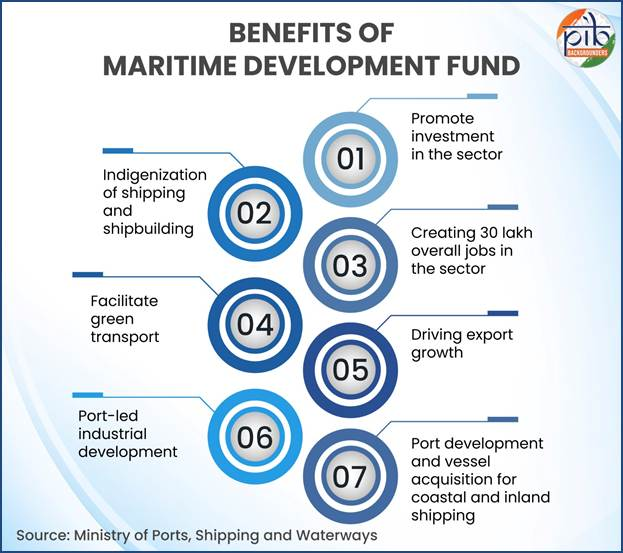
- Maritime Development Fund with ₹25,000 crore outlay focuses on investment and interest incentivization.
- Shipbuilding Development Scheme offers capital support, risk coverage, and capacity-building for shipbuilding clusters with ₹19,989 crores outlay.
- Maritime India Vision 2030 (MIV 2030): Aiming for India to become a top 10 shipbuilding nation by 2030 and create a world-class, efficient, and sustainable maritime ecosystem. Includes 150+ initiatives across ten key maritime sectors.
- Right of First Refusal (RoFR): Indian shipyards get priority in government tenders for vessel acquisition. Revised hierarchy favors Indian-built, Indian-flagged, and Indian-owned vessels.
- Public Procurement Preference: Ships under ₹200 crore must be procured from Indian shipyards as per the Make in India Order, 2017.
- Standard Tug Designs: Five variants released for use by major ports to ensure uniformity and boost domestic manufacturing.
- MoUs were signed between major ports and coastal states to develop shipbuilding clusters with joint investments, aiming to position India among the top five global shipbuilding nations by 2047.
Conclusion
- India’s shipbuilding sector is entering a promising phase of growth, supported by a series of progressive initiatives and policy reforms.
- These measures aim to modernize infrastructure, enhance domestic manufacturing capabilities, and attract global investment, laying a strong foundation for long-term development.
- By focusing on innovation, sustainability, and skill development, the sector is well-positioned to meet the strategic goals outlined in Maritime India Vision 2030.
Source: TH
Previous article
India Proposes Medical Device Rule Changes To Boost Ease Of Business
Next article
Illegal Migrants in India
