


Syllabus: GS3/Agriculture
Context
- The National Horticulture Board (NHB) has amended the guidelines for the development of Commercial Horticulture through Production and Post-Harvest Management of Horticulture Crops scheme to ensure equitable distribution of government assistance.
Key Amendments by the National Horticulture Board (NHB)
- Expanded definition of ‘family’: The revised definition of family brings within its ambit the subsidy applicant’s spouse, father, mother, sons and daughters.
- As per the old guidelines, the term ‘family’ was defined as “the husband, wife, and dependent minor children.”
- Exclusion of public officials: Under the new guidelines, the government has made clear that five categories of people shall not be eligible for financial assistance under NHB Schemes. These comprise of:
- Present holders of constitutional posts.
- Present ministers and ministers of state; members of Lok Sabha and Rajya Sabha, members of State Legislative Assemblies/Councils, mayors of municipal corporations and chairpersons of district panchayats.
- Serving employees of Central/State Government ministries/departments, PSUs, autonomous bodies and local bodies, except MTS/Class-IV/Group D employees. Superannuated/retired pensioners receiving a monthly pension of ₹10,000 or more, except MTS/Class-IV/Group D pensioners.
- Group of Farmers
- Family members of persons falling in the above categories may, however, avail one-time assistance, subject to the applicable provisions of the revised definition of family.
- One Family–One Subsidy Principle: Only one member of a family can avail financial assistance under NHB schemes.
- Assistance received by any family member will be treated as assistance received by the entire family.
- The restriction applies across all NHB schemes and components, including assistance obtained through HUFs, partnership/proprietorship firms or companies.
- Reduction in subsidy: The Centre has also reduced the subsidy component from 50 per cent to 35 per cent for beneficiaries in general category states and 45 per cent in North Eastern or Himalayan states.
- Voluntary exit mechanism: Beneficiaries can voluntarily exit the scheme during the lock-in period by refunding the subsidy along with applicable interest, subject to prescribed conditions.
Horticulture Sector in India
- Horticulture is the branch of agriculture that deals with the cultivation, production, management and post-harvest handling of fruits, vegetables, flowers, spices, plantation crops and ornamental plants.
- India is the second largest producer of fruits and vegetables in the world. It continues to hold a strong position in the production of spices, coconut and cashew nuts.
- India’s horticulture production reached 367.72 million tonnes in 2024-25, driven by 114.51 million tonnes of fruits and 219.67 million tonnes of vegetables.
- The horticulture area in the country is expected to be about 301.51 Lakh Ha in 2025-26.
- The horticulture sector accounts for approximately 37 per cent of the Gross Value Output (GVO) within the agricultural crops sub-sector of Agriculture and Allied sectors.
About the Scheme
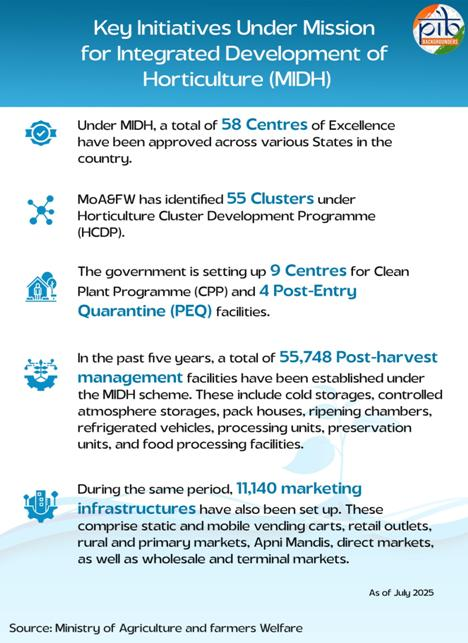
- The Development of Commercial Horticulture through Production and Post-Harvest Management of Horticulture Crops is a flagship credit-linked subsidy scheme run by the National Horticulture Board (NHB) under the Mission for Integrated Development of Horticulture (MIDH).
- It promotes high-tech commercial farming, protected cultivation, and robust cold-chain infrastructure, which reduce crop waste and maximise profits.
- It covers crops such as capsicum, cucumber and tomato, along with flowers such as rose, lilium and chrysanthemum.
About the National Horticulture Board (NHB)
- The National Horticulture Board was established by the Government of India in 1984 as an autonomous organisation under the administrative control of the Ministry of Agriculture and Farmers Welfare.
- The Board aims to develop production clusters or hubs for integrated high-tech commercial horticulture, create post-harvest and cold chain infrastructure, ensure the availability of quality planting material, and promote the adoption of advanced technologies for high-tech commercial horticulture.
Source: IE
Previous article
Regenerative Agriculture For a Resilient India
