


Rajghat Excavations
Syllabus: GS1/History and Culture
Context
- Banaras Hindu University (BHU) recently opened 22 boxes containing over 10,000 artefacts excavated from Rajghat, Varanasi, in 1957 under the supervision of archaeologist T.N. Roy.
Key Discoveries from the 1957 Excavation
- The boxes contained more than 10,000 archaeological artefacts, including:
- Painted black pottery, nearly 3,000 years old.
- Ancient sculptures, coins, tools and stamp seals.
- Objects made of copper, ivory and bone.
- Several inscribed seals, including those bearing the Brahmi script.
Archaeological Significance of Rajghat
- Rajghat lies on the north-eastern edge of Varanasi, near the confluence of the Ganga and Varuna rivers.
- It is an important archaeological site of the Middle Ganga Valley and formed an important settlement of ancient Varanasi, associated with the Kashi Mahajanapada.
- Seals and sealings bearing the name ‘Varanasi’ helped establish the site’s connection with ancient Varanasi.
- The earliest archaeological remains at Rajghat were identified in 1939 during the expansion of Kashi railway station.
Source: IE
Liberia
Syllabus: GS1/Places in News, GS2/IR
Context
- A 12-member delegation of Liberian lawmakers visited India to study women’s political participation and gender-responsive governance under the framework of South-South cooperation.
About Liberia (Capital: Monrovia)
- Location: Liberia is a sovereign country on the west coast of Africa bordered by Sierra Leone to the west, Guinea to the north and Côte d’Ivoire to the east, while the Atlantic Ocean lies to the south and southwest.
- History: Liberia is one of Africa’s two countries that were not formally colonised by a European power; the other is Ethiopia.
- Climate: The country has a tropical, humid climate with high temperatures, humidity and heavy seasonal rainfall.
- Biodiversity: Liberia has approximately 35–40% of the remaining Upper Guinean rainforest, making it a critical ecological zone for West African biodiversity conservation.
- Protected areas such as Sapo National Park and Gola Forest National Park safeguard endangered species like the pygmy hippopotamus and the Diana monkey.
- International Role:
- Liberia was a founding member of the United Nations in 1945.
- It was also a founding member of the Organization of African Unity (OAU) in 1963, which was later transformed into the African Union (AU).
- India’s Contribution to Liberia: In 2007, India deployed the first-ever all-female police unit in Liberia, which served until 2016, promoting women’s participation in peacekeeping and inspiring more Liberian women to join uniformed services.
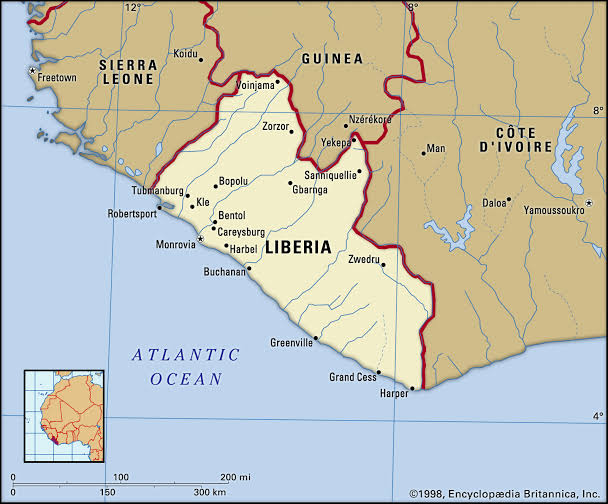
Source: IE
Barren-land Fallacy
Syllabus: GS3/Environment
In News
- Recently, it has been observed that Barren-Land Fallacy can lead to incorrect afforestation and disrupt local ecological balance.
Barren-land Fallacy
- It is the concept that land which is not a forest is barren, degraded or biologically insufficient and therefore should be transformed into a forest.
- It can lead to inappropriate tree-planting drives including planting trees in environments where they do not naturally belong.
- For example, growing water-thirsty eucalyptus in water-stressed regions can upset the local ecological equilibrium.
Correct Approach
- Grasslands, savannas, scrublands, marshes and deserts are valuable natural ecosystems, some of which are dependent on low tree cover.
- Therefore, the aim of ecological restoration should be to restore the naturally suited environment, not just to increase the tree cover.
Source: TH
Glyphosate Herbicide
Syllabus: GS2/Health; GS3/Agriculture
In News
- Recently, environmentalists have raised concern over the alleged spraying of glyphosate on forest department land in parts of Himachal Pradesh.
Glyphosate
- It is a herbicide used to manage grasses, broadleaf and invasive weeds in a wide variety of agricultural and non-agricultural contexts.
- It is crucial for growing crops such as corn, soybean, cotton, canola, fruits, vegetables, nuts and sugarcane, especially glyphosate-resistant crops.
- Glyphosate is approved in India under the Insecticides Act, 1968 mostly for weed control in tea plantations, but its usage has apparently been spread illegally to a variety of edible/non-edible crops, houses and institutions.
Source :DTE
National Teachers Awards
Syllabus: Miscellaneous
Context
- The President of India will confer National Teachers Awards on 48 school teachers at Vigyan Bhawan, New Delhi.
About National Teachers Awards
- The awards are conferred every year on Teachers’ Day (5th September), which commemorates the birth anniversary of Dr. Sarvepalli Radhakrishnan, former President of India and a renowned philosopher-educationist.
- Teachers are chosen through a three-stage transparent, online process at the District, State, and National levels, coordinated by the Department of School Education & Literacy.
- Exclusion: Retired teachers who have not served at least a part of the calendar year – at least for four months i.e. up to 30th April in the year to which the National Award relates. Teacher/Headmasters who have indulged in tuitions.
- Contractual Teachers and Shiksha Mitras are also not eligible.
Do you know?
- National Education Day is observed on 11th November in honour of Maulana Abul Kalam Azad, India’s first Education Minister.
Source: PIB
