


Syllabus: GS3/Agriculture
In News
- Regenerative Agriculture is supporting long-term agricultural production, environmental sustainability and farm profitability.
About
- India’s agriculture and allied industries have shown a decadal increase of 4.45% over FY16-FY25.
- To support this expansion the ecological roots of farming must be restored.
- Intensive farming causes abuse of chemicals, poor soil health and irregular rainfall that lead to increasing cost of inputs, aggravating climate shocks and making small and marginal farmers more vulnerable.
- However, regenerative agriculture can help restore soil health, ecosystem services, boost climate resilience and minimise dependency on external inputs.
Regenerative agriculture
- It is a holistic strategy to farming that seeks to restore soil health and improve biodiversity.
- Its aim is to guarantee the long-term productivity and resilience of farming systems. Healthy soils yield more food and nutrition, sequester more carbon, and are home to biodiversity.
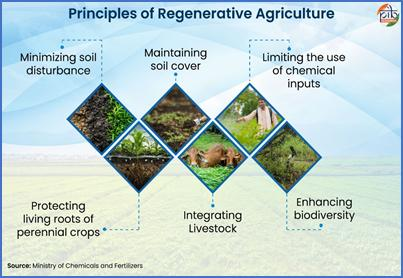
Practices come under regenerative agriculture
- Micro-irrigation systems: It delivers water to the roots of plants including foggers, sprinklers and drippers. This indicates low wasting of water and excellent water use efficiency.
- Farm Mechanisation: It is the use of machines and equipment to ease and automate some farm operations in agriculture.
- It helps to optimise the critical inputs like water, fuel and fertilisers thereby lowering waste and carbon footprint.
- Managing Nitrogen Fertiliser: The secret is to select the suitable fertiliser and to use it at the right time in the right amount.
- Natural farming: An agricultural approach based on indigenous knowledge systems of India and free from chemicals.
- The technique is based on utilisation of biological inputs like Beejamrut, Jeevamrut, GhanJeevamrut, Neemastra and Dashparni created from the inputs of native cattle.
- Integrated Farming System (IFS): It is a broad approach to farm production systems, in which more than one farm firm is integrated in a single system.
- It encourages strategies like intercropping, crop rotation, multi-cropping and mixed farming that make the best use of resources.
- Agroforestry: It is the amalgamation of fruit and plantation crops with perennial tree systems to evolve a more sustainable and profitable farming method.
- Climate-Resilient Agriculture (CRA): Refers to practices and technology that enhance the capacity of agricultural systems to cope with climate change-related stresses and shocks.
Benefits of Regenerative Farming
- Environmental Impacts
- Soil restoration: Regenerative approaches restore soil organic matter, soil structure and long term soil fertility resulting in sustained agricultural productivity.
- Improved biodiversity: Regenerative practices provide a higher diversity of pollinators, beneficial insects and soil microbes. And so the whole ecology is in sync.
- Climate change mitigation: These technologies take more carbon out of the environment than they put in, effectively cancelling emissions from farming.
- Regenerative agriculture is highly aligned with SDG 13 (Climate Action).
- Water efficiency : Healthy soil holds more water, which means less run-off.
- It also benefits aquatic systems by reducing erosion of soil and transporting sediments and toxins to streams and lakes.
- Economic and Social Outcomes
- Profitability: Healthier soils imply less synthetic fertilizer, pesticide and irrigation.
- It reduces input costs, stabilises yields and increases farmers’ net revenues.
- Job creation: Regenerative agriculture creates new jobs in farming, advice services, technology and ecological management.
- More resilient: Regenerative farms are more resilient to changes in climate and market conditions.
- Profitability: Healthier soils imply less synthetic fertilizer, pesticide and irrigation.
Challenges
- Transition Lag and Temporary Yield Losses: Soils take 3 to 5 years to rebuild naturally occurring microbial activity; hence yields may decrease somewhat before rebounding and exceeding input costs.
- High Upfront Capital: Specialised equipment such as no-till seed drills or rotational livestock fence requires a substantial initial outlay.
- Knowledge and Labour Deficit: The generic chemical schedules are not suited for the diversity of crops and rotational grazing needs, which require wide regional agronomic knowledge.
- Policy and Certification Gaps: Many areas still sustain conventional chemical-intensive commercial crops and official regeneration certifications are in process.
Targeted Interventions
- National Mission for Natural Farming: It was announced in 2024 develops an enabling support ecosystem to assist farmers to steadily shift to natural farming.
- It gives an output based incentive of ₹4,000 per acre each year for two years for a maximum of one acre per farmer.
- It envisages establishment of 10,000 need-based Bio-input Resource Centers to ensure simple access for farmers to bio-inputs like Jeevamrit and Beejamrit.
- Paramparagat Krishi Vikas Yojana (PKVY), launched in 2015, has become a key pillar of India’s organic agriculture movement.
- More Crop Per Drop : The country has been implementing Per Drop More Crop (PDMC) since 2015-16.
- It promotes the increase in the efficiency of the use of water in fields through micro-irrigation systems, especially drip and spray irrigation.
- Rainfed Area Development Project (RADP): It has been implemented through area based cluster technique for support of Integrated Farming System (IFS) since 2014-15.
- It involves a more robust use of existing methodologies and a greater engagement with the community. Farmers are motivated Rs 30000/- per family for adoption of IFS System.
- Each cluster will also get a stipend of 10,000 to aid in training and capacity building activities.
- It involves a more robust use of existing methodologies and a greater engagement with the community. Farmers are motivated Rs 30000/- per family for adoption of IFS System.
- Sub-Mission on Agroforestry: The previous Sub-Mission on Agroforestry (SMAF) has been reformed as Agroforestry Component under Pradhan Mantri Rashtriya Krishi Vikas Yojana (PM-RKVY) w.e.f. 2023-24.
- It encourages the setting up of agroforestry nurseries for Quality Planting Material (QPM) for farmers.
- Soil Health Card Scheme: The Soil Health Card Scheme (SHC) was launched in 2015 and delivers plot-wise soil test findings, through scientific testing, to farmers for each landholding.
Source :PIB
Previous article
India’s Private Space Ecosystem
