


Syllabus: GS3/Science & Technology
Context
- PM Modi interacted with founders and CEOs of over 20 space start-ups and highlighted the potential of India’s private space ecosystem to attract global scientific and technological talent.
India’s Emerging Private Space Ecosystem
- India’s space economy currently stands at $8.4 billion, accounting for 2–3% of the global space economy. It is expected to be $40–45 billion by 2030.
- The Indian Space Policy 2023 led to the entry of private players to space-related activities in India.
- Companies such as Pixxel, Dhruva Space, Skyroot Aerospace, Agnikul Cosmos, and Bellatrix Aerospace have emerged as pioneers of a new space era.
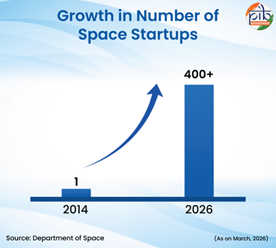
- Skyroot Aerospace became India’s first space-tech unicorn. Its Vikram-1 became the first privately developed Indian orbital-class rocket to successfully place a payload into Low Earth Orbit (LEO).
- Pixxel Space is building hyperspectral imaging satellites that provide Earth observation data to commercial customers and government agencies in India, Europe and the United States.
Major Reforms in the Space Sector of India
- Establishment of IN-SPACe (Indian National Space Promotion and Authorisation Centre, 2020): Acts as a single-window regulator and facilitator for private companies, authorising and promoting their participation in space activities.
- Corporatisation via NewSpace India Limited (2019): It was set up as ISRO’s commercial arm to transfer technology, manufacture satellites/launch vehicles through industry, and provide commercial satellite services.
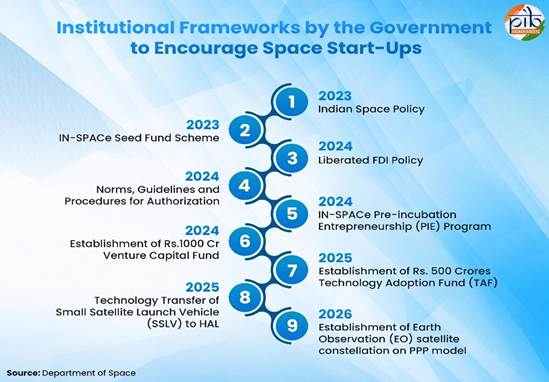
- Schemes to encourage the private sector have been implemented by IN-SPACe: Seed Fund Scheme, Pricing Support Policy, Mentorship Support, Design Lab for NGEs, Skill Development in Space Sector, ISRO facility utilisation support and technology transfer to non-governmental entities (NGEs).
- The ₹1,000 crore Venture Capital (VC) Fund under IN-SPACe aims to accelerate private participation in the space sector.
- IN-SPACe also introduced the ₹500 crore Technology Adoption Fund (TAF).
- Liberalised FDI Policy for Space: The revised policy permits up to 74% automatic FDI in satellite manufacturing and operations, 49% automatic FDI in launch vehicles and spaceports, and 100% automatic FDI in the manufacturing of satellite components and subsystems.
- SpaceTech Innovation Network (SpIN): SpIN is a one-of-its-kind public-private collaboration for start-ups and SMEs in the space industry.
Significance of the Privatisation of the Space Sector
- Private companies operate with a profit motive, which drives them to reduced costs in space missions and satellite launches.
- Privatisation introduces competition into the space industry, which can drive both efficiency and innovation.
- Private players facilitate the commercialisation of space applications and services in agriculture, disaster management, urban planning, navigation, and communication, as well as in other sectors.
- Private companies have a greater degree of autonomy in making decisions, which enables them to take up new projects.
- It helps to generate employment, enable modern technology absorption and make the sector self-reliant.
Challenges
- Space technology is expensive and needs heavy investment. This kind of lucrative power is available only to selected rich corporates, which can lead to monopolisation of the sector.
- Building and operating space technology and infrastructure requires specialised technical expertise and resources.
- Protecting intellectual property rights (IPR) is crucial for incentivising innovation and investment in the space sector.
- Indian private companies in the space sector have to face stiff competition from the established players such as SpaceX, Blue Origin, etc. in the international market.
Way Ahead
- Private entities are now actively involved in crucial aspects of research, manufacturing, and fabrication of rockets and satellites, fostering a vibrant ecosystem of innovation. It is expected to integrate Indian companies into global value chains.
- With this, companies will be able to set up their manufacturing facilities within the country, duly encouraging ‘Make In India (MII)’ and ‘Atmanirbhar Bharat’ initiatives of the Government.
National Space Day
- August 23rd was declared as “National Space Day” to honour the success of the Chandrayaan-3 mission.
- It achieved a safe and soft landing of the Vikram Lander at the ‘Shiv Shakti’ point and deployed the Pragyaan Rover on the lunar surface.
Source: AIR
Previous article
AI Designed Bacteriophages
Next article
Regenerative Agriculture For a Resilient India
