


Syllabus: GS2/Governance
Context
- The Supreme Court has ruled that the definition of “industry” under the Industrial Relations Code (IRC), 2020 must be interpreted independently and will not automatically be governed by the landmark 1978 Bangalore Water Supply judgment.
The 1978 Bangalore Water Supply Judgement
- In Bangalore Water Supply and Sewerage Board v. R. Rajappa (1978), a seven-judge bench, adopted a broad interpretation of “industry” under Section 2(j) of the Industrial Disputes Act, 1947.
- The judgement evolved the Triple Test, under which an activity could qualify as an industry when it involved:
- Systematic and organised activity;
- Organised by cooperation between employer and employee;
- Production and/or distribution of goods or services calculated to satisfy human wants and wishes.
- The interpretation brought several establishments, including hospitals, educational institutions and municipalities, within the ambit of labour law.
- Core sovereign functions, such as defence, judiciary and law enforcement, were generally excluded.
Supreme Court Ruling
- The Court held that the meaning of “industry” under Section 2(p) of the IRC, 2020, must be determined from the language, structure and context of the new Code itself.
- The interpretation of the term ‘industry’ under IRC would be done on a clean slate.
- The 1978 judgement will continue to govern pending disputes under the Industrial Disputes Act, 1947. However, it will not act as the binding foundation for interpreting “industry” under the IRC.
Why was the 1978 judgement reconsidered?
- India’s labour market has undergone substantial transformation since 1978 due to:
- Liberalisation and privatisation;
- Expansion of the private and service sectors;
- Changing forms of employment and work arrangements, including the emergence of gig and platform-based work;
- The transition from a predominantly public-sector-orientated economy to a more diversified economy.
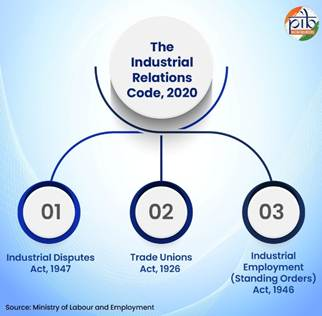
- The new Labour Codes were intended to consolidate and modernise India’s fragmented labour legislation.
The Industrial Relations Code, 2020
- As per Section 2(p) of the Industrial Relations Code, 2020, the term “industry” now encompasses any systematic activity carried on by cooperation between employer and worker, regardless of whether capital is invested or profit is intended, thereby bringing non-profit and low-capital activities within its ambit.
- Pro-Labour Benefits:
- Extends labour rights to employees in non-profit and non-capital-based organisations.
- Expands access to formal dispute resolution through Conciliation Officers and Industrial Tribunals.
- Broadens collective bargaining rights to more workers
- Statutory benefits (like notice for change of service conditions, retrenchment compensation, and grievance redressal mechanisms) to be given to workers in newly included sectors.
Way Ahead
- The new interpretation should ensure that labour-law reform promotes industrial growth and flexibility without weakening workers’ fundamental labour protections.
- Clear legislative and judicial guidance will be essential to prevent uncertainty and preserve industrial peace.
Previous article
News In Short 20-08-2026
Next article
India and Japan: Deepening Cooperation
