


Idea of a ‘perfect victim’ or an ‘ideal victim’
Syllabus: GS2/Polity and Governance
Context
- Bombay High Court set aside the 2021 judgment of the trial court that had acquitted Tarun Tejpal.
- The High Court also said that it had fallen for the notion that a sexual assault complainant must be a ‘perfect victim’ and conduct herself in a certain way to appear credible.
About
- The idea of a ‘perfect victim’ or an ‘ideal victim’ was theorised by Norwegian criminologist Nils Christie in 1986.
- According to him, ‘perfect victim’ possesses five main attributes.
- They are often female, disabled, very young, or very old, and are therefore weak in relation to the offender.
- They are involved in “respectable activities”.
- They cannot reasonably be blamed for being where they were during the crime.
- They do not know the offender personally.
- They are attacked by a perpetrator who is “big and bad”.
- This one-size-fits-all idea of victimhood is propagated widely by the media, social media, films, and by the larger society.
- This narrow perception of an ‘ideal victim’ creates a hierarchy of victimisation.
- Those who are thought of as “undeserving” are even perceived as contributing to the situation and receive less sympathy or none at all.
- The High Court Stand: The High Court criticised the Sessions Court for focusing on the complainant’s conduct, reactions, and personal background instead of the evidence on record.
- Recently, the Supreme Court issued a report recommending greater gender sensitivity in judicial writing.
- It cautioned judges against drawing adverse conclusions from delayed reporting, lack of physical injuries, inconsistencies in testimony or a survivor’s demeanour, noting that trauma affects people differently.
Source: TH
Coking Coal
Syllabus: GS3/Economy
Context
- Indian Steel mills are facing mounting pressure on margins as higher coking coal prices, driven by supply disruptions in Australia and China and the Iran war, raise steelmaking costs.
About
- India, the world’s second-largest crude steel producer, meets around 90% of its coking coal requirements through imports, with Australia accounting for at least half of these imports.
- In steel making, coal is converted into coke, a high-carbon fuel that generates the intense heat required in blast furnaces and helps extract iron from iron ore.
- Coking coal accounts for nearly 40% of steel production costs.
- Coking coal has suitable properties and relatively low ash content to produce strong coke required for blast furnaces.
- On the other hand, non-coking coal, despite its relatively high ash content, can generate sufficient heat to run boilers and turbines, making it suitable for power generation.
Initiatives
- Mission Coking Coal (2021): Aims to reduce import dependence by increasing domestic coking coal production to 140 MT and raising the blending of domestic coal in steelmaking from 10% to 30% by 2030.
- Critical and Strategic Mineral: The Government has notified coking coal as a Critical and Strategic Mineral under the Mines and Minerals (Development and Regulation) Act, 1957 (MMDR Act) to encourage domestic exploration and production.
Source: IE
New Development Bank
Syllabus: GS2/IR; GS3/Economy
In News
- Iran decided to join the New Development Bank to strengthen monetary, financial and banking cooperation with BRICS countries.
New Development Bank
- It is a multilateral development bank established by Brazil, Russia, India, China and South Africa (BRICS).
- It was founded in 2015 and Its membership is open to members of the United Nations, as well as to borrowing and non-borrowing member countries.
- It aims to mobilize resources for infrastructure and sustainable development projects in emerging markets and developing countries.
- Members : India, Brazil, Russia, China, South Africa, Bangladesh, UAE, Egypt, and Algeria are members of NDB.
- Uzbekistan became the New Development Bank’s tenth member and the first Central Asian country to join the institution.
- Focus Areas :

- It brings together eleven major emerging markets and developing countries of the world: Brazil, China, Egypt, Ethiopia, India, Indonesia, Iran, Russia, Saudi Arabia, South Africa and the United Arab Emirates.
- It serves as a useful platform for consultation and cooperation on contemporary issues having global as well as regional significance, and issues of global political and economic governance.
- It comprises :

Source: Reuters
Helicase: The DNA Separator
Syllabus: GS3/Science and Technology
Context
- In a recent study scientists found how cells make sure they start copying DNA only at the right time.
About
- Helicase is an enzyme that unwinds the two strands of DNA so that the cell can copy the genetic information stored in them.
- DNA is normally a double helix, i.e. two long strands held together by bonds between bases on each strand, spiralling around each other.
- When a cell divides, it needs to make a copy of the DNA, which requires these strands to be separated.
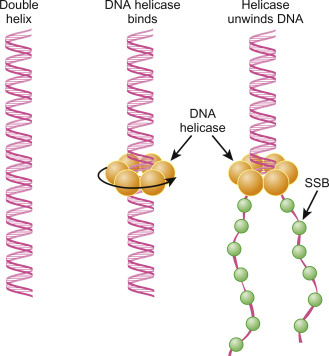
- Helicase attaches to a particular region of DNA and moves along the molecule.
- It uses energy from ATP — the cell’s main chemical energy source — to change its shape and force apart the two DNA strands.
- The result is a Y-shaped region called the replication fork, where the two strands are exposed.
- Other enzymes called topoi somerases relieve this twisting and prevent the DNA from becoming tangled or breaking.
- Once the helicase has separated the strands, other replication machinery can use each exposed strand as a template.
Source: TH
Raichur Miyawaki Forest
Syllabus: GS3/ Environment
In Context
- The Miyawaki method has been in the news repeatedly over the past year from Raichur’s Yakalaspura dumpsite-turned-forest in Karnataka, to Rajkot’s Nakrawadi landfill transformation in Gujarat, to urban afforestation drives in Mumbai.
What is the Miyawaki Method?
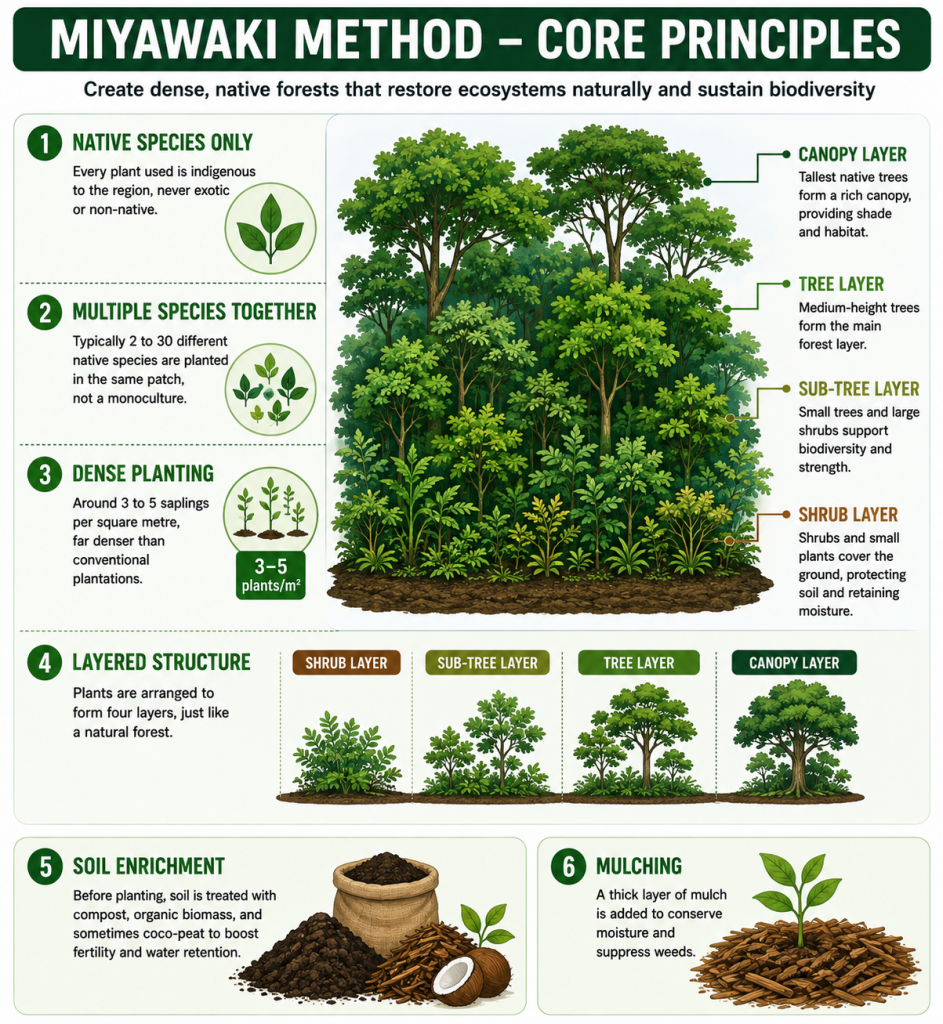
- The Miyawaki method is an afforestation technique that creates dense, native, multi-layered forests in a short span of time, even in very small urban spaces.
- It was developed in the 1970s by Japanese botanist and plant ecologist Dr Akira Miyawaki, who based it on the idea of “potential natural vegetation” means the forest that would naturally exist in a region if left undisturbed.
- The core idea is rather than planting a few trees sparsely and waiting decades for a forest to form, plant many native species very close together and let them compete for sunlight and nutrients.
Source: TH
Amazon Rainforest
Syllabus: GS3/Environment
Context
- A recent study published in Global Change Biology has found that just 15–25 tree species play a major role in regenerating deforested areas of the Amazon rainforest.
About
- The Amazon rainforest, often called the lungs of the Earth, is home to about 10% of all known plant and animal species — and countless others that haven’t even been discovered yet.
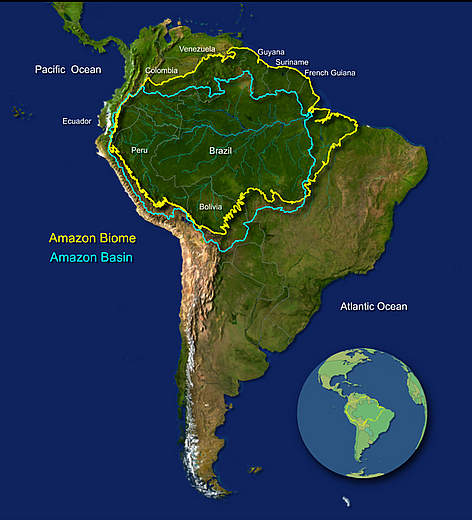
- The Amazon spans 8 countries and one overseas territory: Brazil, Bolivia, Colombia, Ecuador, Guyana, Peru, Suriname, Venezuela, and French Guiana (a French overseas territory).
- It stores around 250–300 billion tonnes of carbon, equivalent to 15–20 years of global greenhouse gas emissions, and generates rainfall that supports some of the world’s largest cities and most vital agricultural regions.
- It is home to over 47 million people, including 2.2 million Indigenous and traditional communities, whose cultures and livelihoods are deeply tied to the forest.
Source: TH
