


Syllabus: GS3/Economy
Context
- India’s coconut sector, deeply rooted in the country’s agricultural economy and cultural traditions, is steadily evolving from a predominantly traditional farming activity into a diversified, export-oriented industry.
About Coconut
- It is often described as the “Kalpavriksha” or “Tree of Life” because almost every part of the plant has economic or practical uses.
- Type of Plant: Coconut is a perennial plantation crop and a monocotyledonous palm belonging to the family Arecaceae.
- Coconut is native to the Indo-Pacific region, with its origin commonly traced to Southeast Asia.
- Climatic Requirements: Coconut requires a warm and humid tropical climate for optimal growth. It grows best in regions with temperatures ranging between 25°C and 30°C and requires high and evenly distributed rainfall.
- Soil Requirements: Coconut thrives in well-drained sandy loam, alluvial, laterite, and coastal soils.
Economic and Livelihood Significance
- India holds a prominent place in the global coconut economy. The country ranks first in production and third in cultivation area, accounting for 31.24 percent and 17.90 percent of global totals, respectively.
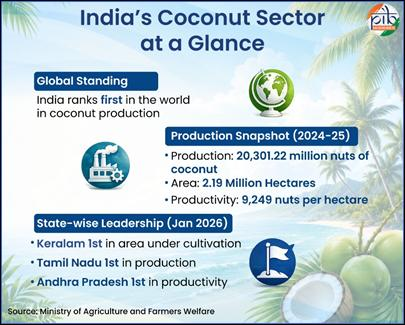
- The coconut sector supports the livelihoods of nearly 30 million people in India, including around 10 million farmers.
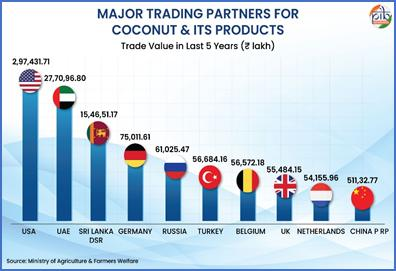
- Export Potential: India’s coconut product exports reached ₹7,038.35 crore in 2025-26, registering a 62% increase over the previous year.
Government Initiatives
- MSP for Copra: Copra, the dried kernel of coconut, is among the 22 mandated agricultural crops covered under the Minimum Support Price regime.
- Coconut Promotion Scheme: In order to address pest outbreaks, root wilt disease, and aging plantations, the Coconut Promotion Scheme was announced in the Union Budget 2026-27. The scheme seeks to enhance coconut production and productivity.
- Coconut Development Board (CDB): Established in 1981 under the Ministry of Agriculture and Farmers Welfare, the CDB provides institutional support for the integrated development of coconut cultivation and the coconut industry. It operates across 22 States and Union Territories.
- Other schemes supporting the production of quality planting material include:
- Establishment of Nucleus Coconut Seed Garden: Supports the establishment of coconut seed gardens to produce high-quality coconut seedlings and improved varieties.
- Establishment of Small Coconut Nursery: Promotes production of quality coconut seedlings through the establishment of public and private nurseries. During 2025-26, assistance was provided to establish12 new nurseries with a combined annual production capacity of 1.06 lakh seedlings.
- Accreditation and Rating of Coconut Nurseries: Ensures the availability of genuine, high-quality planting material through nursery accreditation and quality assessment.
Challenges
- Despite its strong production base, the coconut sector faces several challenges:
- Ageing and declining plantations;
- Pest and disease outbreaks, including root wilt disease;
- Low levels of mechanisation in some regions;
- Need for greater value addition and processing capacity;
- Price fluctuations affecting farmer incomes;
- The need to strengthen India’s position in high-value global markets.
Way Forward
- Promote high-yielding and disease-resistant planting material.
- Strengthen rejuvenation and replanting of ageing plantations.
- Encourage integrated and multi-tier farming systems to diversify farmer incomes.
- Expand processing and value addition at the farm and local-enterprise level.
- Improve access to technology, mechanisation and post-harvest infrastructure.
- Strengthen export competitiveness through quality standards, branding and market diversification.
Source: PIB
Previous article
Legality of Polygamy in India
