


Maharashtra seeks UNESCO Heritage Tag for Dahi Handi Festival
Syllabus: GS1/Culture
Context
- The Maharashtra government is seeking UNESCO Intangible Cultural Heritage recognition for the Dahi Handi festival.
- It also plans to send ‘Govindas’, who form human pyramids during the festival, to Spain to showcase this traditional practice.
About the Intangible cultural heritage
- It includes the practices, knowledge, expressions, objects, and spaces that communities see as part of their cultural identity.
- Passed down over generations, this heritage evolves, strengthening cultural identity and appreciation of diversity.
- Historical Background: For the Safeguarding of Intangible Cultural Heritage, UNESCO adopted the 2003 Convention during its 32nd General Conference in Paris.
- India ratified the convention in 2005.
- India’s UNESCO heritage entries: To date, 16 Indian elements have been inscribed on the UNESCO Representative List (including Deepavali, Durga Puja, Kumbh Mela and Garba).
Dahi Handi Festival
- Dahi Handi, held a day after Janmashtami to mark the birth of Lord Krishna, combines religious devotion with community participation and sport.
- Participants, or Govindas, form tall human pyramids to reach and break an earthen pot filled with curd, butter, and milk.
- According to legends, the child-god Krishna or Kanha and his friends used to form human pyramids to break pots hung from the ceilings of neighbourhood houses to steal curd and butter.
- The practice became particularly popular across Mumbai and the Mumbai Metropolitan Region, where Dahi Handi competitions are now organised with substantial prize money.
- The state government also provides Rs 10 lakh insurance cover to each Govinda participating in Dahi Handi.
India-Spain Connection
- The traditional practice of building human pyramids and towers is the common link between the Dahi Handi festival and Spain, where communities practice building human towers called castells.
- Spain’s Catalan Castells (human towers)— is already recognized by UNESCO.
- Spanish teams regularly visit Mumbai and Thane to participate in the Dahi Handi festival.
Source: CNBC TV18
Communal Award
Syllabus: GS1/History
In News
- Recently, the anniversary of the Communal Award announcements was observed.
Communal Award
- In August 1932 British Prime Minister Ramsay MacDonald formally announced the Communal Award.
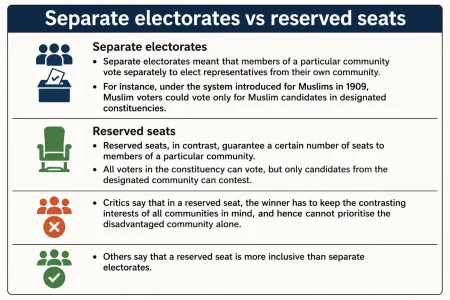
- It recognised the Depressed Classes as a minority and granted them separate electorates for 20 years.
- The arrangement gave them 71 special seats in the provincial legislatures.
- It also provided separate electorates for Muslims, Sikhs, Indian Christians, Anglo-Indians and Europeans, along with communal allocations of seats in the provincial legislatures and other safeguards for minority representation.
- MacDonald backed the proposal on the ground that separate electorates would provide the Depressed Classes distinct political representation, while their voting rights in general constituencies would preserve their unity with other Hindus.
Mahatma Gandhi Response
- He was opposed to the British suggestion of separate electorates for the Depressed Classes vehemently claiming that it would split the Hindu society rather than solve the social problems of the community.
- He warned Secretary of State Samuel Hoare that he would fight the move with his life.
- He began his fast unto death at Poona on 20 September 1932, declaring his determination to end untouchability and to bring about social peace between the caste Hindus and the Depressed Classes.
- Prominent personalities like M.C. Rajah and B.G. Horniman also denounced separate electorates which they believed could widen the gulf between the Depressed Classes and other Hindus.
B.R. Ambedkar Views
- He was the most vocal champion of separate electorates for the Depressed Classes, believing that upper-caste reformers like Gandhi were unable to represent them sufficiently and that they needed autonomous political leadership and representation.
- As Gandhi’s fast approached, Madan Mohan Malaviya contacted the leaders of the Hindu and the Depressed Classes for negotiations, but Ambedkar first declined, emphasising that the interest of the Depressed Classes was more essential than Gandhi’s personal fast.
Poona Pact
- During Gandhi’s Poona fast, key figures including Madan Mohan Malaviya, Tej Bahadur Sapru, M.R. Jayakar, C. Rajagopalachari and Rajendra Prasad talked with B.R. Ambedkar to settle the controversy over separate electorates.
- The Poona Pact, signed on September 24, 1932, replaced separate with combined electorates for the Depressed Classes but vastly expanded the number of reserved seats from 71 to 148 in the provincial legislatures and to 18% of the seats in the Central Legislature.
- The British Government adopted it as a modification to the Communal Award.
- The system of reservation lasted even after independence and at present, 84 Lok Sabha seats are reserved for Scheduled Castes and 47 for Scheduled Tribes.
Source :IE
Danube Port
Syllabus: GS1/Places in News
Context
- A Russian attack targeted port infrastructure in Ukraine’s Izmail district in the southern region of Odessa.
- Izmail is close to the Romanian border and is home to Ukraine’s largest port on the Danube river.
Danube River
- The Danube is a major international river and an important inland waterway in Europe, connecting Central and Eastern Europe with the Black Sea.
- Origin: Black Forest of Germany.
- It is stretched approx. 2,850 kilometers and is the second-largest river in Europe after the Volga.
- It flows through ten countries: Germany, Austria, Slovakia, Hungary, Croatia, Serbia, Bulgaria, Romania, Moldova, and Ukraine.
- The Danube is recognized for its unique biodiversity, including numerous endangered species, and serves as a critical habitat for many migratory birds.
Source: TH
Electronics Component Manufacturing Scheme (ECMS)
Syllabus: GS3/Economy
Context
- The Ministry of Electronics and Information Technology (MeitY) approved projects collectively worth ₹7,877 crore for incentives under the Electronics Component Manufacturing Scheme (ECMS).
Electronics Component Manufacturing Scheme
- Objective: To develop a robust component manufacturing ecosystem by attracting investments (global / domestic) across the value chain by integrating its domestic electronic industry with the Global Value Chains (GVCs).
- The Target Segment Category under Scheme includes;
- Sub-assemblies
- Bare components
- Selected bare components
- Supply chain ecosystem and Capital equipment
- Sub-assembly – Telecom.
- Types of Incentive: Turnover linked incentive, capex incentive and hybrid incentive.
- Tenure of the Scheme:
- Turnover Linked Incentive: Six years with one year of gestation period.
- Capex Incentive: Five years.
India’s electronics sector
- India’s electronics production has increased from ₹1.90 lakh crore in 2014-15 to an estimated ₹13.11 lakh crore in 2025-26, registering nearly a seven-fold increase.
- Electronic goods have now become India’s third-largest export category, with exports reaching USD 47.96 billion in FY 2025-26.
- India has evolved from being a net importer of mobile phones to becoming the world’s 2nd-largest mobile phone manufacturer.
Source: TH
Rotating Detonation Engines
Syllabus: GS3/ Science & Technology
Context
- Recently, the India-based defence start-up D-Propulse announced that it had successfully demonstrated a rotating detonation engine at a Defence Research & Development Organisation facility in Hyderabad.
About Rotating Detonation Engine
- A Rotating Detonation Engine (RDE) is an advanced engine that uses detonation instead of conventional burning to generate thrust.
- Significance: The engine design promises to use fuel more efficiently than conventional rocket engines. If less fuel is required, some of the saved mass can potentially be used for additional satellite payload.
- In a conventional engine, fuel burns through deflagration, where the flame travels at a speed lower than the speed of sound.
- In an RDE, the fuel-air or fuel-oxidiser mixture undergoes detonation, in which a powerful shock wave travels at supersonic speed.
- This detonation wave continuously moves around a ring-shaped (annular) combustion chamber.
- The high-pressure gases produced during this process are then directed through a nozzle to generate thrust.
Source: TH
Navy to Lease Two New MQ-9B Sea Guardian Unmanned Aircraft
Syllabus: GS3/Defence
Context
- The Ministry of Defence signed a contract with the U.S. General Atomics Aeronautical to lease two MQ-9B Sea Guardian High-Altitude Long-Endurance (HALE) Remotely Piloted Aircraft Systems (RPAS) for the Indian Navy.
About
- The MQ-9B SeaGuardian HALE RPAS is an unmanned aerial vehicle designed for intelligence, surveillance and reconnaissance (ISR), as well as precision strike missions.
- It can remain airborne for over 30 hours, operate at altitudes above 40,000 feet and cover vast maritime and land areas.
- A global Maintenance, Repair, and Overhaul (MRO) facility will be set up in India under contract to assemble some of the MQ-9Bs in India to support India’s long-term goals to boost indigenous defence capabilities.
- A certain percentage of the components for the drones will be sourced indigenously.
Source: IE
Exercise MAITREE-XV (2026)
Syllabus: GS3/Defence
In News
- The Indian Army contingent departed for Thailand to participate in the 15th edition of the India-Thailand Joint Military Exercise MAITREE-XV (2026) at Vibhavadi Rangsit Camp, Surat Thani, Thailand.
Exercise MAITREE
- It was instituted in 2006 and is an important platform for sharing best practices and strengthening military cooperation between India and Thailand.
- It enhances interoperability, mutual understanding and camaraderie between the two Armies, further reinforcing the longstanding bilateral relations between the two nations.
- It will enhance combined capabilities in executing Joint Counter Insurgency/ Terrorist Operations in Jungle and semi-urban Environment under Chapter VII of United Nations Charter.
Source :PIB
Previous article
Artificial Intelligence (AI) Agent
Next article
Draft SHANTI Rules 2026
