


Syllabus: GS3/Infrastructure
Context
- India’s governance has undergone a fundamental transformation through Digital Public Infrastructure (DPI).
India’s Digital Economy
- The Digital Economy now contributes about 12–14% of India’s Gross Domestic Product (GDP) and is projected to account for 20% over the next decade.
- As per the State of India’s Digital Economy Report 2026, India is now the world’s fifth-largest digitalised economy and the fourth-highest ranked G20 economy.
- Key Milestones in India’s Digital Self-Reliance Landscape
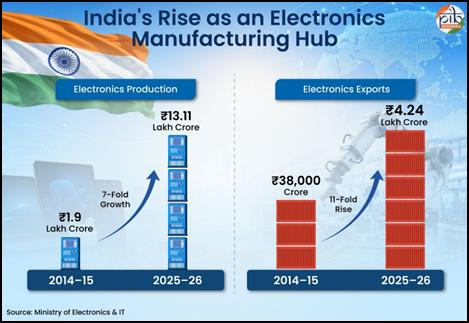
- Third-largest Export Sector: Electronic goods have now become India’s third-largest export category.
- Employment and Women Participation: Electronic manufacturing ecosystem supports nearly 25 lakh jobs, with women accounting for nearly 30% of the workforce.
- Global Mobile Manufacturing Hub: India is now the world’s 2nd largest mobile phone manufacturer.
Digital Public Infrastructure (DPI)
- The United Nations defines Digital Public Infrastructure as a set of foundational digital systems that form the backbone of modern societies.
- These systems enable secure and seamless interaction between people, businesses and governments.
- For digital infrastructure to deliver public value, it must be inclusive, interoperable and governed in the public interest.
- When linked with payments and data exchange frameworks, it creates a unified architecture that strengthens state capacity and widens opportunity.
Foundations of India’s DPI: The JAM Trinity
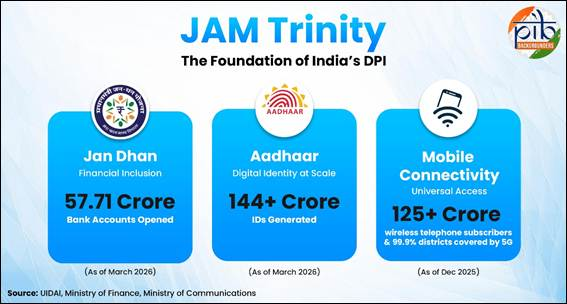
- Jan Dhan bank accounts, Aadhaar enrolment and widespread mobile phone penetration created the base layer for India’s digital transformation.
- Jan Dhan Yojana (2014): It was launched as the National Mission for Financial Inclusion, set out to give every unbanked adult in India a bank account.
- It led to a widened financial participation where savings entered the formal system strengthening economic agency.
- Aadhaar: It enabled unique identification and secure authentication for efficient service delivery. Access to services became more reliable and transparent.
- Affordable Mobile Data: Wireless data cost dropped drastically making digital services more affordable.
- Mobile Phones and Connectivity: Fifth generation (5G) mobile services are now available in 99.9% of districts, covering 85% of the population.
- This extensive digital reach ensured that identity and banking were not confined to urban centres.
Challenges
- Fragmented Federal Coordination: Implementation of DPI often requires coordination between the Union Government, States, local bodies, and private stakeholders.
- Variations in digital readiness and administrative capacity across states create uneven implementation and service delivery.
- Dependence on Private Technology Ecosystem: Although DPI is publicly driven, many services depend heavily on private fintech firms which may create systemic vulnerabilities and reduce strategic autonomy.
- Language and Accessibility Barriers: Many digital platforms are still not fully accessible in regional languages or for persons with disabilities.
- Trust Deficit Among Citizens: Concerns regarding misuse of personal data, digital fraud, surveillance, and online scams reduce public trust in digital systems.
- Weak Grievance Redressal Mechanisms: Delayed grievance resolution reduces the effectiveness and credibility of DPI systems.
- Cross-Border Data and Sovereignty Concerns: With increasing global integration of digital platforms and cloud infrastructure, concerns arise regarding data localization, cross-border data flows, and protection of national digital sovereignty.
- Environmental and Energy Costs: Large-scale digital infrastructure, data centers, telecom networks, and cloud computing systems consume significant energy and contribute to environmental stress.
Government Initiatives
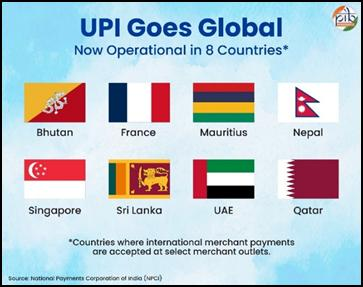
- Unified Payments Interface (UPI): It enables instant, interoperable and secure transactions between individuals and merchants in real time.
- The International Monetary Fund, in its 2025 report on growing retail digital payments, recognised UPI as the world’s largest retail fast payment system by transaction volume.
- UPI accounted for 85% of India’s digital payment transactions by volume in FY 2025–26.
- Public Financial Management System (PFMS): It is a web based online transaction system that enables end to end monitoring of government funds and electronic payments to implementing agencies and beneficiaries.
- This reform helped remove duplicate and fake beneficiaries and reduce leakages.
- Open Network for Digital Commerce (ONDC): Launched in 2022, ONDC is an open network designed to democratise digital commerce by connecting buyers and sellers through interoperable platforms rather than a single marketplace.
- DigiLocker: Launched in 2015, DigiLocker introduced a secure digital document wallet for citizens.
- It allows individuals to store, access and share authenticated electronic documents with consent-based access.
- UMANG: Launched in 2017, UMANG, or the Unified Mobile Application for New age Governance, was designed to advance mobile governance in India.
- It provides a single window mobile and web platform to access services from central, state and local government bodies.
- IndiaAI Mission: It is strengthening AI education, infrastructure and responsible AI adoption. It is promoting AI skills across schools, higher education institutions and professional training programmes.
- PM GatiShakti: Launched in 2021, the PM GatiShakti National Master Plan provides a GIS based digital platform for integrated planning and coordinated implementation of infrastructure projects.
- Global Partnership: Government has signed Memoranda of Understanding (MoU) and agreements with 24 countries for cooperation on India Stack and Digital Public Infrastructure.
- These partnerships focus on sharing technical knowledge and supporting replication of digital governance platforms.
Conclusion
- India has built a world-class digital public infrastructure in a relatively short period and that it has demonstrably improved inclusion, efficiency, and security in public service delivery.
- The work ahead is not to replace this architecture by any means, but to deepen its reach, strengthen its governance, and extend its benefits to those who remain at the margins of the digital economy.
Source: PIB
Previous article
Black Money in Elections Hampers Democracy: SC
Next article
Artificial Intelligence (AI) Agent
