


Syllabus: GS2/Issues Related To Education
Context
- India’s universities continue to lag in major global rankings despite abundant talent, while institutions in China, Singapore and Hong Kong have rapidly strengthened research, autonomy and global competitiveness.
About Higher Education in India
- India has one of the world’s largest higher-education systems, comprising universities, colleges and standalone institutions.
- Its expansion has significantly improved access, but quality, research productivity, employability and institutional governance remain uneven.
Current Statistics (AISHE, 2023-24)
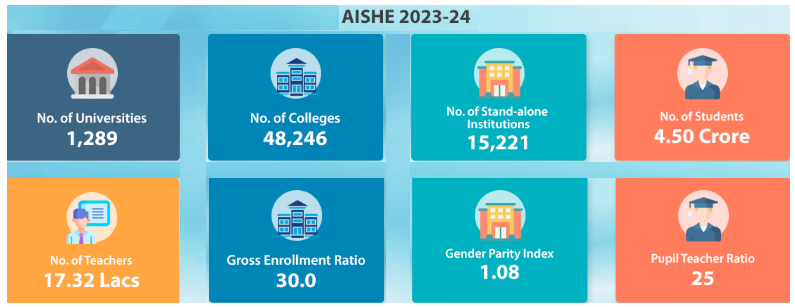
- Gross Enrolment Ratio (GER): According to All India Survey on Higher Education (AISHE, 2023-24)GER was 30 in 2023-24 which was 23.7 in 2014-15.
- Female GER has risen to 31.2 in 2023-24 from 22.9 in 2014-15;
- Scheduled Castes (SC) GER have increased to 27.8 in 2023-24 from 18.9 in 2014-15; and
- Scheduled Tribes (ST) GER have increased to 22.8 in 2023-24 from 13.5 in 2014-15.
- Gender Parity Index (GPI): It measures the relative access to education of males and females, and it stands at 1.08 for 2023-24.
- It has remained above 1.0 for seven consecutive years, indicating consistently higher female participation in higher education.
- Enrolment in Higher Education: It has been continuously increasing from 3.42 crore in 2014-15 to 4.46 crore in 2022-23 and 4.50 crore in 2023-24 (i.e. 31.5% increase since 2014-15).
- Increase in female enrolment in higher education from 1.57 crore in 2014-15 to 2.18 crore in 2022-23 and 2.24 crore in 2023-24 (i.e. 42.2% increase since 2014-15).
- The enrolment of SC students has increased to 69.72 lakh in 2023-24 from 46.07 lakh in 2014-15 (an increase of 51.4% since 2014-15).
- The enrolment of ST students has increased to 28.83 lakh in 2023-24 from 16.41 lakh in 2014-15 (an increase of 75.7% since 2014-15).
- Similarly, the enrolment of Other Backward Classes (OBC) students has increased to 1.80 crore in 2023-24 from 1.13 crore in 2014-15 (60.2% increase).
- STEM Enrolment: It has risen from 91.5 lakh in 2014-15 to 1.02 crore in 2023-24.
- The share of female students in STEM enrolment has risen from 38.4% in 2014-15 to 44% in 2023-24.
- The total number of faculty/teachers increased to 17.32 lakh in 2023-24, of which 55.1% are male and 44.9% are female.
- The female faculty strength has increased from 5.69 lakh in 2014-15 to 7.78 lakh in 2023-24.
Key Issues & Concerns
- Merit and Integrity: Appointments, promotions and admissions must consistently prioritise merit, fairness and institutional interest.
- Perceived favouritism or opaque decision-making damages institutional credibility and teaches students that rules need not apply equally to everyone.
- Misunderstanding Universities: A university is neither a conventional government department nor a corporation.
- It is a learning and knowledge-producing community requiring academic freedom, professional autonomy and accountability.
- Uniform policies can therefore be counterproductive.
- Faculty evaluation should recognise differences between disciplines, teaching and research-oriented institutions, institutional size and local conditions.
- Excessive bureaucratic control can also undermine initiative.
- Leadership Deficit: Sound policies often fail because institutions lack capable academic leadership and robust implementation mechanisms.
- A culture that punishes every failure discourages experimentation; institutions instead need responsible risk-taking, continuous learning, mentoring and leadership development.
- Research and Employability Gaps: India’s research ecosystem remains concentrated in a limited number of institutions.
- Weak industry-academia linkages, inadequate research support, limited internationalisation and uneven faculty quality contribute to low employability and modest global research visibility.
- Systemic Unevenness: Islands of excellence cannot transform the entire ecosystem.
- Policies designed around the weakest institutions and uniformly imposed across diverse universities may restrict stronger institutions while failing to adequately strengthen weaker ones.
Related Efforts & Initiatives
- NEP 2020: Sets the overall direction like multidisciplinary education, institutional autonomy, internationalisation, and a stronger research orientation.
- NEP 2020 had proposed replacing this fragmented set-up with a single body, the Higher Education Commission of India (HECI).
- The HECI legislation is still pending, so reform is happening body by body instead of through one unified regulator.
- Anusandhan National Research Foundation (ANRF): ANRF was set up under the ANRF Act, 2023, absorbing the earlier Science and Engineering Research Board (SERB).
- It is India’s apex research-funding body that NEP 2020 had envisaged.
- NIRF: Domestic performance benchmarking.
- Institutions of Eminence (IoE): The IoE scheme was launched in 2017–18 with a target of 20 institutions with 10 public and 10 private granted greater autonomy.
- PM-USHA: Support for improving state higher-education institutions.
- Academic Bank of Credits and multiple-entry/exit framework: Greater curricular flexibility.
- SWAYAM and DIKSHA: Expansion of digital learning and access.
Way Forward: Strengthening Higher Education in India
- Ensure Accountable Autonomy: Grant universities greater academic, administrative and financial autonomy with clearly defined accountability mechanisms.
- Reduce excessive bureaucratic interference while strengthening transparent audits and outcome-based evaluation.
- Promote Merit-Based Governance: Ensure transparent, merit-based appointments and promotions.
- Strengthen institutional leadership through professional selection, mentoring and regular capacity-building of academic administrators.
- Adopt Differentiated Governance: Avoid a one-size-fits-all approach. Develop different evaluation and promotion frameworks for research-intensive, teaching-oriented, multidisciplinary and specialised institutions.
- Strengthen Research & Innovation: Increase competitive and predictable research funding.
- Promote industry–academia collaboration, interdisciplinary research, international partnerships and technology transfer.
- Strengthen the Anusandhan National Research Foundation as a catalyst for research.
- Improve Faculty Quality: Strengthen faculty recruitment based on merit and subject expertise.
- Encourage continuous professional development, pedagogical innovation and international academic exposure.
- Focus on Employability: Align curricula with emerging industry and societal needs.
- Expand internships, apprenticeships, vocational exposure, entrepreneurship programmes and soft-skill development.
- Build a Culture of Learning: Replace a fear-of-failure culture with responsible experimentation and institutional learning.
- Use periodic reviews, peer learning and evidence-based policy to improve academic practices.
- Reduce Regional & Institutional Gaps: Provide targeted support to weaker institutions while allowing high-performing universities greater flexibility.
- Promote collaboration and resource-sharing among institutions to prevent isolated ‘islands of excellence’.
- Strengthen Internationalisation: Attract reputed foreign faculty and students, expand global research collaborations and encourage joint degrees.
- Create conditions that enable Indian universities to compete more effectively in global rankings.
| Daily Mains Practice Question [Q] Discuss the major challenges facing India’s higher education sector and suggest measures to make Indian universities globally competitive. |
Previous article
The Makkah Pact: Challenges With India & World
