

Syllabus: GS3/Agriculture
Context
- The Gulf conflict, fluctuations in global fertiliser and energy markets, and the increasing risk of climatic stress from El Niño have reinvigorated interest in natural farming as a means of boosting Indian agriculture and cutting reliance on external inputs.
About Natural Farming
- It is a chemical-free, agroecological farming approach that reduces dependence on inputs obtained from outside and instead relies on biological resources available locally, biodiversity, crop diversification, mulching and microbial formulations.
- It aims to increase soil health, preserve water, cut production costs and boost climate resilience unlike conventional agriculture.
- National Mission on Natural Farming (NMNF) promotes sustainable agricultural output through on-farm biomass recycling, biological pest management and indigenous farming practices.
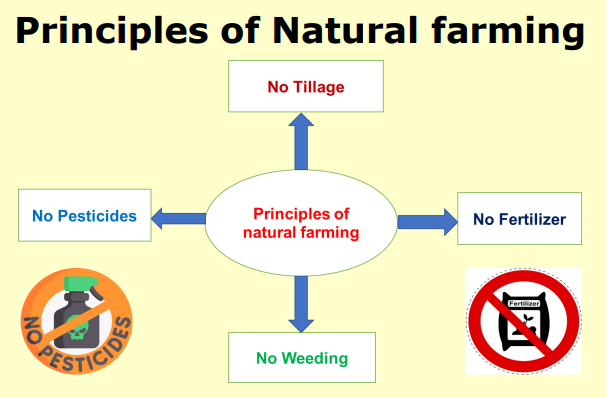
- It is aligned with the Food and Agriculture Organization (FAO) concepts of agroecology: diversity, recycling, resilience, local knowledge, farmer participation, and circular rural economies.
Pillars of Natural Farming
- Bijamrita/Beejamrutha: A fermented microbial culture derived from cow dung and urine, jaggery, pulse flour, and soil.
- Stimulate microbial activity to make nutrients bioavailable; protect against pathogens.
- Jivamrita/Jeevamrutha: a microbial coating for seeds, based on cow dung, urine, and lime.
- Protects young roots from fungus and seed borne or soil borne diseases.
- Acchadana-Mulching: Covering the top soil with cover crops and crop residues;
- Produces humus, conserves top soil, increases water retention, encourages soil fauna, prevents weeds.
- Whapasa-Moisture: Soil aeration, a result of Jivamrita and Acchadana– represents the changes in water management brought about by improved soil structure and humus content;
- Increase water availability, water use efficiency, increase resilience to drought.
Status of Natural Farming in India
- India’s agricultural sector continues to be significantly dependent on imported fertilisers and fossil fuel-based inputs, groundwater extraction and chemical-intensive farming, making it vulnerable to global supply disruptions and climatic shocks.
- In response to these difficulties, the Union Government has launched many initiatives:
- National Mission on Natural Farming (NMNF) for promotion at village level through capacity building and training of farmers.
- PM Program for Restoration, Awareness, Nourishment and Amelioration of Mother Earth (PM-PRANAM) incentivises the States to limit the usage of chemical fertilisers.
- Several States such as Andhra Pradesh, Himachal Pradesh, Gujarat, Kerala and parts of the Northeast have enacted policies to assist natural farming, agroecology or organic transitions.
- Despite growing policy support, natural farming currently remains limited in coverage and lacks the institutional ecosystem that enabled the success of the Green Revolution.
| Key Differences Between Natural Farming and Organic Farming | |
| Natural Farming | Organic Farming |
| Relies entirely on natural ecological processes with minimal external inputs. | Avoids synthetic chemicals but allows approved organic inputs. |
| Uses locally available on-farm inputs (e.g., Jeevamrit, Beejamrit, mulching). | May use purchased organic manure, compost, bio-fertilizers, and biopesticides. |
| Very low, as inputs are farm-made. | Relatively higher due to purchase of certified organic inputs. |
| Certification generally not mandatory; Participatory Guarantee Systems (PGS) may be adopted. | Often requires formal organic certification for premium markets. |
| Focuses on self-sustaining agroecosystems and minimal human intervention. | Focuses on replacing chemical inputs with organic alternatives. |
| Mainly promotes local consumption and reduced production costs. | More market-oriented with export and premium-price potential. |
| Promoted under the National Mission on Natural Farming (NMNF) | Supported under schemes such as Paramparagat Krishi Vikas Yojana (PKVY) and Mission Organic Value Chain Development for North Eastern Region. |
Concerns and Issues Related to Natural Farming
- Weak Institutional Framework: Natural farming does not have an integrated support structure of research institutions, extension services, trained workers, bio-input centers, procurement processes and dedicated marketplaces unlike Green Revolution.
- Transition Challenges: Farmers may experience temporary uncertainty in yields during the transition phase, which discourages adoption in the absence of proper financial and technical support.
- Limited Scientific Validation: While field experiences seem promising, there is still a lack of region-specific studies on productivity, soil health, pest management and long-term sustainability.
- More engagement of ICAR, State Agricultural Universities (SAUs) and Krishi Vigyan Kendras (KVKs) is required.
- Market Constraints: Price premium or secured procurement is usually not there for natural farming products. In the absence of positive market signals there is no motivation for farmers to move away from input-intensive agriculture.
- Misinterpreting Sri Lanka’s Experience: Sri Lanka’s agricultural disaster after a sudden fertiliser ban is often invoked against natural farming.
- The problem, however, was not in the agroecological concepts, but in the sequencing and the absence of institutional preparation.
Related Efforts and Policy Momentum
- The Government has already established the foundations for an agricultural transition:
- The National Mission on Natural Farming (NMNF) encourages farmer training, demonstration plots and cluster based implementation.
- PM-PRANAM urges States to rationalise fertiliser use.
- NITI Aayog’s Natural Farming project enables evidence-based scaling through inter-departmental convergence.
- MANAGE and similar institutions assist capacity building, outreach and knowledge dissemination.
- International organisations, such as the UNEP, have pointed up India’s natural farming programs as significant instances of climate-resilient agriculture.
- These efforts demonstrate the political will is there but implementation now needs strong institutional backing.
Case Study: Lessons from Experience
- Andhra Pradesh’s Community Managed Natural Farming (APCNF) programme represents India’s most comprehensive natural farming initiative.
- Its recognition through the Food Planet Prize 2026, one of the world’s largest food-system awards, has brought global attention to the model.
- It demonstrates that successful agricultural transition depends on long-term institution building; continuous farmer handholding; community mobilization; capacity development; strong extension services; and market support.
- The experience is akin to the emergence of India’s Self-Help Group (SHG) movement that started with tiny pilots and has now emerged as one of the world’s largest rural livelihood programs through persistent institutional funding.
Way Forward: Strengthening the Ecosystem
- Natural farming should not be seen as an ideological alternative but a national resilience strategy against climate change, geopolitical shocks and fluctuating input markets.
- Key priorities include:
- Develop cluster-based ‘living landscapes’ covering contiguous villages with comprehensive institutional support.
- Establish bio-input resource centres, Farmer Producer Organizations (FPOs), soil-health monitoring systems, demonstration farms, and transition finance.
- Enhance scientific research through ICAR, SAUs and KVKs to generate area specific evidence.
- Market linkages, certification support, value chains and procurement methods for naturally farmed produce to be ensured.
- Integrate natural farming with climate adaptation, water conservation and rural livelihood programs across departments.
- Make the transition in stages, based on evidence, not on sudden policy changes.
| Daily Mains Practice Question [Q] Examine the significance of natural farming for India’s agricultural sector. Discuss the institutional challenges in scaling up natural farming and suggest measures to build a robust ecosystem for its successful adoption. |
Previous article
Fiscal Federalism: Efficiency Versus Equity Concerns
