


Rajya Sabha Clears Appropriation Bill for Expenditure of ₹54,067 Crore
Syllabus: GS2/ Polity and Governance
Context
- The Rajya Sabha passed the Appropriation Bill, 2026, authorising ₹54,067.44 crore from the Consolidated Fund of India toward Excess Grants for expenditure incurred in FY 2022–23.
What is the Appropriation Bill?
- The Appropriation Bill is introduced under Article 114 of the Constitution of India to authorise the withdrawal of funds from the Consolidated Fund of India to fulfil government expenditure.
- It deals with appropriation of funds already voted by the Lok Sabha and charged expenditure, as authorised under Article 114(3).
- The Bill does not allow any amendments, as it only seeks approval for expenditure already voted.
- It is introduced after the Demands for Grants are voted by the Lok Sabha under Article 113.
What are Excess Grants?
- Excess Grants are required when actual expenditure during a financial year exceeds the amount originally approved by Parliament.
- In cases of Supplementary, Additional, or Excess Grants (Article 115), a separate Appropriation Bill is also introduced to authorise the withdrawal of the additional amount from the CFI.
- They are presented after the financial year has ended and are examined by the Public Accounts Committee (PAC) before parliamentary approval.
Source: TH
Good Samaritan Scheme
Syllabus: GS2/Governance
Context
- Only 813 people have been awarded under the Good Samaritan scheme over the past five years, from 2021-22 to 2025-26.
About
- It was launched in 2021 by the Ministry of Road Transport and Highways (MoRTH).
- Bystanders, or Good Samaritans or Raah-Veers, are among the most important links in saving lives on the road. They are often the first responders at the scene of a road accident.
- The scheme provides a reward of Rs 25,000 to anyone who helps an accident victim reach a hospital during the “Golden Hour” i.e. the first 60 minutes after a critical accident.
- Earlier, the reward amount was Rs 5,000.
- The cash prize and certificate were introduced to encourage the public to assist accident victims and inspire others to help save lives.
Data Under the Scheme
- Only 77 Good Samaritans were awarded in 2021-22, followed by 75 in 2022-23, 384 in 2023-24, 177 in 2024-25 and 100 in 2025-26.
- Uttar Pradesh, Tamil Nadu, Maharashtra, Madhya Pradesh, Karnataka, Rajasthan, Bihar and Andhra Pradesh account for two-thirds of road accident deaths in the country.
- Out of these eight states, Rajasthan awarded the highest number of Good Samaritans, followed by Bihar, Madhya Pradesh, Uttar Pradesh, Andhra Pradesh and Tamil Nadu.
- Two states saw no beneficiaries under the scheme over the last five years.
Source: IE
Blue Zones
Syllabus: GS2/ Health
Context
- Okinawa, Japan, one of the world’s recognised Blue Zones, has drawn global attention for its high life expectancy and healthy ageing.
What are Blue Zones?
- Blue Zone is a geographic area where people live longer, healthier lives than average and have an extraordinary concentration of centenarians (those beyond the age of 100 years).
- The concept was developed by journalist Dan Buettner, demographer Michel Poulain, and physician Gianni Pes after studying regions with exceptional longevity.
- The five recognised Blue Zones are: Okinawa (Japan), Sardinia (Italy), Nicoya Peninsula (Costa Rica), Ikaria (Greece) and Loma Linda, California (United States).
Source: TH
Farakka Treaty
Syllabus: GS2/IR
Context
- With the 1996 Farakka Treaty set to expire on 12 December 2026, demands have been raised to review its provisions in light of Bihar’s future water requirements.
About
- The Farakka Treaty, also known as the Ganga Water Treaty, was signed on 12 December 1996 between Prime Minister H.D. Deve Gowda of India and Prime Minister Sheikh Hasina of Bangladesh.
- It governs the sharing of Ganga waters at the Farakka Barrage. During the lean period (11 March–11 May), 35,000 cusecs of water are allocated alternately to each country for 10-day periods, subject to water availability.
- The Farakka Barrage, built on the Bhagirathi River in West Bengal, was constructed to improve the navigability of the Kolkata Port by diverting water into the Hooghly River.
- Article XII provides that the treaty is renewable by mutual consent after the completion of its 30-year term.
Source: TOI
Measures for the Safety of Indian Seafarers
Syllabus: GS3/Economy
In News
- The Government has implemented a comprehensive framework to protect Indian seafarers amid security tensions in Iran, the Strait of Hormuz, the Persian Gulf, and adjoining waters.
Safety Seafarers
- Seafarers drive the global economy, moving over 80% of the world’s trade.
- India is one of the world’s largest providers of seafarers, and must focus on strengthening welfare, skilling and reskilling initiatives to build a future-ready maritime workforce.
Safety of Indian Seafarers: Key Measures
- ‘Seafarer-First’ framework: The Government has adopted a ‘Seafarer-First’ framework to safeguard Indian seafarers amid heightened tensions
- Security advisories: Government Issued several DGS circulars (2026) recommending to not operate in conflict zones, restricting voyages thru Strait of Hormuz, making ship security drills mandatory, voyage specific risk assessments, complying with ISPS Code, and requesting seafarers to register with the Indian Embassy in Tehran.
- eNavik Portal : The Government has enhanced monitoring and emergency response for Indian seafarers with the eNavik Portal (effective from July 1, 2026) providing 24×7 digital reporting, crisis management and grievance redressal.
- The online ship reporting system provides real-time data on vessels transiting high-risk areas.
- Company Security Officers are to submit vessel and crew details to the DG Communication Center.
- Communication & Monitoring : 24×7 Control Room and DG Communication Center (MMDAC) works in tandem with the Indian Navy
- Regular security advisories and navigational warnings are established, as well as emergency communication protocols.
- Evacuation & Repatriation: 60 vessels passed safely through the Strait of Hormuz and 3,972 Indian seafarers were repatriated from the Gulf region.
- Seafarers Welfare Fund Society provides continuous updates, welfare counselling and financial assistance of ₹10 lakh in case of fatalities to the families.
- Controlled Deployment: The employment of Indian Seafarers is confined to licensed agencies, which have undergone verification for approvals, compliance with deployment restrictions, and safe emigration procedures.
- Consent-Based Crew Changes: Emergency crew changes in conflict zones may only be made with the express consent of the seafarer and within the legal and safety framework that has been stipulated.
- The government has issued advisories to discourage deployment through the Strait of Hormuz, ensuring seafarers are not forced into hazardous voyages.
- Risk Disclosure & Due Diligence: Shipping companies & agencies should inform seafarers about the voyage route, security risks, details of the vessel, insurance, and exposure to high-risk areas before employing them.
- Grievance Redressal: Toll Free helplines, WhatsApp help, email support, eNavik portal and DG Communication Center are provided for emergency help and grievance redressal thru 24×7 support system.
Source :PIB
Third-party Insurance Cover
Syllabus: GS2/Governance
Context
- The Supreme Court extended the mandatory third-party motor insurance coverage of new vehicles by a year.
Third Party Insurance Cover
- Third-party liability insurance is a policy purchased from an insurance company that protects the policyholder against claims made by a third party for damages due to the policyholder’s actions.
- A common example of third-party liability insurance is car insurance, which is designed to protect you against the claims of other drivers in case of an accident.
- It is a statutory requirement for all vehicle owners as per the Motor Vehicle Act.
About SC Directions
- New cars will now have four years of coverage and two-wheelers six years.
- SC in 2018 (S. Rajaseekaran v. Union of India case), mandated that purchasers of new vehicles obtain three-year third-party insurance for cars and five-year cover for two-wheelers.
- It directed the Centre to evolve a pilot project by which fuel for vehicles can be refused at petrol pumps until valid insurance is obtained.
- Automatic Number Plate Recognition cameras, deployed on highways and roads to detect traffic violations to be integrated with insurance data maintained by the Insurance Information Bureau of India (IIB) and vehicle registration data available on the VAHAN portal.
- State police personnel to be equipped with mobile applications linked to the IIB and VAHAN databases.
Need for Mandating the Third Party Insurance
- The object behind mandatory insurance under Section 146 of the MVA is not just that victims of road accidents are compensated, it is also that they are not drawn into prolonged litigation.
- The result of vehicles remaining uninsured is that the victims of the accident and their families have no recourse to adequate compensation within a reasonable time period.
Source: TH
Agni-4
Syllabus: GS3/Defence
Context
- India successfully test-fired the medium-range ballistic missile Agni-4 from the Integrated Test Range at Chandipur in Odisha.
About
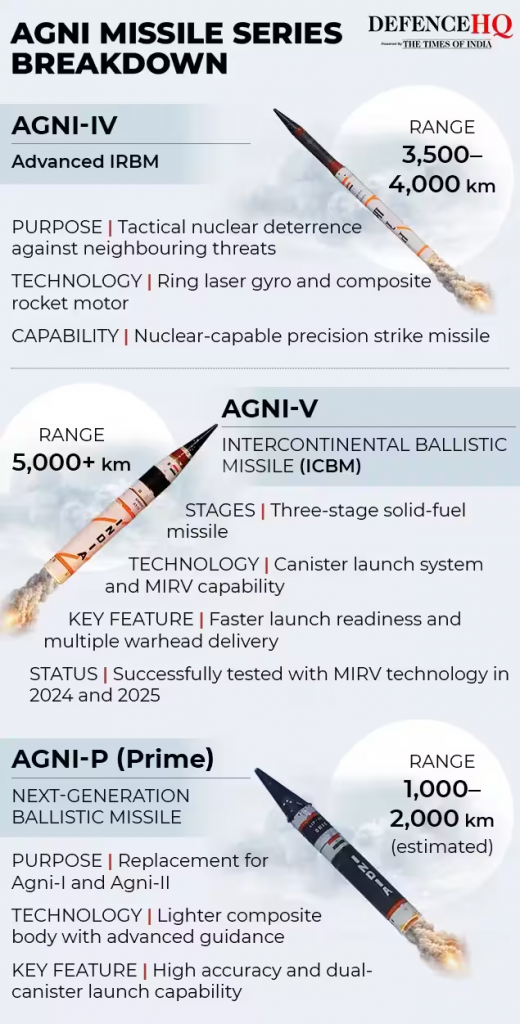
- Agni-4 is a two stage surface-to-surface nuclear-capable ballistic missile powered by solid-fuel rocket motors.
- It has a strike range of up to 4,000 km and forms a vital component of India’s strategic deterrence capability.
- The missile is 20 metres long, 1.3 metres in diameter, weighs around 17 tonnes, and can carry a payload of about 1,000 kg.
- It can be launched from a road-mobile, self-contained launcher, enhancing its survivability and operational flexibility.
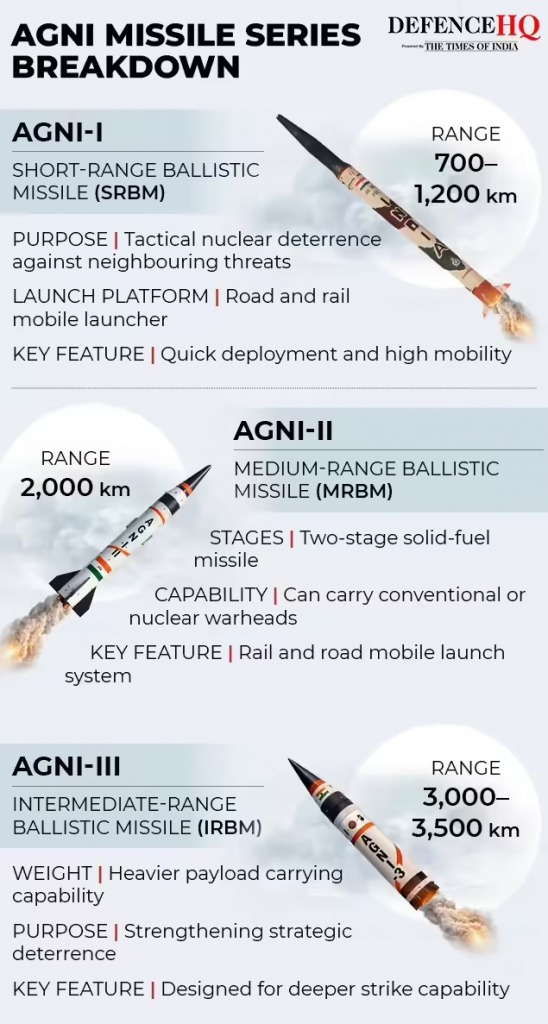
- Agni-4 forms part of India’s Agni series of ballistic missiles, which includes Agni-I, Agni-II, Agni-III, Agni-IV, Agni-V, and the newer Agni-Prime.
Source: TOI
Dr. M. S. Swaminathan Award for Environment Protection
Syllabus: Awards
In News
- P. Pechiyammal of Ramanathapuram and Govindhammal of Villupuram were given the Dr. M. S. Swaminathan Award for Environment Protection 2026.
Do you know?
- Pechiyammal was recognised for pioneering the collection of ghost fishing gear (abandoned fishing nets, nylon ropes and plastic waste) from coastal areas, a move that has helped reduce marine pollution.
- Govindhammal was recognised for her contribution toward promoting sustainable agriculture, empowering farmers with better seeds and improved farming practices.
Dr. M. S. Swaminathan Award for Environment Protection
- It was instituted by the Rotary Club of Madras East (RCME) in the name of its honorary member and agricultural scientist, the late M.S. Swaminathan.
- It is being supported by CavinKare Pvt. Ltd.
- It is presented to either an individual, a company, or an NGO that has contributed, either directly or indirectly, to enhancing environmental protection and awareness.
M. S. Swaminathan
- Birth and Early age: Born on 7 August 1925, Kumbakonam, Tamil Nadu
- He opted for agriculture rather than medicine after seeing the Bengal Famine (1942–43), believing that better crop varieties could change the lives of farmers and provide food security.
- Contributions:
- Green Revolution: He was instrumental in the Green Revolution in the 1960s and 70s that transformed India from food shortages and dependence on imports to self-sufficiency in food production.
- Scientific Efforts : He Started research at the Central Rice Research Institute (1954) on improvement of fertilizer responsiveness for developing high-yielding rice varieties.
- He Realised the need for semi-dwarf, fertilizer-responsive varieties of wheat that would not lodge.
- He worked with Norman E. Borlaug and Orville Vogel introduced Mexican dwarf wheat varieties, leading to the Wheat Revolution in India by the late 1960s.
- He was the first Indian to become Director General of the International Rice Research Institute, Philippines (1982-88), and his leadership was recognized with the first World Food Prize in 1987
- Conservation of the Environment: He worked extensively for mangrove restoration and conservation of coastal eco-system in Kendrapara district of Odisha.
- He Introduced the notion of trusteeship management of biosphere reserves 1999
- With support of the Global Environment Facility (GEF), helped establish the Gulf of Mannar Biosphere Reserve Trust.
- He advocated large scale mangrove plantation to protect coastal communities from future disasters after the 2004 Indian Ocean Tsunami.
- Welfare of farmers: As Chairman, National Commission on Farmers (2004-06) recommended that the MSP should be at least 50% above the weighted average cost of production (C2+50%) so that farmers get remunerative incomes.
- Awards : In 2024, he was conferred the Bharat Ratna posthumously.
- For his visionary leadership that propelled the Green Revolution to success, he was recognised as “Father of Economic Ecology” by the United Nations Environment Programme.
Source :TH
