


Uzbekistan
Syllabus: GS1/Geography
Context
- India and Uzbekistan have agreed to expand their strategic partnership.
About Uzbekistan
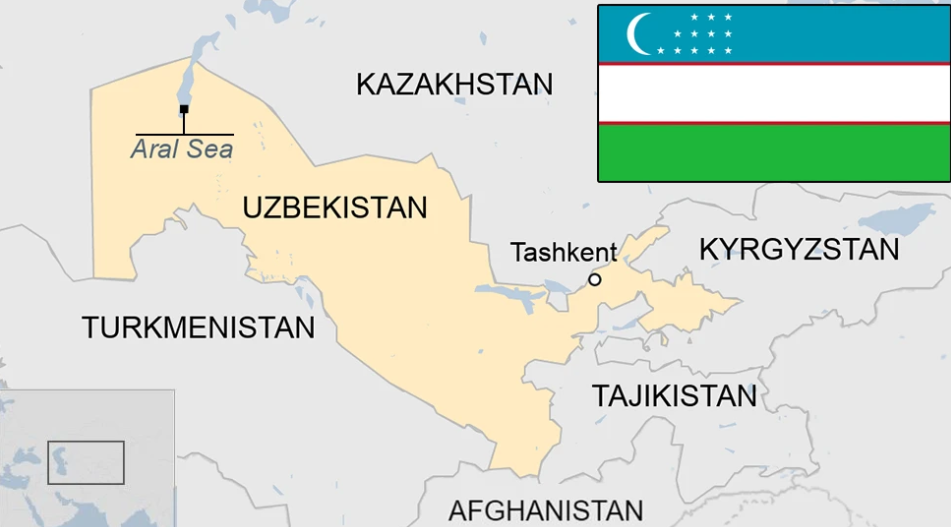
- Uzbekistan is Central Asia’s most populous country, with a population of 30.8 million people.
- It shares borders with Kazakhstan, Turkmenistan, Kyrgyzstan, Tajikistan, and Afghanistan.
- Along with Liechtenstein, it is one of the world’s only two doubly landlocked countries (all its neighbours are also landlocked).
- Its economy is largely dependent on commodity exports, making it vulnerable to fluctuations in global commodity prices.
- Tashkent is the capital and largest city.
- Major rivers: Amu Darya and Syr Darya.
Source: AIR
V2V Communication
Syllabus: GS2/Government Initiatives; GS3/Science and Technology
Context
- The Ministry of Road Transport and Highways (MoRTH) has released draft rules proposing mandatory Vehicle-to-Vehicle (V2V) communication systems in new vehicles from October 2028.
What is V2V Communication?
- V2V communication enables nearby vehicles to exchange real-time information, including their speed, position, direction, acceleration, etc. This information can provide advance warnings to drivers or vehicle systems in safety-critical situations, including sudden braking, forward-collision risk, unsafe lane changes and the approach of emergency vehicles.
- Unlike conventional vehicle-safety systems, which primarily depend on onboard sensors and driver reaction, V2V communication can provide information beyond the direct line of sight.
- It is therefore expected to complement Advanced Driver Assistance Systems (ADAS) and support proactive accident prevention, connected mobility and future intelligent transport applications.
Do you know?
- A total of 4,80,583 road accidents were recorded in India in 2023, resulting in 1,72,890 deaths.
Source: PIB
The Bankers’ Books Evidence Bill, 2026
Syllabus: GS3/ Economy
Context
- The Bankers’ Books Evidence Bill, 2026 was passed in Lok Sabha.
About
- The Bill seeks to repeal and replace the Bankers’ Books Evidence Act, 1891.
- The Act provides for certified copies of bank records to be used as evidence in legal proceedings without requiring production of the original records.
Key Provisions of the Bill
- Admissibility of electronic records: An electronic or digital record of a banker’s book will be admissible, valid, and legally enforceable as evidence, subject to certain conditions. These include:
- The said copy is a true copy of such entry or information, and correctly represents or is appropriately derived from such records,
- No unauthorised change of data is observed or detected, and
- No tampering with the system or other event which may be essential for establishing integrity and accuracy.
- Application to other entities in the financial sector: The Act applies to entities engaged in the business of banking and any post office savings bank or money order office. The Bill retains this.
- It further empowers the central government to extend the provisions of the Bill to any entity or class of entities operating in the financial sector, by notification.
MSME Sustainable ZED Certification Scheme
Syllabus: GS3/Economy
In News
- The Ministry of Micro, Small and Medium Enterprises (MSME) is promoting quality-driven and environmentally sustainable manufacturing through the MSME Sustainable (Zero Defect, Zero Effect – ZED) Certification Scheme.
MSME Sustainable ZED Certification Scheme
- It encourages MSMEs to manufacture high-quality products while minimizing their environmental impact.
- It supports enterprises in continuously improving their technology, systems, and manufacturing practices to enhance quality, productivity, and sustainability.
- All MSMEs registered with the UDYAM registration portal (of the MoMSME) will be eligible to participate in MSME Sustainable (ZED) Certification and avail related benefits/incentives.
Benefits
- It offers Bronze, Silver and Gold certifications, allowing MSMEs to progressively improve their quality and sustainability standards.
- Eligible enterprises can avail financial assistance of up to 75 per cent of the cost of testing, system or product certification (up to ₹50,000), ₹2 lakh for consultancy and handholding support, and ₹3 lakh for adopting cleaner technologies, pollution-control measures and Zero Effect solutions.
- It is encouraging women entrepreneurs, with the government providing a 100 per cent subsidy on the cost of ZED certification for women-owned MSMEs since November 2023.
Source: DD
Merchant Discount Rate (MDR) on UPI Transactions
Syllabus: GS3/ Indian Economy
Context
- The Reserve Bank of India Governor said that “someone will have to pay the cost” of UPI transactions, which are currently free for merchants and customers.
What is Merchant Discount Rate (MDR)?
- Merchant Discount Rate (MDR) is the charge paid by the merchants to banks/payment service providers for digital payments transactions.
- It is generally calculated as a percentage of the transaction value and is shared among banks, payment service providers, and payment networks.
- To promote digital payments, the Government has recommended Zero MDR on UPI and RuPay debit card transactions from January 2020.
Why is MDR on UPI Being Considered?
- UPI has become the world’s largest real-time payment system and so operational costs have gone up sharply.
- Banks and payment service providers incur cost on:
- Payments processing and settlement.
- Cybersecurity and fraud management.
- Maintenance of network and server infrastructure.
- Innovation and technological advancements.
- The current paradigm is financially challenging because only half of these costs are covered by government incentive payments.
- The UPI platform currently costs about ₹0.4-1 per transaction to operate and maintain and there were around 24,161.69 crore UPI transactions conducted in 2025-26.
Source: TH
Creators Economy of India
Syllabus: GS3/ Economy
Context
- PM Modi said that India has an extraordinary pool of creative talent, which can be leveraged to strengthen the country’s position as a global hub for content creation.
What is Creators Economy (Orange Economy)?
- Refers to the ecosystem where individuals (content creators) use digital platforms to create, distribute, and monetise content, skills, or influence directly to audiences often without traditional intermediaries.
- Key Components of a Creators Economy:
- Creators: YouTubers, podcasters, bloggers, influencers, educators, gamers, artists.
- Platforms: YouTube, Instagram, X etc.
- Monetisation Tools: Ads, brand sponsorships, subscriptions, tips, NFTs, merchandise.
- Audiences/Communities: Followers, subscribers, niche communities.
- Enablers: Payment gateways, analytics tools, AI tools, creator management agencies.
Steps Taken by the Government to Promote Creative Economy
- The World Audio Visual & Entertainment Summit (WAVES) 2025: The primary objective of WAVES was to give a fillip to India’s orange economy by integrating content, creativity and culture into a structured engine of economic growth and global influence.
- Indian Institute of Creative Technologies (IICT): To institutionalise skilling and innovation, the Government has established the IICT, Mumbai as a National Centre of Excellence for Animation, Visual Effects, Gaming, Comics, and Extended Reality (AVGC-XR).
- Strategic Integration of Creators and Digital Talent: Prasar Bharati is actively integrating digital creators into public service broadcasting to foster a more inclusive digital economy.
- The “Creator’s Corner,” which airs on DD News and DD National, provides national exposure to micro-influencers and emerging voices.
Clouded Leopard Conservation Action Plan (CAP)
Syllabus: GS3/Environment
In News
- Recently, the Clouded Leopard Conservation Action Plan (CAP) was launched on the occasion of International Clouded Leopard Day (4th August).
Clouded Leopard (Neofelis Nebulosa)
- Characteristics: It is a medium-sized, highly arboreal wild cat, known for its large cloud-shaped markings, long canine teeth, and exceptionally long tail.
- It is a nocturnal hunter that feeds on a variety of arboreal and terrestrial prey, including deer, primates, porcupines, pangolins and squirrels.
- Habitat and Distribution: It is found mainly in primary tropical forests but also in secondary forests, dry forests, mangroves and above 3,500 m in the Himalayas.
- It occurs from the Himalayan foothills of Nepal across Mainland Southeast Asia to China.
- It is extinct in Taiwan, and in Vietnam, China, and Bangladesh its populations are critically low and close to local extinction (extirpation).
- Threats: Habitat loss and fragmentation caused by rapid deforestation and infrastructure development, but the biggest drivers of population decline remain illegal hunting and snaring for the wildlife trade.
- Conservation Actions: It is included on CITES Appendix I
- The IUCN Red List of Threatened Species lists Clouded Leopard as Vulnerable.
Clouded Leopard Conservation Action Plan (CAP)
- It is prepared under the Government of India–GEF–UNDP initiative.
- It provides a comprehensive framework for securing habitats, restoring forest connectivity, strengthening scientific monitoring, and empowering local communities for conservation of the species.
- The action plan identifies 14 priority conservation landscapes across Northeast India, along with landscape-scale habitat restoration and corridor conservation to strengthen connectivity between forest habitats.
Source: PIB
Previous article
The World Development Report 2026
Next article
National Handloom Day 2026
