


Syllabus: GS3/Cybersecurity
Context
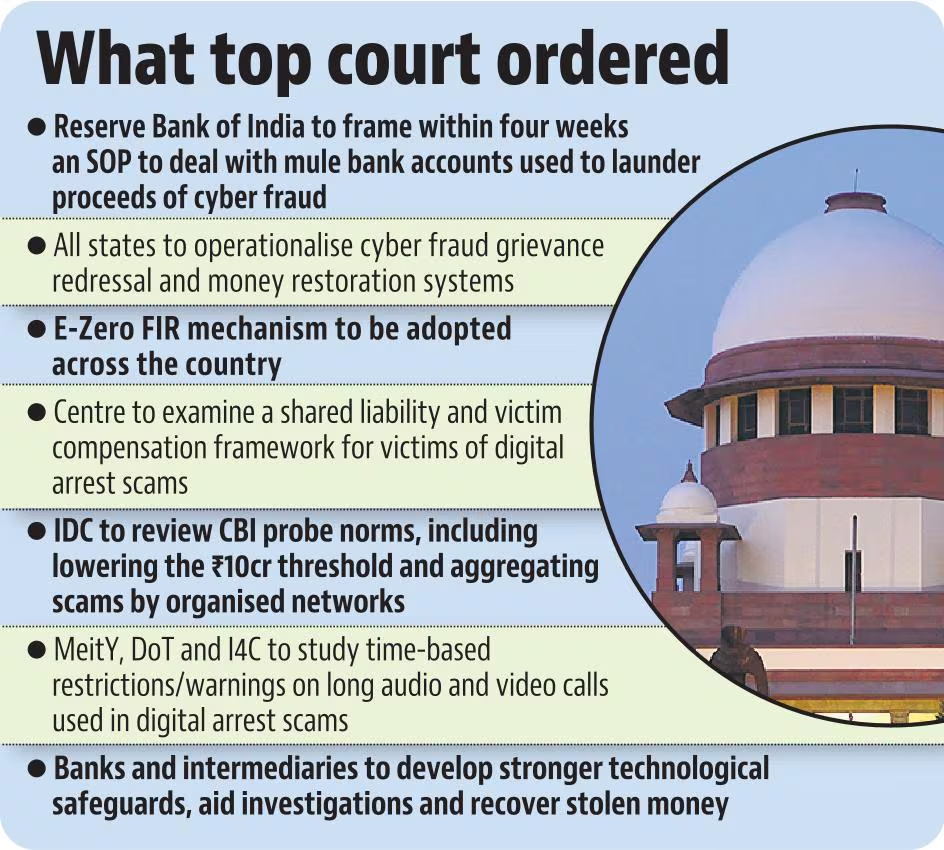
- The Supreme Court passed a detailed order directing the Centre, States, the Reserve Bank of India and telecom authorities to prepare standard operating procedures (SOPs) to curb “digital arrests” scams.
What is Digital Arrest Scams?
- A digital arrest is a cyber extortion scam where fraudsters impersonate law enforcement or government officials, using fake video calls, staged studio backdrops, and forged legal documents to terrify victims into believing they face immediate imprisonment, forcing them to transfer money under extreme psychological pressure.
Main Challenges in Tackling the Scams
- High-Tech Tools: Use of deepfakes, number spoofing, encrypted messaging, and dark web data leaks makes attribution difficult.
- Psychological Pressure: Fraudsters exploit fear, urgency, and authority figures, especially targeting senior citizens.
- Instant Payment Rails: Rapid money transfers via UPI and online banking allow scammers to siphon funds before accounts can be frozen.
- Enforcement & Reporting Barriers: Delayed victim reporting due to fear or embarrassment, combined with cross-border legal challenges.
Impacts of These Scams
Key Supreme Court Directions
- Earlier, the Supreme Court tasked the Central Bureau of Investigation (CBI) with cracking down on ‘digital arrest’ scammers by giving the agency a “free hand” to launch an anti-corruption probe into bankers involved in the opening of mule accounts linked to cybercrimes.
- Primary Role for CBI: CBI authorized as the lead agency for digital arrest scams and all states directed to give general consent under the DSPE Act, 1946.
- The Supreme Court to directly order the CBI, overriding State consent, to conduct a pan-India investigation and hunt down scammers.
- The court directed the CBI to identify police officers from different States, and domain experts, to aid the investigation.
- Global Action: CBI tasked with coordinating with INTERPOL to dismantle overseas cyber syndicates.
- AI-Driven Financial Tracking: RBI was directed to respond to the use of Artificial Intelligence and Machine Learning to trace ‘layering’ or the moving of the proceeds of crime through multiple bank accounts to escape detection.
- Platform & Telecom Accountability: Digital platforms ordered to share data under IT Rules 2021, while the Telecom Department must enforce stricter SIM registration and KYC norms.
- Regional Integration: States and UTs instructed to operationalize regional cyber units linked directly to the Indian Cybercrime Coordination Centre (I4C).
Initiatives to Tackle Digital Arrest
- Indian Cyber Crime Coordination Centre (I4C): It provides a framework and ecosystem for Law Enforcement Agencies (LEAs) to deal with cyber crimes in a comprehensive and coordinated manner.
- ‘Joint Cyber Coordination Teams’ have been constituted for seven regions at Mewat, Jamtara, Ahmedabad, Hyderabad, Chandigarh, Visakhapatnam and Guwahati under the I4C.
- National Cyber Crime Reporting Portal: It is launched to enable the public to report incidents pertaining to all types of cyber crimes.
- A toll-free number 1930 has been operationalized to get assistance in lodging online cyber complaints.
- Anti-Spoofing Systems: DoT measures to identify and block incoming international calls disguised as domestic Indian numbers.
- Public Awareness: Regular alerts distributed through SMS, railway/airport displays, and the CyberDost initiative.
- National Cyber Crime Reporting Portal: It is launched to enable the public to report incidents pertaining to all types of cyber crimes.
- A toll-free number 1930 has been operationalized to get assistance in lodging online cyber complaints.
- The Citizen Financial Cyber Fraud Reporting and Management System module has also been launched for immediate reporting of financial frauds and to stop siphoning off funds by the fraudsters.
- Cyber Swachhta Kendra (Botnet Cleaning and Malware Analysis Centre): This initiative is aimed at creating awareness about botnet and malware infections and providing tools for detection and cleaning.
- It also provides cyber security tips and best practices for citizens and organisations.
Source: TH
Previous article
Indian Statistical Institute (ISI) Bill, 2026
