


Syllabus: GS1/ Society, GS3/ Economy
Context
- NITI Aayog, in its report “Reimagining Care: Strategies for Empowering Caregivers in Viksit Bharat @2047,” has advocated the setting up of a National Carer Council (NCC) to regulate, standardise and professionalise the caregiving services in India.
What is the Care Economy?
- Caregiving involves the physical, emotional, and social support provided to individuals who are unable to perform daily activities independently due to age, illness, or disability, according to the World Health Organisation.
- There are two types of caregivers – formal and informal.
- A formal caregiver, referred to as a personal care aid, is a professional who provides non-medical assistance and support to help older individuals, people with disabilities (PwDs), or patients with terminal or chronic illnesses with their daily activities.
- Informal caregivers can be family members, friends, or volunteers who take care of the elderly.
- The Indian care services market was valued at USD 29.62 billion in 2023 and is projected to grow at a compound annual growth rate (CAGR) of 13.76 per cent, reaching USD 72.31 billion by 2030.
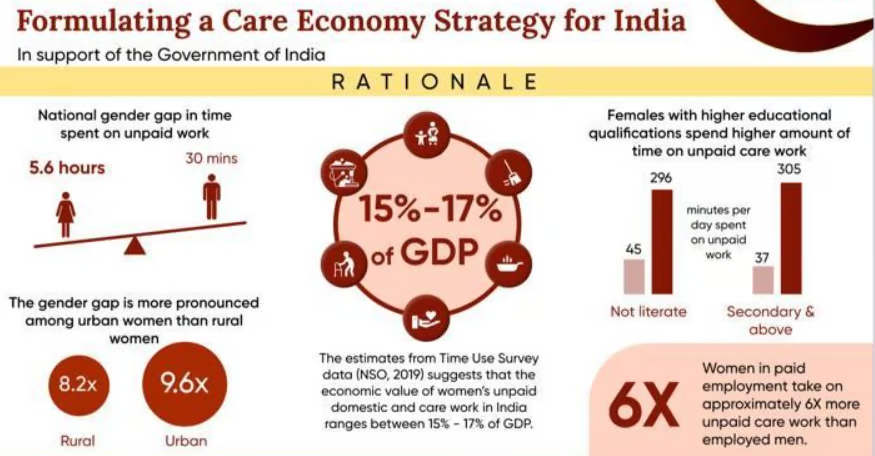
Why is the Demand for Care Services Rising?
- Demographic Transition: An expanding elderly population is creating the need for long-term eldercare services in India.
- Urbanisation and Migration: The joint family structures are being eroded because of rapid urbanisation and migration. Nuclear families are generally devoid of informal networks for caring support.
- Rising Female Workforce Participation: More women entering the workforce has increased the demand for organised childcare and caregiving services.
Government Initiatives Related to the Care Economy
- SHATAYU (Senior Holistic Care Assistance and Training for Your Utility) Dashboard: A Dashboard, developed to support and strengthen caregiving services for senior citizens across the country, was also launched during the National Workshop on “Creating a Well-Functioning Care Economy” in 2026.
- JEEVAN (Joint Elderly Empowerment & Virtual Assistance Network) Application: It is an accessible, citizen-facing mobile application engineered to serve as a single-window support ecosystem for senior citizens.
- The app consolidates information on government welfare schemes, senior citizen homes, and support services.
- Vayo Manasa Sanjeevani: It is an initiative to spread awareness and provide online education to promote mental health support among elderly persons and support healthy ageing.
Initiatives Taken by the State Government
- Geriatric Caregiver Training Programme: The Government of Odisha runs a 3-month certificate course, which provides training for extending physical and mental health support to elderly persons.
- Monthly Allowance for Unpaid Caregivers: Karnataka became the first state in India to introduce a scheme titled “Carer’s monthly allowance scheme” which provides a monthly allowance of Rs. 1,000 to parents of individuals with severe disabilities such as Cerebral palsy, muscular dystrophy, Parkinson’s disease, and multiple sclerosis.
Challenges in Implementing Care Economy Reforms
- Fiscal Constraints: The expansion of the care infrastructure and staff training will require significant public investment and a long-term commitment to funding.
- Social Attitudes to Care Work: Care work is still perceived as a private family responsibility and not a public policy issue. Societal patriarchal traditions that are highly ingrained curtail the acknowledgement of unpaid caring work.
- Weak Regulatory Capacity: Ensuring quality standards and monitoring care institutions across India is an administrative challenge.
- Lack of Skilled Care Workforce: India does not have a properly trained care workforce, particularly in the areas of eldercare, disability care and early children care.
Way Ahead
- Establish a National Caregiving Policy with adequate legal structure.
- Establish the National Carer Council as the highest regulating body.
- Scale up carer training initiatives across the country through public-private partnerships.
- Integrate caring with health, social protection and skills development programs.
Source: NITI AAYOG
Previous article
News In Short 05-08-2026
Next article
Indian Statistical Institute (ISI) Bill, 2026
