


Syllabus: GS2/Polity and Governance
Context
- A report by the Association for Democratic Reforms (ADR) and National Election Watch looks at the self-sworn election affidavits of all sitting CMs of 28 states and three Union territories.
Major Highlights
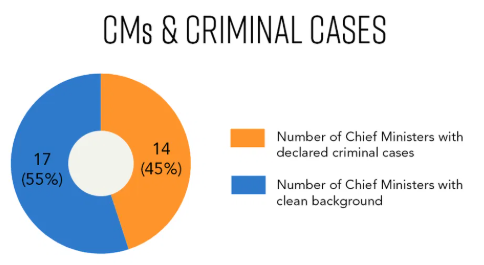
- 45% (14) of India’s current Chief Ministers have criminal cases lodged against them.
- Women Representation: Of the 31, only one, Delhi Chief Minister Rekha Gupta is a woman.
- In total, India has 390 female MLAs (9%) of the total 4123 representatives across state and UT assemblies.
- Educational Qualification: Nine (29%) are post-graduates, the largest single group followed by seven graduates (23%) and six graduate professionals (19%).
- Three CMs hold doctorates, while two have studied only up to Class 10.
Reasons of Criminalisation of Politics
- Weak Disqualification Laws: As per the Representation of the People Act, 1951 (RPA) disqualification of the candidates occurs only after conviction. Since trials take years, candidates contest multiple elections before any judgment.
- Money and Muscle Power: Candidates with financial resources and local influence are seen as “winnable” candidates.
- Low Voter Awareness: Affidavits disclose candidate details, but many voters remain unaware or vote on caste/religious lines.
- Party Complicity: Parties at times justify the candidature on the basis of popularity and electoral chances.
- Judicial Delays: Due to the frequent adjournments and long duration of judicial processes criminals escape conviction.
Impact of Criminalisation of Politics
- Erosion of Democratic Values: It undermines the principle of free and fair elections and voters are left with restricted choices, weakening the spirit of representative democracy.
- Corruption: The presence of criminal elements escalates electoral malpractices such as voter intimidation, booth capturing, and the use of black money in campaigns.
- Decline of Public Trust: Repeated election of tainted representatives, lead to declining voter turnout and weakening people’s faith in democratic institutions.
- Distortion of Policy-Making: Elected representatives use political power to protect personal and criminal networks and divert policy-making away from public interest.
Key Committee Recommendations
- Indrajit Gupta Committee (1998) & 2nd ARC (2007) recommended partial state funding of elections to curb the use of black money and reduce corruption.
- The National Commission to Review the Working of the Constitution in its 2002 report recommended measures to enhance the accountability of political parties, including the statutory audit of party expenses and the disclosure of candidates’ assets and liabilities.
- The Law Commission’s 244th Report (2014) recommended disqualifying politicians from contesting elections as soon as charges are framed against them for offenses that carry a maximum punishment of five years or more.
- The report specifically recommended expediting trials for sitting MPs and MLAs by establishing fast-track courts.
Supreme Court Interventions
- In Lily Thomas v. Union of India (2013), the Court ruled that any sitting MP, MLA, or MLC would be immediately disqualified upon conviction for a crime with a sentence of two years or more.
- In Public Interest Foundation v. Union of India (2018), the Court directed political parties to publicize the criminal records of candidates, detailing the nature of offences and charges.
- In 2020, the Supreme Court of India ordered political parties to publish details of candidates with pending criminal cases on their websites, social media, and in newspapers, along with the reasons for their selection, within 48 hours of candidate selection.
130th Constitution Amendment Bill
- Background: The bill was introduced in 2025 and was subsequently referred to a Joint Parliamentary Committee (JPC) following intense opposition protests.
- Major Features: The Bill provides for the removal of a minister if he/she is accused of an offence punishable with five or more years of imprisonment, and has been arrested and detained for 30 consecutive days.
- If the Prime Minister or a Chief Minister remains in custody for 30 consecutive days, they must resign; otherwise, they would automatically cease to hold office on the 31st day.
- The removal can be directed by the President or Governor upon the advice of the Prime Minister or the Chief Minister, respectively, or automatically on the 31st day of detention.
- At present, ministers leave office through resignation, dismissal by the Prime Minister or Chief Minister, or disqualification following conviction under existing laws.
Conclusion
- The criminal background of the elected representatives undermines democratic governance, weakens the rule of law, and erodes public trust in institutions.
- The issue needs to be addressed with the electoral reforms, speedy trials of the cases, transparency in political funding and informed voter participation.
Source: TH
Previous article
Cloudbursts In India
Next article
ILO Convention No. 193
