


Syllabus: GS3/Environment
Context
- Yale University released the Environmental Performance Index (EPI) 2026, ranking India 176th out of 177 countries. The report highlighted India’s ongoing environmental challenges and ignited a renewed discussion about its methodology and policy implications.
Environmental Performance Index (EPI)
- It is a biennial global index developed by the Yale Center for Environmental Law & Policy in collaboration with the Center for International Earth Science Information Network, Columbia University.
- Objective:
- It measures how effectively countries protect environmental health and ecosystem vitality.
- It offers a data-driven assessment of environmental consequences and policy effectiveness.
- It helps governments to identify priority areas for strengthening environmental governance.
Key Findings (EPI 2026)
- Estonia is the top ranked country with 74.79 while Laos is the lowest ranked.
- Many industrialised economies fared better due to more robust environmental legislation and institutional capabilities.
- Air pollution, loss of biodiversity and climate mitigation are still key worldwide concerns.
- Environmental quality is evaluated in areas such as air quality, climate change, biodiversity, water resources, agriculture, fisheries, waste management and sanitation.
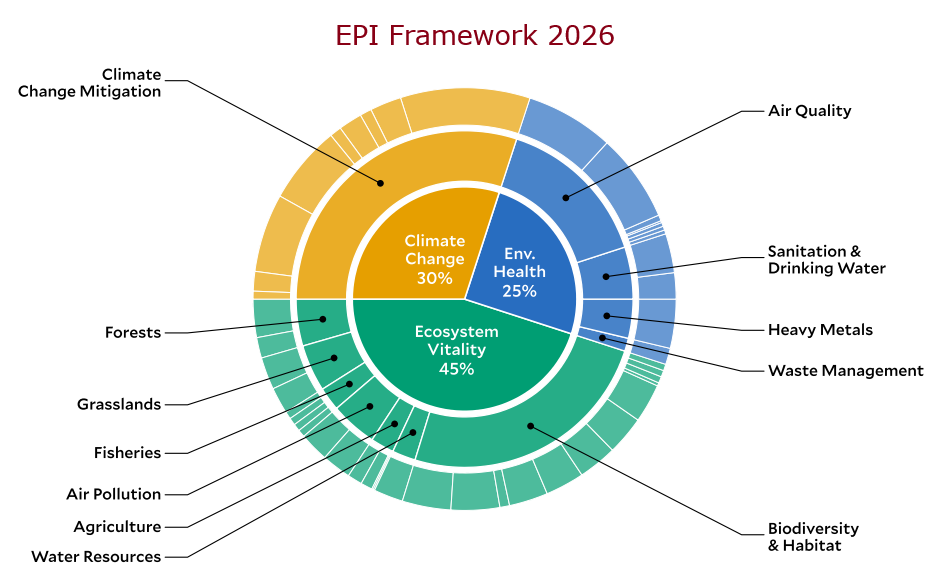
Findings Related to India (2026)
- India is 176th out of 177 countries with a score of 22.46.
- Earlier, India ranked 141st in 2016, 177th in 2018, 168th in 2020, 180th in 2022 and 176th in 2024.
- Key Observations:
- India has been among the five worst-performing countries since 2022.
- India faces the challenge of reconciling economic development with energy access and environmental sustainability, the research said.
- Air quality, biodiversity and greenhouse gas emissions continue to be pressured by growing urbanisation and industrialisation.
Areas Showing Improvement
- Climate Change (130th place): It has improved by 13.98 points over the last decade.
- It shows progress on expanding renewable energy, improving energy efficiency and implementing regulations on climate change.
- Waste Management (Rank 141st): Progress in municipal trash management programmes and Swachh Bharat Mission.
- Sanitation (Rank 141st): Expansion of sanitation infrastructure and improved access to toilets contributed positively.
Major Areas of Concern
- Air Quality (Rank 174th): The air quality score has slipped a bit in the last decade despite the National Clean Air Programme (NCAP).
- Major sources include emissions from vehicles, coal-based power generation, industrial pollutants, construction-related dust and biomass burning.
- Biodiversity (Rank 174): Major issues continue with habitat destruction, deforestation, infrastructural growth and ecosystem fragmentation.
- Tree Cover: Performance declining in the decade due to diversion of forest and land-use changes.
- Fisheries: Sustainability indicators are going down because of overexploitation and degradation of aquatic habitats.
- Pesticide Pollution: The continued dependency on chemical-intensive agriculture has led to poor environmental performance.
- Urban Environmental Management: In many towns the treatment of waste water and the control of pollution are still inadequate.
Related Efforts in India
- Constitutional Provisions:
- Article 48A: Protection and improvement of the environment.
- Article 51A(g): Duty to protect the natural environment.
- Government Initiatives:
- National Clean Air Programme (NCAP)
- National Action Plan on Climate Change (NAPCC)
- Swachh Bharat Mission
- Namami Gange Programme Green India Mission National Biodiversity Action Plan
- CAMPA Fund
- Jal Jeevan Mission
- The Plastic Waste Management Rules – Extended Producer Responsibility (EPR)
- Mission LiFE (Lifestyle for Environment)
Related Global Efforts
- Paris Agreement (2015)
- UN Sustainable Development Goals (SDGs) with special emphasis on SDGs 6, 11, 12, 13, 14 and 15
- Convention on Biological Diversity (CBD)
- Global Biodiversity Framework Kunming–Montreal (2022)
- United Nations Framework Convention on Climate Change (UNFCCC)
- Ramsar Convention on Wetlands
- The Montreal Protocol and the Kigali Amendment
- UN Decade of Ecosystem Restoration (2021-2030)
Way Forward
- Enhance monitoring and enforcement to improve the enforcement of environmental regulations.
- Speed up the shift to clean energy and decrease dependence on fossil fuels.
- Cleaner transport, regulation of industrial emissions and dust management to improve urban air quality
- Enhance wastewater treatment and integrated urban waste management.
- Promote sustainable agriculture . Reduce the excessive use of pesticides and promote natural farming practices .
- Expand ecosystem restoration, afforestation and biodiversity conservation activities.
- Enhanced environmental data quality, transparency and outcome-based monitoring.
- Integrate environmental sustainability into development planning to guarantee balanced and inclusive growth.
Next article
News In Short 31-07-2026
