


Cauvery River
Syllabus: GS1/Geography
Context
- Tamil Nadu Chief Minister has urged PM to ensure that no statutory or administrative approval is granted to Karnataka’s proposed Mekedatu project unless it is consistent with the Cauvery Water Disputes Tribunal (2007) award and the Supreme Court’s 2018 judgment on Cauvery water sharing.
About Cauvery River
- The Cauvery is an inter-State river in southern India and one of the major east-flowing peninsular rivers that drains into the Bay of Bengal.
- It originates at Talakaveri in the Brahmagiri Hills of the Western Ghats in Kodagu (Coorg) district, Karnataka.
- The Cauvery basin extends across Karnataka, Tamil Nadu, Kerala, and the Union Territory of Puducherry, covering an area of about 81,155 sq. km.
- The river has a total length of about 800 km.
- Major Tributaries
- Left-bank tributaries: Harangi, Hemavati, Shimsha and Arkavati.
- Right-bank tributaries: Lakshmantirtha, Kabbani, Suvarnavati, Bhavani, Noyil and Amaravati.
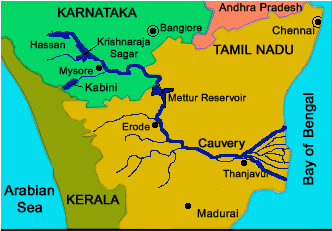
Source: TH
PM CARES Fund
Syllabus: GS2/Governance/GS3/Economy
In News
- The PM CARES Fund has not made public any audited financial statements since its last disclosure for Financial Year 2022-23.
PM CARES Fund
- The Prime Minister’s Citizen Assistance and Relief in Emergency Situations (PM CARES) Fund is a public charitable trust.
- It was established in March 2020 to support relief efforts during public health emergencies and other disasters
- It is funded entirely through voluntary contributions, and it is audited by an independent auditor.
- The Prime Minister is the ex-officio Chairman of the PM CARES Fund, and the Minister of Defence, Minister of Home Affairs and Minister of Finance, Government of India are ex-officio Trustees of the Fund.
- Donations to the PM CARES Fund qualify for 100% deduction under Section 80G of the Income Tax Act, 1961 and are also eligible to be counted as CSR expenditure under the Companies Act, 2013.
- The Fund has also been granted exemption under the Foreign Contribution (Regulation) Act (FCRA), enabling it to receive donations from individuals and organisations based overseas through a designated foreign contribution account.
Objectives
- It aims to provide relief and assistance in public health emergencies, disasters and calamities;
- It aims to support research and other vital infrastructure, pharmaceutical facilities and healthcare infrastructure.
- It aims to provide financial aid and grants to affected individuals and communities.
Do you know?
- The Prime Minister’s Office (PMO) has refused to disclose details on the creation and operation of the PM CARES Fund, telling a Right to Information applicant that the fund is “not a public authority” under the ambit of the RTI Act, 2005.
- At present, PM CARES remains outside the ambit of the RTI Act, parliamentary scrutiny, and audit by the Comptroller and Auditor General.
Source: TH
Parliamentary Panel Recommends Polar Ambassador, Arctic Council Membership
Syllabus: GS2/IR
Context
- The Parliamentary Committee on External Affairs, in its report, has recommended that India should appoint a Polar Ambassador and seek full-fledged membership of the Arctic Council to strengthen its engagement in Arctic affairs.
About
- India is currently one of the 13 observer countries of the Arctic Council, which comprises of 8 nations that have landmass in the region.
- The observer countries do not have decision making powers. They also can’t make financial contributions or undertake research in the arctic directly.
Arctic Council
- It is an intergovernmental forum established to promote environmental protection, sustainable development, and scientific cooperation in the Arctic.
- It comprises eight Arctic States: Canada, Denmark, Finland, Iceland, Norway, Russia, Sweden, and the United States.
- It was established in 1996 through the Ottawa Declaration.
India’s Role in Arctic Research
- India, despite being a non-Arctic nation, plays an active role in Arctic research.
- National Centre for Polar and Ocean Research (NCPOR): India conducts scientific studies on climate patterns, marine biodiversity, and glacial dynamics.
- India’s Arctic Policy, titled India and the Arctic: Building a Partnership for Sustainable Development, was released by the Ministry of Earth Sciences in 2022.
- India established Himadri (in 2008), its research station in Svalbard, Norway, to study Arctic climate systems and their global impact.
Source: IE
Protection and Indemnity Cover under Bharat Maritime Insurance Pool (BMIP)
Syllabus: GS3/Economy
In News
- The Department of Financial Services (DFS) has launched India’s first sovereign-backed Protection and Indemnity insurance product under Bharat Maritime Insurance Pool (BMIP).
India’s first sovereign-backed Protection and Indemnity insurance product
- It is designed by the New India Assurance Company
- It provides financial protection against third-party liabilities, including Crew & Cargo liability, pollution liability, wreck removal, 24×7 port correspondent network with an indemnity limit up to $1.5 billion, through the combined capacity of the pool
Bharat Maritime Insurance Pool (BMIP)
- In April 2026, the Union Cabinet approved the setting up of the Bharat Maritime Insurance Pool (BMIP) with a sovereign guarantee of ₹12,980 crore to provide uninterrupted maritime insurance cover.
- It aims to provide cost-effective insurance to Indian-flagged/controlled vessels and ships carrying cargo to and from India, even in high-risk geopolitical areas.
- It deals with India’s dependence on foreign International Group of Protection & Indemnity (IGP&I) Clubs for third-party liability insurance.
Coverage
- It covers all major maritime risks including:
- Hull & Machinery
- Cargo Protection and Indemnity (P & I)
- War Risk
- The member insurers shall underwrite policies of a total underwriting capacity of Rs 950 crore.
Objectives
- BMIP mechanism ensures the continuity of maritime war risk insurance coverage
- It fosters the development of domestic underwriting capacity, and enhances confidence among India’s shipping and trade stakeholders.
- Extending the pool to include Protection and Indemnity coverage would further strengthen India’s maritime risk management framework and improve the resilience of its maritime insurance ecosystem.
Source: Air
Lavender Cultivation
Syllabus: GS3/Agriculture
Context
- Lavender cultivation is expanding in Jammu and Kashmir as farmers look for crops better suited to warmer winters, erratic rainfall and shrinking irrigation sources.
About
- In 1970, scientist Akhtar Hussain introduced lavender from Bulgaria to Jammu and Kashmir.
- Lavender is a perennial shrub that grows well on sloping land, needing only one or two irrigations during the growing season.
- It is naturally resistant to many pests and can continue flowering for nearly two decades after planting.
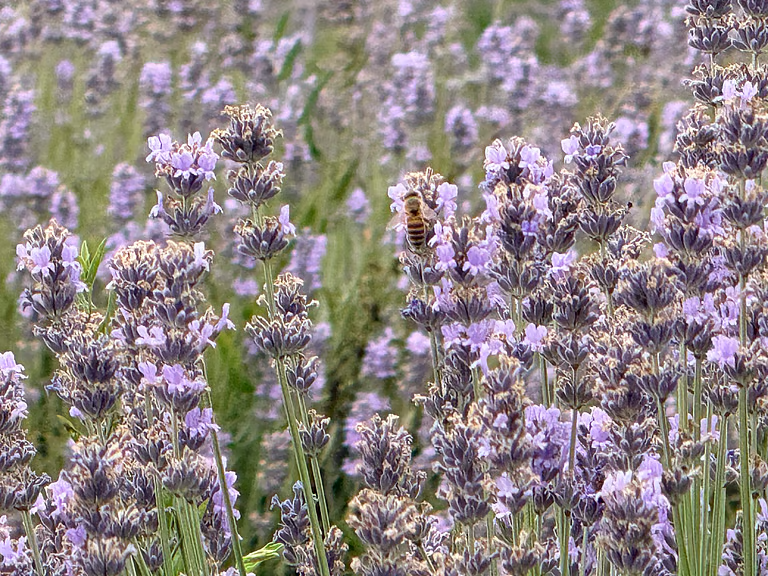
- CSIR developed an elite variety of lavender suitable for cultivation in temperate regions of J&K and provided free saplings and end-to-end agro-technologies to farmers.
- It also installed distillation units for essential oil extraction in several regions of J&K.
- The success of Lavender cultivation in J&K earned it the sobriquet, ‘Purple Revolution’.
- Significance: The crop is creating new income streams through essential oil, dried flowers, lavender honey.
- Lavender has also created opportunities for women in rural Jammu and Kashmir.
- The crop has also created a seasonal tourism economy, every summer, blooming lavender fields in Bhaderwah attract visitors, photographers and researchers.
Source: DTE
AI Palletising Technology
Syllabus: GS3/ S&T
In News
- AI-powered palletising is gaining traction as warehouses automate repetitive lifting and sorting. Future Market Insights projects the market to reach $9 billion by 2036.
About
- AI palletising and depalletising refers to the use of AI, computer vision, machine learning and robotic arms to automate the stacking of goods onto pallets and the unloading of goods from pallets.
- Traditional robotic palletisers have been widely used in manufacturing for decades. However, these systems generally follow fixed programming and work best when handling products of uniform size and shape. They struggle when warehouses process mixed cartons, irregular packaging or damaged boxes.
- AI-powered palletising systems are designed to address these limitations. They combine robotic arms with computer vision, AI software and machine learning algorithms to recognise different products, calculate gripping points and determine the safest stacking pattern without requiring manual reprogramming for every change in package configuration.

Source: BS
India’s First Telecom Manufacturing Zone (TMZ)
Syllabus: GS3/ Economy
In News
- Recently, the Department of Telecommunications and the Madhya Pradesh government signed an agreement to set up India’s first dedicated Telecom Manufacturing Zone (TMZ) in Gwalior.
About
- It is a 350-acre industrial campus where a company doesn’t just assemble telecom equipment, it can design the product, test it in an on-site lab, get it certified, and manufacture it, all without leaving the zone.
- It is the “plug-and-play” idea behind the TMZ. A Special Purpose Vehicle (SPV) would be established with Madhya Pradesh holding 51% and the DoT holding 49%.
- The zone is meant to cover the entire telecom value chain like handsets, optical fibre cables, antennas, routers, satellite communication equipment, and even semiconductor chips.
- The project is expected to attract investments worth around Rs 3,500 crore while creating significant employment opportunities in the state.
Source: AIR
Houbara Bustards
Syllabus: GS3/ Species In News
In News
- Uzbekistan, Kazakhstan, and the UAE are coordinating to release 672 captive-bred birds into the Aral Sea region in Karakalpakstan.
About Houbara Bustards
- Asian Houbara (Chlamydotis macqueenii), sometimes called MacQueen’s Bustard.
- It belongs to the bustard family — the same family as India’s Great Indian Bustard, though the two are quite different in terms of how threatened they are.
- They thrives in arid and semi-arid habitats, including sandy and rocky deserts, gravel plains, dry steppes, and open shrublands across Central Asia, the Middle East, North Africa, and parts of South Asia, particularly the Thar Desert and the Rann of Kutch.
- Its camouflage is so good like sandy-brown mottled feathers on top, pale underneath that it disappears against desert soil.
- Strong legs let it cover rough desert terrain at speed, and it only takes to the air when there’s no other option.
- Conservation Status:
- IUCN Red List: Vulnerable
- CITES: Appendix I (Strictly prohibiting international commercial trade)
- Convention on Migratory Species (CMS): Appendix I (Requires strict protection across migratory corridors).
Source: DTE
Previous article
India & Environmental Performance Index (EPI) 2026
