


Syllabus: GS1/Geography
In News
- Cloudbursts have become more common in the Himalayan states leading to flash floods, landslides and heavy loss of lives and property.
What is a Cloudburst?
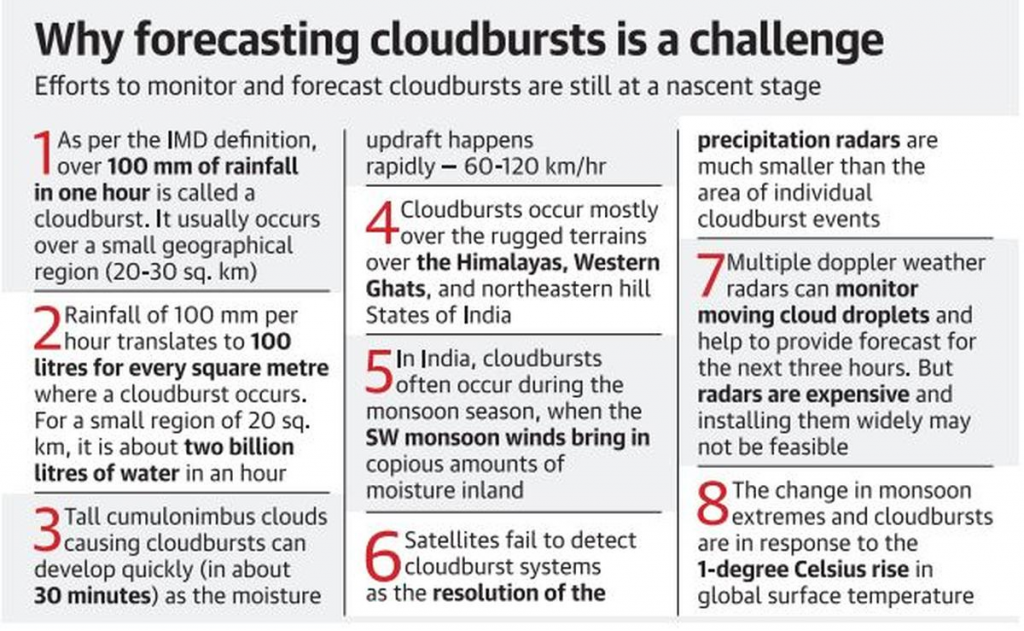
- India Meteorological Department (IMD) defines a cloudburst is a sudden release of downpour — an extreme weather event of rainfall over a small area (20-30 sq. km.); a rainfall of 100 mm or more in one hour recorded in a station.
- It is a severe weather event in which there is very heavy rain in a short period of time over a small area.
- These cloudburst events are mostly associated with westward-moving cyclonic circulations in the middle troposphere (implying a cold-core in the lower troposphere).
- The troposphere is the lower atmosphere, where almost all weather phenomena occur — stretching from the Earth’s surface to 18-20 kilometres high at the equator, only six km high at the poles.
- The orographic forcing and strong convection leading to the formation of deep cumulonimbus clouds as high as 15 km are responsible for most of the cloudburst events
Cloudbursts in India
- Cloudbursts are infrequent, but climate change is increasing their frequency as a warmer atmosphere can hold more moisture.
- The cloudbursts are mostly confined to the remote Himalayan and Western Ghats regions where there are few weather stations and rain gauges leading to under-reporting.
- There have been a spurt of cloudburst-like incidents in Uttarakhand, Himachal Pradesh and Jammu & Kashmir, especially during the July-August monsoon months.
- The India Meteorological Department (IMD) said that nearly 30 cloudbursts were officially recorded between 1970 and 2016, but experts say the real figure is far higher.
Why Do Mountain Regions Experience More Cloudbursts?
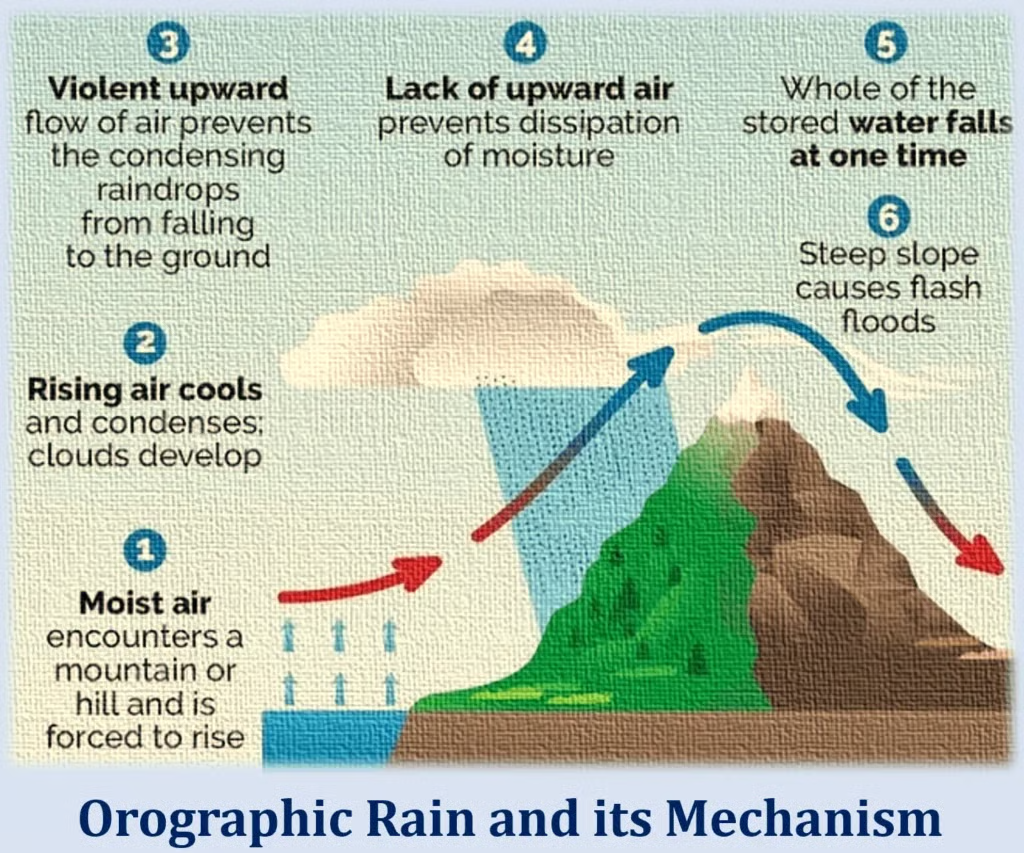
- Cloudbursts are more common in mountainous regions due to orographic lift, where warm, moisture-laden air is forced to rise along mountain slopes, cools, and condenses.
- Mountains create conditions of low pressure, leading to strong build-up of clouds and collisions of air that make rain heavier.
- Sometimes powerful upward drafts of air hold the rain away, and the raindrops grow larger and larger until they are too heavy to stay aloft.
- Then suddenly they fall in a short time, and there is a great cloudburst.
- Cloudbursts can also take place in plains but conditions are not so favourable as in hilly areas.
Effects of Cloudbursts
- Cloudbursts are the most intense end of the rainfall spectrum and cause flash floods
- Heavy rains destabilise mountain slopes causing landslides, mudflows and rockslides.
- Sediment and debris clog up river channels, increasing the risk of flooding downstream.
- Rapid floods do not leave enough time for evacuation, resulting in loss of life and displacement.
- Roads, bridges, power lines, communication networks and homes are badly damaged or washed away.
- Crops, fertile topsoil and farmlands are destroyed due to floods and erosion and the livelihood of farmers is affected.
Challenges to Forecast Cloudbursts
- Localised: Cloudbursts happen in very small areas, smaller than the grid size used in most weather models, so it is hard to get the prediction right.
- Fast development – Cloudbursts develop and intensify very quickly, giving very little lead time for forecasting.
- Mountain challenges: Doppler radar signals are blocked by hilly terrain and there are fewer automatic weather stations so data are missing.
- Computational limits: Accurate forecasting needs high-resolution weather models and vast amounts of computing power.
Do you know?
The India Meteorological Department (IMD) is enhancing nowcasting (short-term weather alerts), and Mission Mausam aims to expand the radar network and leverage AI for better hyperlocal forecasts.
Measures for Cloudburst Risk Mitigation
- Strengthen Early Warning Systems: Deploy more Automatic Weather Stations (AWS), Doppler radars and satellite based monitoring especially in the Himalayas to provide timely forecasts and evacuation warnings.
- Use Nature-based Solutions : “Restore wetlands, forests, mangroves and natural floodplains to absorb floodwaters, reduce runoff, prevent landslides and stabilise slopes.
- Climate-resilient Planning: Incorporate climate adaptation into urban and rural planning through risk assessments, resilient infrastructure development and dedicated climate finance.
- Community based Disaster Management: Integrate traditional knowledge and scientific early warning systems to better prepare and respond by involving local communities.
- Research and Regional Cooperation: Build resilience to disaster by investing in climate research, innovative resilience technologies and regional collaboration with neighbouring Himalayan countries.
Conclusion
- Cloudbursts are natural meteorological phenomena driven by the mountain topography and dynamics of the atmosphere.
- But their destructive capacity is much amplified by human actions such as unplanned urban development, destabilisation of slopes and climate change.
- Although cloudbursts cannot be prevented, better real-time forecasting, respect for ecological boundaries in vulnerable mountain areas and empowerment of local communities will help to ensure that these extreme weather events do not become human tragedies.
Source :TH
Previous article
News In Short 30-07-2026
Next article
Criminalisation of Politics
