

Syllabus: GS2/Judiciary; E-Governance
Context
- The Supreme Court (SC) recently released the draft of Regulations for Use of Artificial Intelligence (AI) in Courts, 2026, aimed at developing a governance framework for use of AI in the judiciary.
About
- The Draft Regulations will come into force for the SC on any date notified by the Chief Justice of India.
- For High Courts and courts and tribunals under their jurisdiction, they will come into force separately on the dates notified by that High Court’s Chief Justice.
- Different provisions can be brought into force on different dates, meaning that AI adoption can be further phased to suit the courts’ requirements and circumstances.
Major Highlights of the Regulations
- It permits the use of AI for administrative functions such as case management, preparation of cause lists, scheduling of hearings, transcription of court proceedings and translation of judgments.
- AI systems cannot be used for “risk scoring” in court processes, this includes assessing flight risk, predicting recidivism, evaluating bail eligibility, or determining the credibility of parties or witnesses.
- The processing of personal data through AI systems shall be governed by the provisions of the Digital Personal Data Protection Act, 2023.
- To supervise the adoption of AI in the judiciary, it proposes the creation of a full-time “apex body” at the Supreme Court.
- The Centre of Research and Excellence on Artificial Intelligence (CoRE-AI), will evaluate tools and track developments to support the Apex Body.
- Inform Parties Involved: If a court uses an AI tool to “materially assist” it in any aspect of case management, document analysis, or judicial administration, it will be required to inform the parties in a timely and accessible manner.
- Cybersecurity Audits: Upon deployment, systems will face technical, legal, and ethical audits, as well as separate cybersecurity audits on the same cycle.
- These are to be conducted in-house, since source code and training data can never be shared with a third-party for audit purposes.
- Each Court will also be required to maintain an AI Register documenting approved systems and audit outcomes.
- Each high court will also be required to maintain an emergency fall-back protocol to keep court processes running manually if a system goes down.
- Grievances: The grievance route will apply specifically where harm results from a prohibited use of AI. An affected party can file an application at the earliest opportunity with the court where the relevant AI system was or is being used.
- That court must give the affected party a hearing and pass “appropriate orders as it may deem fit”.
Use of AI in India’s Justice System
- In the Supreme Court, High Courts, National Informatics Centre (NIC) AI tools are now assisting various functions such as:
- Transcription of oral arguments,
- Translation of judgments,
- Identification of defects in e-filing,
- Legal research, and
- Metadata extraction.
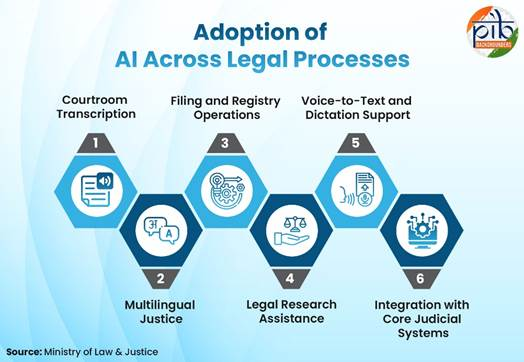
- Over the past decade, courts have moved from basic computerisation to nationwide digital platforms, real-time data systems, virtual courts and multilingual judgment access.
- Latest technologies like AI and its subsets Machine Learning (ML), Optical Character Recognition (OCR), Natural Language Processing (NLP) are being used in the e-Courts software applications developed under the eCourts Project.
Significance of Use of AI in Judiciary in India
- Backlog of Cases: India’s judicial system faces a backlog of cases, undermining public trust in timely justice. AI can streamline case management, reduce backlog, and speed up judicial processes.
- Overcrowding in Prisons: Indian prisons have been housing more inmates than their capacity for decades now, AI can streamline the complaint registration process, track investigations, flag necessary actions, and assess investigation quality.
- Translation and Accessibility: India has 22 scheduled languages and hundreds of dialects. AI-powered translation can make judicial documents and judgments accessible across linguistic barriers.
- The SUVAAS (Supreme Court Vidhik Anuvaad Software) project has translated thousands of judgments into regional languages.
- Enhanced Accuracy: AI can prevent neglect of crucial evidence and ensure a more meticulous and reliable criminal justice process.
- Improving Access to Justice: AI chatbots and virtual assistants can help litigants, especially those without legal representation, navigate procedures, track case status, and file petitions.
Concerns/Challanges
- Bias and Dependence: AI-enabled legal research may show search bias, excluding relevant precedents. Over-reliance risks reducing adjudication to rule-based outputs, sidelining nuanced human judgment.
- Data Protection and Privacy: Absence of clear frameworks on storage and use of judicial data raises concerns.
- Infrastructure Gaps: Courts face uneven Internet connectivity, outdated hardware, and limited technical expertise.
Way Ahead
- A balanced approach must be taken to ensure AI tools respect privacy, civil liberties, and ethical standards, while preventing misuse.
- By leveraging AI, India’s criminal justice system can become more efficient, accessible, and just, while ensuring safeguards are in place to address any challenges.
Source: IE
Previous article
CAG Audit Flags Diversion of DMFT Funds in Chhattisgarh
Next article
India’s First Hydrogen-Powered Train
