


Syllabus: GS3/Science and Technology
Context
- A new study published in Environmental Science & Technology may finally offer a way to efficiently clean tritiated water.
- The research team, from across China, achieved this using a metal-organic framework, work on which won the Nobel Prize for chemistry last year.
About
- In 2023, Japan began releasing treated wastewater from the ruined Fukushimanuclear power plant into the Pacific Ocean.
- The water had been filtered to remove most heavy radioactive elements, yet one particular contaminant remained: tritium.
- Tritium is easily absorbed by the bodies of living creatures and rapidly distributed via blood.
- Tritium is a radioactive isotope of hydrogen. When it bonds with oxygen, it forms tritiated water, or HTO.
- Because tritiated water is chemically almost identical to regular water, it is extremely difficult to separate the two.
- For many decades, officials in the global nuclear industry have opted to dilute tritiated water, i.e. mixing it in large quantities of regular water.
Current Methods of Removing Tritium
- The current most practical way to remove tritium from tritiated water is water distillation, i.e. boiling water and separating the components based on their slightly different boiling points.
- But the difference is so feeble that operators need a distillation tower hundreds of metres tall, which is expensive, uses large amounts of energy, and impractical for the millions of tonnes of water stored at Fukushima.
- Current distillation towers use systems called packings, these are the materials inside the tower that provide surfaces where steam and liquid can interact.
- Until now, these packings were passive: they just sat there and let gravity do the work.
- In the new study, the researchers made the packing material ‘active’.
- They coated a stainless-steel mesh with a metal-organic framework called NH2-MIL-101(Cr). A metal-organic framework is like a microscopic sponge.
- Adding NH2-MIL-101(Cr) increased the available area of the packing by 32-fold.
- The chromium-oxygen clusters inside the framework ‘grabbed’ tritium atoms from the liquid and swapped them with regular hydrogen atoms, with nitrogen and hydrogen attachments also facilitating this swapping.
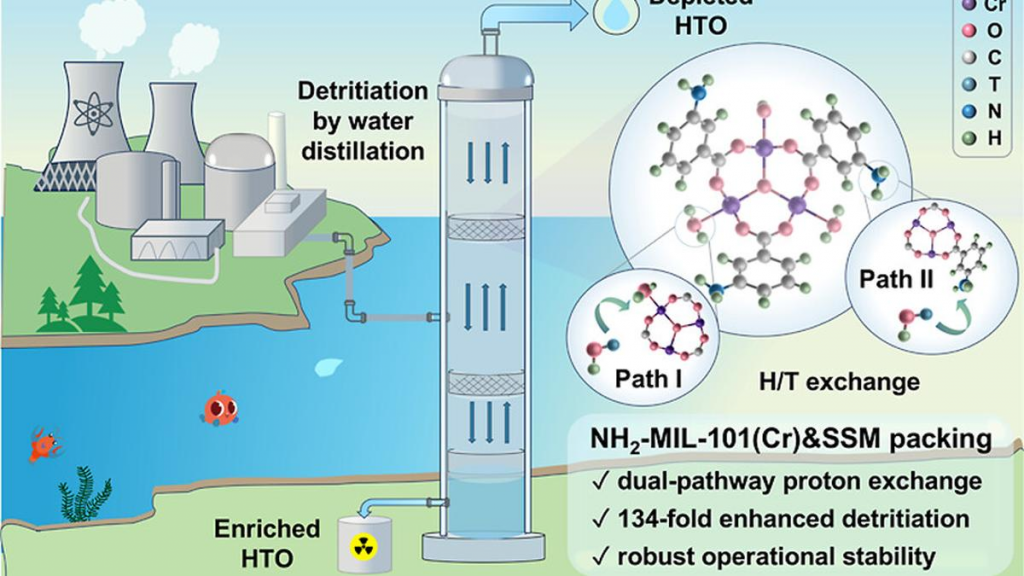
- Outcome: The modified packing achieved a separation efficiency of 42.5 theoretical plates per meter, a record-setting figure in the world of chemical engineering.
- At an industrial height of 10 m, the new material would be 134-times more effective than the current best-reported material.
- It is also one-million-times more effective than the standard commercial packings in the industry today.
- Significance:
- This strategy provides a new approach for improving the detritiation of tritiated water and reducing tritium releases to natural water bodies.
- The results highlight the potential of programmable porous materials to address challenging isotope-contaminant separations.
Nobel Prize in Chemistry 2025
- Susumu Kitagawa, Richard Robson and Omar Yaghi were awarded the Nobel Prize in Chemistry 2025.
- It was awarded for discovering and creating a class of materials, called metal-organic frameworks (MOF).
- Metal Organic Frameworks: MOFs are crystalline structures in which metal ions serve as nodes and organic molecules as connectors.
- The resulting structure can have enormous internal surface areas — thousands of square metres per gram — and their pores can be customised to attract or hold specific molecules.
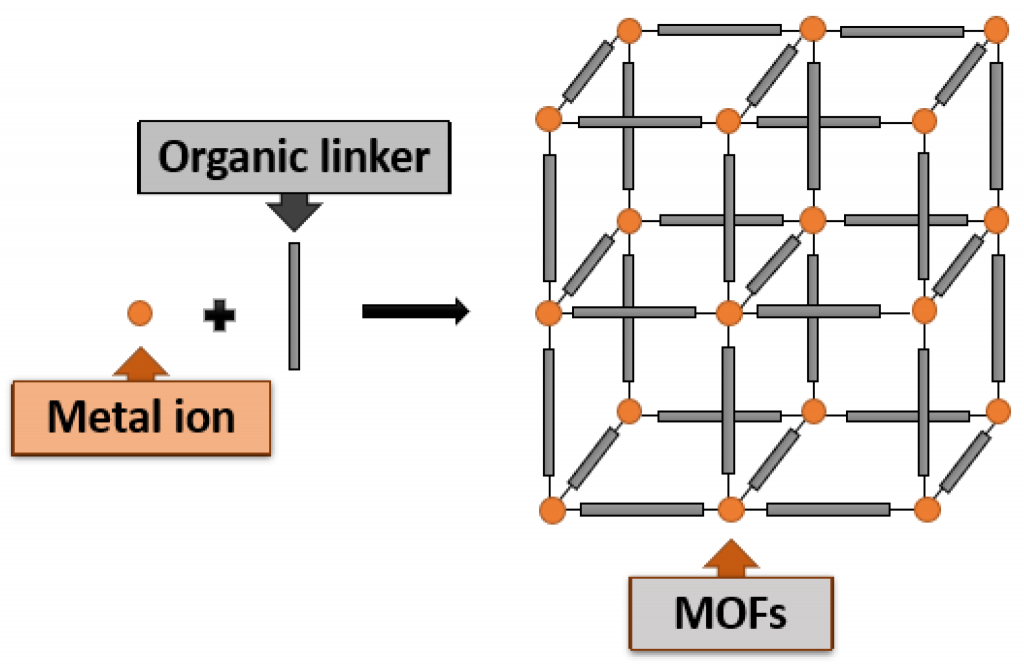
- MOFs form a three-dimensional network with large, porous cavities; this design allows gases and liquids to flow through, making MOFs highly adaptable for various applications.
- By carefully choosing the building blocks, researchers can control the size and shape of the cavities and the chemical environment within.
- As a result, MOFs are among the most versatile materials ever created.
The unique properties of MOFs have led to their application in various fields:
- Water harvesting: MOFs can extract water from dry air, offering a potential solution for water-scarce regions.
- Pollutant Removal: They can filter out harmful substances like PFAS from water, addressing environmental contamination.
- Carbon capture: MOFs are effective in capturing carbon dioxide, aiding in efforts to mitigate climate change.
- Hydrogen storage: Their porous nature allows for the safe storage of hydrogen, crucial for clean energy applications.
Source: TH
Previous article
Draft National Health Research Policy 2026
