


Performance Grading Index 2.0
Syllabus: GS2/ Education
Context
- The Union Ministry of Education released the Report on Performance Grading Index 2.0 for States/UTs (PGI-S) and Performance Grading Index for Districts (PGI-D) for 2025-26.
Performance Grading Index 2.0 for States/UTs (PGI-S)
- The PGI- States/UTs structure comprises total weightage of 1000 points across 70 indicators, which are grouped under 2 Categories viz., Outcome category and Governance & Management category. These categories are further divided into 16 domains, viz.,
- Learning Outcomes and Quality,
- Access
- Infrastructure & Facilities,
- Equity,
- Governance Processes, and
- Teachers Education & Training.
- The framework is fully aligned with data from the Unified District Information System for Education Plus (UDISE+), PARAKH Rashtriya Sarvekshan 2024, PM POSHAN Portal, PRABAND Portal, and Vidyanjali Portal.
Performance Grading Index for Districts (PGI-D)
- The PGI-D framework comprises a total weightage of 600 points across 70 indicators, which are grouped under 6 categories viz., Outcomes, Effective Classroom Transaction, Infrastructure Facilities & Student Entitlements, School Safety & Child Protection, Digital Learning and Governance Process.
- These categories are further divided into 11 domains, viz.,
- Learning Outcomes and Quality (LOQ),
- Access Outcomes (AO),
- Teacher Availability and Professional Development Outcomes (TAPDO),
- Learning Management (LM),
- Learning Enrichment Activities (LEA),
- Infrastructure, Facilities, Student Entitlements (IF&SE),
- School Safety and Child Protection (SS&CP),
- Digital Learning (DL),
- Funds Convergence and Utilisation (FCU),
- Attendance Monitoring Systems (AMS) and
- School Leadership Development (SLD).
- The data for PGI-D are drawn from several sources, viz., Unified District Information System for Education Plus (UDISE +), PARAKH Rashtriya Sarvekshan 2024 (PRS 2024) and the PRABANDH Portal.
Source: PIB
Hummus Trail
Syllabus: GS2/IR
Context
- A rights organisation has filed a ‘war crimes’ complaint with India against an Israeli soldier spotted along ‘hummus trail’.
About
- The Hummus Trail is an informal term for a network of destinations in India that are especially popular among young Israeli travellers.
- These places often have Hebrew signboards, Israeli cafés, Chabad houses, and hostels, creating a familiar environment for visitors.
Background
- Every year, around 80,000 Israelis visit India, many after completing their mandatory military service.
- This long post-service journey, known as Tiul Gadol (“The Big Trip”), usually lasts 6–12 months and is considered a cultural rite of passage.
- In 2026, Israel allocated 4 million NIS to strengthen tourism cooperation with India.
Legal Aspect
- India is a party to the Fourth Geneva Convention.
- Under the Geneva Conventions Act, 1960, Indian courts can prosecute persons accused of grave breaches of the Geneva Conventions if they are found in India, regardless of where the alleged offence took place.
Key Features
- Major destinations include Kasol, Old Manali, Dharamkot, Pushkar, Goa, Hampi, Kerala, and the Andaman & Nicobar Islands.
- Many visitors use the trail as a period of rest and recovery after military service, including coping with combat-related stress.
- Some locations have also witnessed concerns over rave parties, drug abuse, and narcotics-related activities, prompting closer monitoring by authorities.
Source: IE
Guwahati Declaration
Syllabus: GS2/ Governance
In News
- Recently, the BRICS nations have adopted the Guwahati Declaration.
About
- The declaration called for closer cooperation among BRICS countries to address the evolving nature of illicit drug trafficking.
- They expressed concern over the proliferation of synthetic drugs and New Psychoactive Substances (NPS), misuse of emerging technologies and digital platforms, apart from the exploitation of maritime routes by transnational criminal syndicates.
- The Guwahati meeting brought together Brazil, China, Ethiopia, India, Indonesia, Iran, Russia and the United Arab Emirates.
Source: TH
What is the Right To Be Forgotten?
Syllabus: GS2/ Governance
In News
- The Delhi High Court has laid down the principles governing the right to be forgotten.
More about the News
- In Laksh Vir Singh Yadav v. Union of India, the court held that the right to be forgotten flows from Article 21’s guarantee of dignity and informational privacy.
- The HC followed the Supreme Court’s judgment in K.S. Puttaswamy v. Union of India (2017) that held privacy is a fundamental right under Article 21, including the right to informational privacy.
- The court said the structured proportionality test is that retention must have a legitimate purpose and that the harm to privacy must be balanced against the public interest.
What is the ‘right to be forgotten’?
- The “right to be forgotten” is the right to have information erased or de-indexed from the public digital environment when its continued accessibility is harmful and serves no public interest.
- The concept came to the fore in 2014, when a Spanish citizen, Mario Costeja González, complained to the European Court of Justice that Google continued to display an old newspaper notice about the auction of his repossessed house even though the debt had been settled.
- The court ruled in his favour, laying the groundwork for the right to erasure, which was later incorporated into Article 17 of the European Union’s General Data Protection Regulation (GDPR).
What are the challenges?
- De-indexing can benefit at the search level, but it won’t prevent mirrors, archive copies, or social media sharing.
- Without effective technical compliance and coordination among platforms, the right may remain largely symbolic.
Source: TH
Pinaka Long Range Guided Rocket (LRGR)
Syllabus: GS3/Defence
Context
- The DRDO successfully conducted the flight-test of the Pinaka Long Range Guided Rocket (LRGR) at the Integrated Test Range (ITR), Chandipur, Odisha.
About Pinaka
- Pinaka is an indigenous Multi Barrel Rocket Launching System (MBRL) named after the mythical bow of Lord Shiva.
- It was developed by the Defence Research and Development Organisation (DRDO) as a replacement for the Russian-origin Grad rocket system.
- The system was first used operationally during the Kargil War (1999).
Key Features
- An all-weather artillery rocket system with a strike range of about 120 km, capable of firing a salvo of 12 rockets in just 44 seconds.
- Designed with shoot-and-scoot capability, enabling quick relocation after firing to avoid enemy counterattacks.
Do you know?
- Pinaka has also achieved export success, with Armenia becoming its first foreign customer, while several other countries have expressed interest in procuring the system.
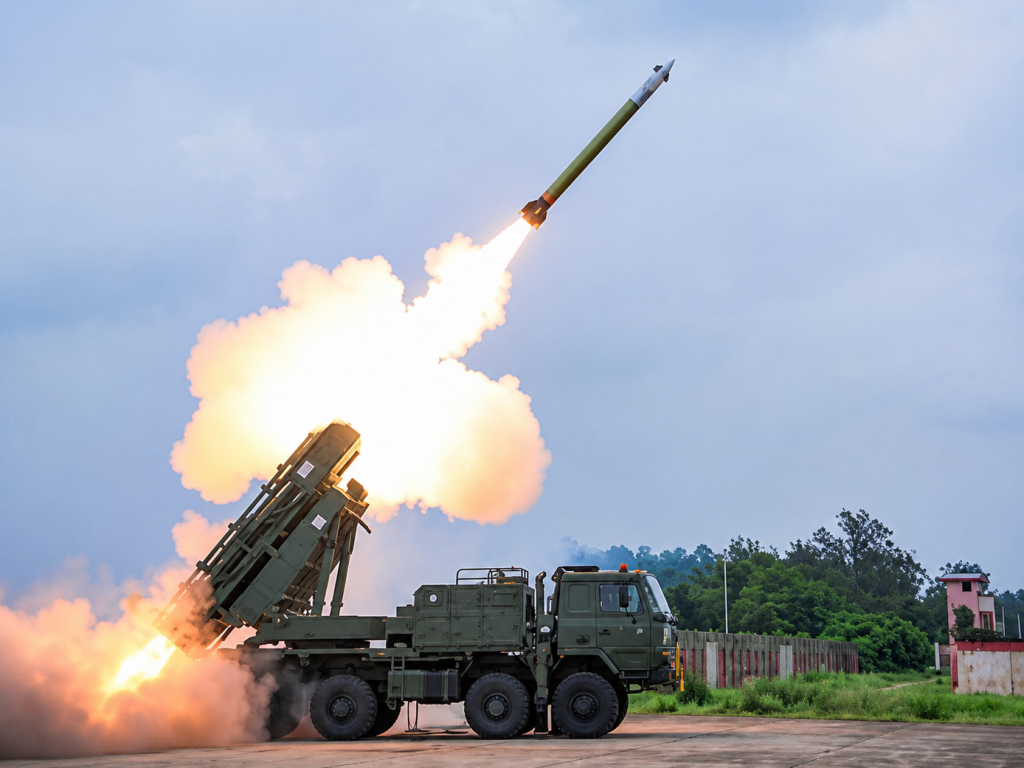
Source: DDNews
Astra Missile
Syllabus: GS3/Defence
Context
- Indonesia became the first country that signed a pact to import India’s ASTRA missiles.
- These missiles will arm Indonesia’s Su-30 fleet.
About the Astra Missile
- Developed by: Defence Research and Development Organisation (DRDO).
- Type: Advanced Beyond-Visual-Range Air-to-Air Missile (BVRAAM).
- Range: Capable of engaging aerial targets over 100 km away.
- Features:
- Advanced guidance and navigation systems for high precision.
- All-weather, day-and-night operational capability.
- Maximum speed: exceeds Mach 4.
- Operational ceiling: up to 20 km altitude.
- Significance: Enhances India’s indigenous air combat capabilities and aligns with Aatmanirbhar Bharat in defence production.

Source: IE
Durand Cup
Syllabus: Miscellaneous
Context
- The President of India, unveiled and flagged off the Trophies of the Durand Cup Tournament 2026.
About Durand Cup
- Established in 1888, the Durand Cup stands as Asia’s oldest and the world’s third-oldest football tournament.
- It is organized by the Indian Army on behalf of the three Services.
- The inaugural edition was held in Simla in 1888, before the tournament moved to New Delhi in 1940.
- The tournament champions receive three trophies: the Durand Cup and the Simla Trophy, both rolling honours, and the President’s Cup, crafted afresh each year and awarded for permanent keepsake.
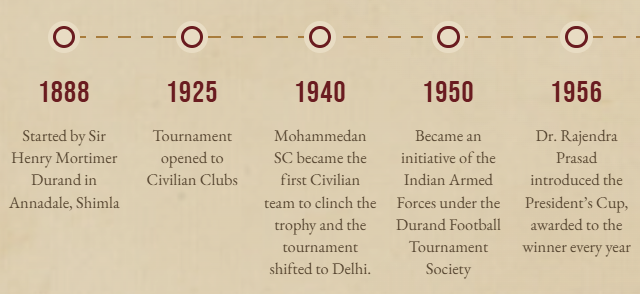
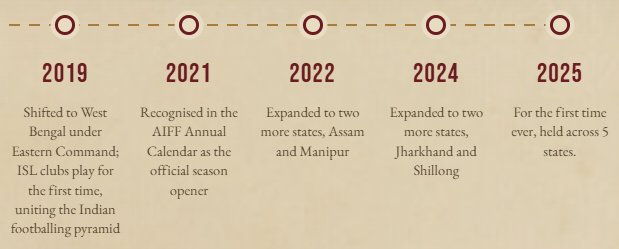
Source: PIB
Previous article
India’s Toy Ecosystem
Next article
Proposed Amendments to NFSA
