


Syllabus: GS3/Economy
Context
- The Union Finance Minister stated that India is building a globally competitive toy manufacturing ecosystem through higher quality standards, policy support, skilling, and improved market access.
India’s Toy Manufacturing Ecosystem
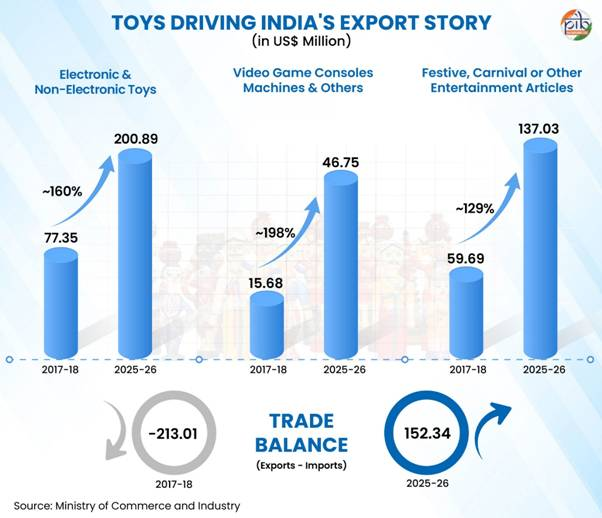
- India’s toy exports reached 186 million dollars in 2025-26 with Indian toys now reaching 153 countries.
- Toy imports have declined by 71% since 2019 reflecting the success of quality-focused and self-reliant manufacturing.
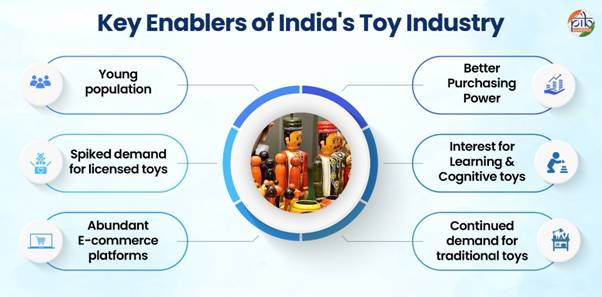
- India’s toy market is projected to reach five billion dollars by 2034.
- Employment in Games and Toys more than doubled, rising from 8,685 in 2018–19 to 17,693 in 2023–24.
Significance
- Import substitutions: Toy imports have fallen sharply since 2018-19 thereby reducing India’s dependence on Chinese manufacturers who earlier dominated over 80% of India’s toy market.
- Rise in Export growth: A shift from a net importer to a competitive exporter in select segments.
- Employment potential: Labour intensive sector offering employment opportunities to both men and women particularly in traditional toy making clusters like Channapatna (Karnataka) and Kondapalli (Andhra Pradesh).
- Role in cultural Soft power: Indigenous toys rooted in Indian mythology, freedom struggle themes and traditional games offer a channel for cultural soft power alongside economic gains.
- MSME driven growth: Over 90% of India’s toy manufacturing units are in the MSME sector this will align with the sector’s growth.
Government Initiatives
- National Action Plan for Toys (NAPT), 2020: NAPT was formulated to promote the design of toys based on Indian values, culture, and history.
- The initiative monitors the quality of toys and restricts imports of sub-standard and unsafe products.
- Quality Control Order (2020): It mandated BIS certification for toys to curb substandard and unsafe imports, particularly from China.
- Toy Biz International B2B Exhibition: The exhibition provides a platform for toy manufacturers to showcase their products to domestic and international buyers.
- Toycathon: Launched in 2021, Toycathon supports the vision of Atmanirbhar Bharat. It encourages collaborative development of innovative toys and games by students, teachers, designers, experts, and start-ups.
- To strengthen the electronic toy segment, the Government also organised the Electronic Toy Hackathon (e-Toycathon) for the first time in 2025.
- e-Toys Lab: The e-Toys Lab, established by the Ministry of Electronics and Information Technology (MeitY) at C-DAC, Noida, aims to strengthen India’s indigenous electronic toy industry.
- Manak Manthan: In 2026, BIS organized a Manak Manthan, it focused on the mechanical and physical safety requirements for toys. It is a BIS initiative aimed at promoting the adoption of Indian Standards across industries.
- ODOP (One District, One Product): The ODOP initiative aims to promote district-specific products by identifying, branding, and supporting unique products from each district of the country.
- Geographical Indication (GI) Tagged Toys: Several traditional Indian toys have received GI status, recognizing their unique craftsmanship and regional identity.
- GI Tagged toys include Channapatna Toys and dolls of Karnataka, Leather Toys of Indore, Madhya Pradesh, Thanjavur Doll of Tamil Nadu, etc.
- GST reduction: The reduction of GST on toys from 12% to 5% has made toys more affordable and accessible for consumers.
- Free Trade Agreements (FTA): India has signed trade agreements with UAE, Australia, European Union, Oman, United Kingdom and New Zealand, under these agreements, partner countries provide zero-duty market access for exports of Indian toys.
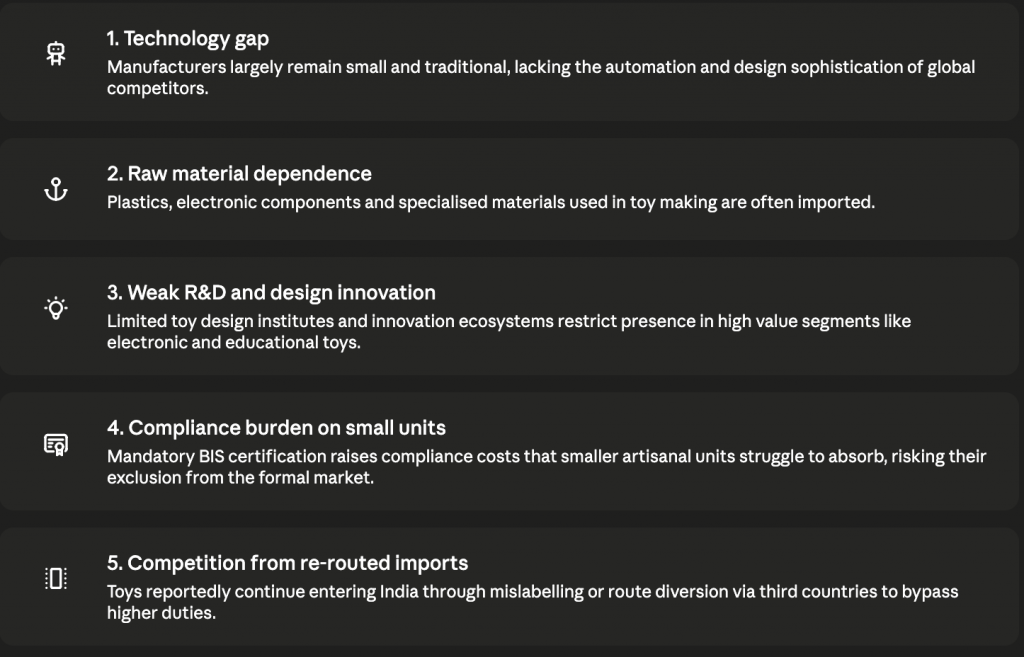
Challenges
Conclusion
- India’s toy industry is successfully blending its rich cultural heritage with modern advancements, emerging as a vibrant contributor to manufacturing, exports and employment.
- Supported by strategic policy interventions and initiatives promoting indigenous production, the sector has transitioned from import dependence to global competitiveness.
Source: AIR
Previous article
Sub-Mission on Agricultural Mechanization
Next article
News In Short 09-07-2026
