


Syllabus: GS3/Economy, Agriculture
Context
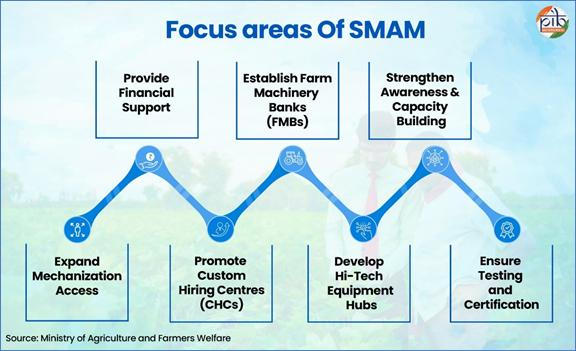
- The Sub-Mission on Agricultural Mechanization (SMAM) expands access for small farmers, women, and disadvantaged groups through targeted mechanization support nationwide.
About
- Sub-Mission on Agricultural Mechanization (SMAM) was launched in 2014–15.
- It is a Centrally Sponsored Scheme under the Rashtriya Krishi Vikas Yojana (RKVY).
- SMAM aims to “reach the unreached” by extending the benefits of mechanization to underserved sections.
- It includes small and marginal farmers, including women, Scheduled Castes (SC), Scheduled Tribes (ST), Farmer-Producer Organizations (FPOs), Self-Help Groups (SHGs), and rural entrepreneurs.
- The scheme promotes the establishment of Custom Hiring Centres (CHCs).
- These are units comprising a set of farm machinery, implements, and equipment meant for hiring by farmers.
Status of Agriculture Mechanization in India
- As per the estimates of 2020-21 of Indian Council of Agricultural Research (ICAR), agricultural mechanization level varies across different crops and their farm operation in the country.
- Mechanization Levels:
- Seedbed Preparation: Highly mechanized (70%+) for major crops.
- Harvesting and Threshing: Least mechanized (<32%) for most crops, except rice and wheat.
- Sowing: Highest mechanization in wheat (65%).
- Planting/Transplanting: Mechanization levels are 20% (sugarcane) and 30% (rice).
- Harvesting/Threshing in Rice & Wheat: >60% mechanized; very low in cotton.
- Across States :
- States like Tamil Nadu, Gujarat and Uttar Pradesh which have widespread use of machines, lack adoption of weeding machines.
- Irrigation technologies adoption is higher in Gujarat and Tamil Nadu but not in other states.
- Assam and Odisha are still relying on manual operations for majority of the activities.
- In the United States, Western Europe, Soviet Union, Brazil, Argentina, China, India, Africa the level of farm mechanisation is at 95%, 95%, 80%, 75%, 75%, 38%, 40% and 20% respectively.
Need for Mechanization in Indian Agriculture
- Labour Shortage: In 2017, the number of people employed in agriculture were 145.66 million which dropped down to 143.4 million during the pandemic.
- The rural to urban migration trend has been observed in all parts of the country which led to situations like labour shortage in agriculture.
- Rise in Labour Wages: With growing demand of labour in the non-agricultural sector due to urbanization and increasing infrastructural capabilities, labour wages have been rising.
- Mechanization of farms is essential to meet the growing food demand.
- Improvement in Efficiency: There is a need for technologies to improve labour efficiency and reduce drudgery for labour intensive methods of production.
- Gap in India: The level of agriculture mechanization in India stands at 40% which is less when compared to China (59.5%), Brazil (75%) and U.S (95%).
- The gap has to be filled with mechanization of agriculture to ensure sustained productivity of the sector.
Challenges
- High Initial Investment: The cost of purchasing modern farm machinery is high, which makes it difficult for small and marginal farmers to afford them.
- Lack of Access to Financing: While government schemes provide financial assistance, many farmers still face challenges in accessing loans or subsidies for purchasing machinery, especially in rural areas.
- Geographical and Climatic Constraints: India’s diverse geography and climate conditions require different types of machinery, which might not always be available or suitable for all regions.
- Labor-Intensive Farming Practices: Many farmers are still accustomed to traditional methods and may resist shifting to mechanized farming, due to cultural reasons or fear of technology.
- Inconsistent Power Supply: Rural areas often face irregular electricity supply, which hinders the use of electric-powered machinery.
- Seasonal Demand: Demand for certain machinery is seasonal, which makes it harder for machinery owners to maintain consistent utilization throughout the year, leading to low returns on investment.
Government Initiatives
- Custom Hiring Centers (CHCs): The government encourages the establishment of Custom Hiring Centers where farmers can access expensive agricultural machinery on a rental basis, thereby reducing the cost burden on individual farmers.
- Farm Machinery Training and Testing Institutes (FMTTIs): FMTTIs provide training to farmers and technicians in the operation and maintenance of agricultural machinery.
- They also conduct testing and certification of agricultural machinery to ensure quality and performance standards.
- Pradhan Mantri Krishi Sinchayee Yojana (PMKSY): PMKSY includes provisions for promoting mechanized irrigation systems such as sprinkler and drip irrigation, which contribute to water conservation and efficient water use in agriculture.
- Rashtriya Krishi Vikas Yojana (RKVY): RKVY supports the adoption of modern agricultural practices including farm mechanization through financial assistance to states for promoting agricultural growth and development.
- Promotion of Innovation and Research: The government encourages research and development in agricultural mechanization through institutions like the Indian Council of Agricultural Research (ICAR) and supports innovation and indigenous development of agricultural machinery.
Source: PIB
Previous article
India Rises to 11th Position Among Global FDI Recipients
Next article
India’s Toy Ecosystem
