


Syllabus: GS2/IR
Context
- India and Australia launched the Australia-India Partnership on Cyber, Critical Technologies and Supply Chains (PACTS).
About
- The framework will replace the 2020 cyber cooperation arrangement.
- PACTS is built around five areas of cooperation:
- Supply chain resilience: The two countries will work on trusted technology supply chains, semiconductor collaboration, critical minerals, undersea cable security and trade diversification.
- Critical technologies: The partnership covers artificial intelligence, space technologies, telecommunications, biotechnology and advanced materials. It also includes research collaboration and work on international standards for safe and secure AI.
- Cybersecurity: Both will cooperate on tackling cybercrime, protecting critical infrastructure, strengthening cyber diplomacy, expanding cybersecurity investments and building cyber skills.
- Digital resilience: Both countries will promote India’s Digital Public Infrastructure (DPI) model across the Indo-Pacific and work on digital solutions for sectors such as health, education, clean energy and connectivity.
- Defence research collaboration: The framework provides for joint defence science research, innovation partnerships, collaboration between defence research organisations and work on maritime technologies.
- Significance:
- The framework gives India a broader platform to work with Australia on technologies and supply chains that have become increasingly important for economic and national security.
- It also provides a structured mechanism for joint research, investment, standards development and technology partnerships across government, academia and industry.
Brief on India-Australia Ties
- India and Australia upgraded their bilateral relationship from a ‘strategic partnership’ in 2009 to a ‘Comprehensive Strategic Partnership’ in 2020.
- Bilateral mechanisms include: 2+2 Defence and Foreign Ministers’ Dialogue, Joint Trade & Commerce Ministerial Commission, Defence Policy Talks, Australia-India Education Council, Defence Services Staff Talks, Energy Dialogue, JWGs on different issues etc.
- Bilateral Trade: Bilateral trade reached $24.1 billion in FY25, with India’s exports valued at $8.58 billion and imports at $15.52 billion. India ranks as Australia’s 8th largest trading partner, while Australia is India’s 14th largest.
- Negotiations are underway for a more comprehensive Comprehensive Economic Cooperation Agreement (CECA) to further deepen trade relations.
- Defence and Security: The ‘Quadrilateral Security Dialogue’ (QSD) is an informal strategic forum comprising four nations – the United States of America (USA), India, Australia and Japan.
- Two Navies had signed the ‘Joint Guidance for the India – Australia Navy to Navy Relationship’ document in 2021.
- Defence Exercises: In 2020, Australia participated in the MALABAR naval exercise and thus joined India, the U S and Japan.
- AUSINDEX: It is a naval exercise between the Royal Australian Navy and the Indian Navy
- The Pitch Black exercise: The Indian Air Force joined Exercise Pitch Black in Darwin in 2018.
- Mutual Logistic Support Arrangement and Defence Science & Technology Implementing Arrangement 2020: The pact enables complex military engagement and excellent collective receptiveness to regional disasters.
- Critical Minerals and Technology: Australia-India Critical Minerals Investment Partnership was signed in 2022, establishing the Australia-India Critical Minerals Research Hub in late 2023.
- The Hub aims to drive innovation in sustainable mining and processing, with government-approved funding of $5 million for collaborative research and scholarships.
- In 2023, Australia and India entered into a Migration and Mobility Partnership Arrangement (MMPA).
- It is a bilateral framework that supports migration and mobility between the two countries, while addressing issues pertaining to illegal and irregular migration.
- New Roadmap for Australia’s Economic Engagement with India: Australia launched it in 2025, identifying nearly 50 targeted opportunities across defence, sports, culture, space, and technology.
- Clean Energy: Leveraging Australia’s renewable energy expertise to support India’s sustainability goals, including the establishment of the India-Australia Rooftop Solar Training Academy in 2025 to train 2,000 women and young people as solar technicians.
- Education and Skills: Strengthening academic partnerships and vocational training programs for knowledge exchange and workforce development.
- Agribusiness: Expanding agricultural trade to meet India’s increasing demand and improve food security.
- Tourism: Promoting cultural exchanges and simplifying visa processes to strengthen people-to-people ties.
Significance of Australia for India
- Strategic Partner in the Indo-Pacific: Australia is crucial for maintaining a free, open, and rules-based Indo-Pacific, aligning with India’s maritime and regional security interests.
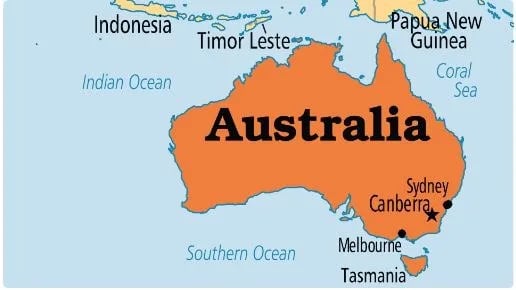
- Key Source of Critical Minerals & Energy: Australia supplies lithium, cobalt, rare earths, coal, and LNG, strengthening India’s energy and industrial security.
- Trade & Economic Partner: Under the India–Australia ECTA (2022), bilateral trade is expanding with reduced tariffs, and negotiations toward a broader CECA are underway.
- Education and Research Hub: Australia is a major destination for Indian students, with growing collaboration in STEM, innovation, and mutual recognition of qualifications.
- Geopolitical Convergence: Close cooperation in QUAD, Indian Ocean Rim Association (IORA), East Asia Summit (EAS), and other multilateral forums helps India diversify partnerships and balance China’s regional influence.
Areas of Concerns
- Trade Imbalance & Limited Diversification: India’s exports remain limited compared to Australia’s resource-heavy exports, creating a persistent trade imbalance and slow progress on a Comprehensive Economic Cooperation Agreement (CECA).
- Indian Diaspora & Safety Concerns: Occasional incidents involving Indian students and community tensions raise concerns about safety and societal integration.
- Visa, Mobility & Skill Recognition Issues: Despite progress, challenges remain in mutual recognition of skills, work visas, and post-study opportunities for Indian students.
- Agricultural Market Access Issues: India faces barriers in exporting agricultural products due to Australia’s stringent sanitary and phytosanitary (SPS) standards.
- Slow Progress in Defence Tech Collaboration: While exercises are strong, cooperation in defence manufacturing, technology transfer, and joint R&D remains underdeveloped.
Way Ahead
- Deepen Strategic & Defence Cooperation: Expand collaboration in maritime security, intelligence sharing, joint defence production, and strengthen QUAD-driven initiatives in the Indo-Pacific.
- Fast-Track CECA & Diversify Trade: Conclude the Comprehensive Economic Cooperation Agreement (CECA) and promote diversification in goods, services, critical minerals, and digital trade.
- Strengthen Critical Minerals & Clean Energy Ties: Build long-term supply chains for lithium, rare earths, and collaborate on green hydrogen, renewable energy, and climate resilience projects.
Source: PIB
Previous article
India–New Zealand Relations
