


Syllabus: GS3/ Economy
Context
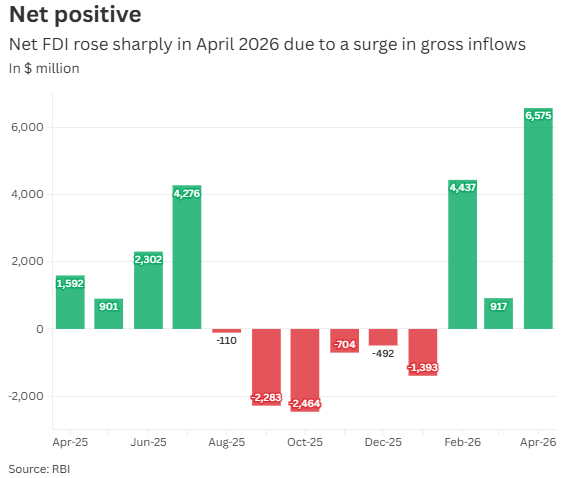
- The data released by the Reserve Bank of India shows that Net foreign direct investment (FDI) rose to $6.6 billion in April 2026, its highest level in nearly five years, driven by a 65% surge in gross inflows.
What is Foreign Direct Investment (FDI)?
- It refers to investments made by foreign entities (individuals or companies) in the business interests of another country, typically in the form of ownership or control of enterprises.
- At present, FDI is prohibited in lottery, gambling and betting, chit funds, Nidhi company, real estate business, and manufacturing of cigars, cheroots, cigarillos and cigarettes using tobacco.
- Net FDI: It represents the difference between foreign investment entering the country and capital flowing out through disinvestment and repatriation.
- A decline in net FDI does not necessarily imply a fall in investor interest, as gross inflows may remain strong.
Routes for FDI in India
- Automatic Route: It means the entry route through which investment does not require the prior approval of the Reserve Bank of India or the Central Government.
- Most sectors, such as manufacturing and software, fall under this route.
- Government Approval Route: It means the entry route through which investment requires prior Government approval and foreign investment received under this route shall be in accordance with the conditions stipulated by the Government in its approval.
- Sectors such as telecom, media, pharmaceuticals, and insurance fall under this route.
Sectors/Activities in Which FDI is Prohibited
- Lottery Business including Government/private lottery, online lotteries, etc.
- Gambling and Betting including casinos etc.
- Chit funds, Nidhi company, Trading in Transferable Development Rights (TDRs).
- Real Estate Business or Construction of Farm Houses;
- ‘Real estate business’ shall not include development of townships, construction of residential /commercial premises, roads or bridges and Real Estate Investment Trusts (REITs) registered and regulated under the SEBI (REITs) Regulations 2014.
- Manufacturing of cigars, cheroots, cigarillos and cigarettes, of tobacco or of tobacco substitutes.
Key Trends in FDI Data
- Surge in inflows: Gross FDI in April 2026, or the total amount of direct investment that entered the country that month, surged to $15.3 billion.
- The gross FDI inflows in the single month of April 2026 was more than 16% of the amount that came in the entire financial year 2025-26.
- The largest share of equity inflows was received by financial services, retail and wholesale trade, manufacturing and computer services. Together, these sectors accounted for more than 80% of total FDI inflows.
- More than 75% of the FDI flows came from Japan, Singapore and Mauritius.
- Slower Outflow Growth: Gross outflows rose at a significantly slower pace, to $8.7 billion in April 2026 from $7.7 billion in April last year — a growth of 13.7%.
- Within this, outward FDI by Indian companies rose nearly 42% in April 2026 to $4.8 billion.
- Around 80% of the flows were directed to the U.S. and the Cayman Islands with Financial, insurance and business services, and the manufacturing sector accounted for more than 90% of the outward flows.
What are the Concerns?
- Sectoral Concentration: The FDI is concentrated in a few sectors especially in financial services, while labour-intensive sectors are receiving relatively lower investment.
- Volatility in Net FDI: Net FDI fluctuates significantly due to changes in repatriation of profits, disinvestment, and outward investments by Indian firms.
- Uneven Regional Distribution: FDI is mostly concentrated in a few states with better infrastructure and business ecosystems, widening regional disparities.
- Global Economic Uncertainty: Geopolitical tensions, trade disruptions, and global economic slowdowns will affect future investment flows into India.
Way Ahead
- India should continue improving the ease of doing business, strengthening infrastructure, and ensuring policy stability to attract sustained and diversified FDI inflows.
- Efforts should focus on expanding FDI into manufacturing, innovation-driven sectors, and less-developed regions to maximize employment generation and balanced economic growth.
Previous article
Digital Sovereignty
Next article
India’s Emerging Technology Ecosystem
