


Syllabus: GS3/Science & Technology
Context:
- Discussion around ‘Sovereign AI’ came to fore following reports of US putting restrictions on access to some cutting-edge AI models like Anthropic’s Fable to non-US nationals, thus calling upon India to come up with its own government-sponsored Large Language Model (LLM).
What is a Sovereign AI Model?
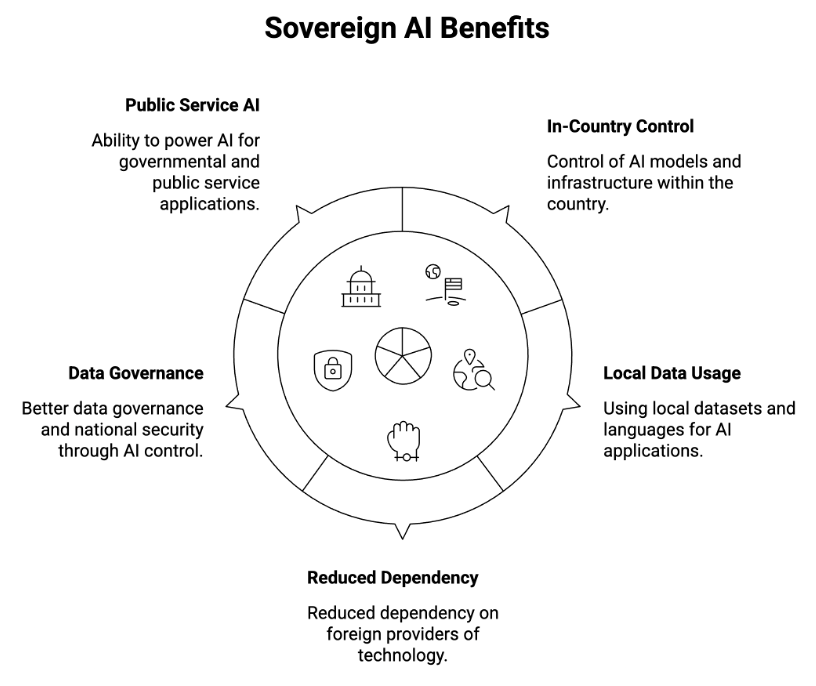
- Sovereign AI is the ability of a country to have its own AI infrastructure, models, data and compute resources under sovereign jurisdiction and control.
India’s Sovereign AI Model
- India has already taken the path of capability building in terms of AI through the IndiaAI initiative, approved in 2024. Its key features include:
- IndiaAI Compute Infrastructure: Establishment of the common computing infrastructure and provision of GPUs and high-performance computing resources for startups, researchers and academia.
- IndiaAI Innovation and Startup Ecosystem: Supporting AI startups and indigenous innovations and building AI applications for governance and industries.
- IndiaAI Datasets Platform: Provision of good quality and non-personal datasets and responsible development of AI applications.
- Skill Development: Increase of AI education and research capabilities; and training of the workforce for future technologies.
- Indigenous Foundation Models: Encouraging Indian organizations to build AI models for India-specific languages and use-cases.
- Hence, India has already started on enhancing its AI capability without necessarily building its sovereign government-funded LLM.
Arguments In Favor of Government-Funded Sovereign LLM
- Strategic and Technological Autonomy: Dependency on foreign AI models would expose India to the possibility of export control, licensing restrictions, and geopolitical pressure.
- Linguistic Diversity: Indian multilingual diversity would demand AI models which are developed keeping in view Indian languages, dialects, and context which could be lacking in the global models.
- Data Sovereignty: Sensitive governmental and citizens’ data could be kept within the jurisdiction of the nation without worries regarding data access by foreign players.
- National Security Applications: AI models built indigenously could be used for various applications related to defence, intelligence, cyber-security and management of critical infrastructure.
- Creation of Long-Term Ecosystem of Innovation: Public investment could help create indigenous technological capability in the field of AI, just like in space technology and digital public infrastructure.
Arguments Against Government-Funded Sovereign LLM
- Very High Financial Cost: Development of frontier LLMs would entail huge financial investments in terms of infrastructure, data generation, recruitment of talented individuals, continuous model training and upgrading.
- These investments could yield very little return in case there are better global alternative options present.
- Risk of Industrial Policy Failure: Governments tend to fail in identifying technological winners. State-driven technology projects could suffer from bureaucracy, inefficiencies, and poor resource allocation.
- Private Sector Innovation Works Better: The leaders of AI globally like OpenAI, Anthropic and Google DeepMind came about because of private sector innovation and venture investment and not because of government industrial policy.
- Availability of Open Source Models: Open source AI models like Llama and Mistral would enable Indian companies to develop their applications without having to incur the huge cost of developing frontier models.
- Usefulness Lies in Applications of AI: For most Indian businesses, usefulness would lie in developing services through AI applications and not in the possession of the best foundation model.
Why Building Government-Funded Sovereign LLM Would Not Be Necessary?
- Lessons from Success of India’s IT Sector: India became a global leader in IT services by importing global technologies, developing human capital and exporting software services across the globe.
- The country never needed indigenous processors, indigenous operating systems and sovereign hard disks to achieve its position as an IT leader.
- Global Technologies Have Never Been a Problem For India: Traditionally, India has always been able to integrate global technologies and focus on developing value creation capabilities in the country.
- Technologies like semiconductors, operating systems and advanced computing technologies were all developed outside India but Indian companies were still able to develop world class business around them.
- Frontier Models Are Not the Bottleneck: Most applications of AI give more importance to cost effectiveness, reliability and domain specific nature.
- Older and open source models would work better in these circumstances rather than frontier models which are expensive.
- Defence Capabilities Could Be Built through Partnership: Rather than striving for total technological independence, India should try to form partnerships with reliable partners like the USA, Japan, European Union, South Korea and Taiwan to have trusted and resilient technology supply chains.
Way Forward: What India Should Do Then?
- Focus On Human Capital: Investment in IITs, IISc, Research universities and AI centres of excellence. Having the strongest pool of human talent remains India’s biggest comparative advantage.
- Ease of Access To Global Technologies: Ease out regulatory and payments related issues involved in getting AI services, access to cloud infrastructure and computation hardware.
- This will make it possible for India to compete globally in AI applications.
- Improvement of Financial Ecosystems: There is a need to encourage venture capital and deep-tech investments in AI.
- Innovation thrives where risks could be taken and capital could be accessed easily.
- Establishment Of AI Ready Public Digital Infrastructure: After the success of Aadhaar, UPI and DigiLocker, India can think of developing AI ready public digital infrastructure.
- Forming Trusted International Partnerships: Collaboration with democratic technology partners to get access to AI hardware, semiconductor technology chain and advanced research networks.
| Daily Mains Practice Question [Q] Discuss the limitations of a strategy centered on developing sovereign AI models and suggest alternative approaches that governments can adopt to strengthen their AI ecosystem. |
