


Abhigyan App
Syllabus: GS2/ Governance
Context
- The Union Home Minister launched the Abhigyan app developed by the National Crime Records Bureau (NCRB).
About
- The app links to the National Automated Fingerprint Identification System (NAFIS) to store fingerprint scans of accused, convicts, and those in prisons on a centralized platform.
- The prints can be matched with the NAFIS database in 35 seconds.
- During routine vehicle checks on the streets, biometric scans of any suspicious individual can be conducted to identify persons wanted in connection with crimes.
Legal Concerns
- The Criminal Procedure Identification Act, 2022 provides the legal basis for such checks.
- However, Section 3 of the Act limits the mandatory recording of measurements, including fingerprints, to people who have been convicted or arrested and those ordered to give security for good behaviour or maintaining peace under the Code of Criminal Procedure, 1973.
- The Act does not mention the possibility of random testing of individuals without any evidence linking them to a punishable offence.
Source: TH
Right To Walk On Footpath Is A Fundamental Right: SC
Syllabus: GS2/Polity and Governance
Context
- In a landmark judgment, the Supreme Court has held that the right to walk on safe and demarcated footpaths is a fundamental right.
About
- The right to walk flows from Article 19(1)(d) (freedom of movement) and Article 21 (right to life and personal liberty).
- According to the Court, the right to walk also supports freedom of expression, assembly, and association under Article 19(1)(a), 19(1)(b), and 19(1)(c).
- The judgment places a duty on municipal corporations, urban development authorities, municipalities, and even panchayats to build, maintain, and protect pedestrian infrastructure.
- The Court emphasized that pedestrian rights must be prioritized over motorised vehicles in urban planning, and citizens can seek legal remedies if safe and accessible footpaths are not provided.
Source: TH
Energy Transition Index (ETI) 2026
Syllabus: GS3/Energy
Context
- According to the Energy Transition Index (ETI) 2026, the global energy transition has effectively stalled despite total energy investments touching $3.3 trillion in 2025.
About Energy Transition Index (ETI)
- The Energy Transition Index (ETI) is an annual index published by the World Economic Forum that measures how effectively countries are transitioning toward secure, sustainable, equitable, and affordable energy systems.
- Evaluation Criteria: The index is based on two broad dimensions:
- System Performance: Energy security, sustainability, and equity.
- Transition Readiness: Policies, regulations, investment, infrastructure, innovation, education, and institutional support.
- Significance: It helps governments identify strengths and weaknesses in their energy transition efforts and guides policy reforms.
Major Findings of Energy Transition Index (ETI) 2026
- Sweden, Finland and Denmark retained their top three positions globally.
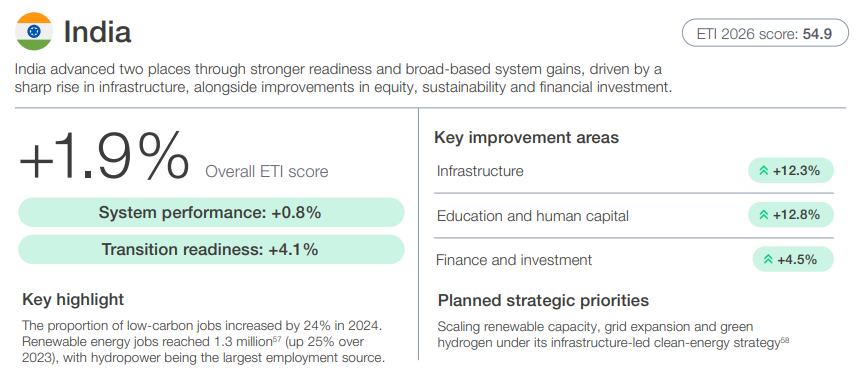
- India advanced two places to rank 70th.
- Global electricity demand grew by 3% driven by electrification, cooling, digital infrastructure and AI, and was seen as emerging as a defining constraint on the transition.
- Emerging economies accounted for around 80% of demand growth but continued to face higher financing costs and infrastructure gaps
- The WEF identifies three priorities: embedding resilience and security into energy system design, accelerating grid and infrastructure development, and creating stable policy environments that attract long-term investment, particularly in emerging markets.
Source: BT
Financial Action Task Force (FATF)
Syllabus: GS2/International Bodies
Context
- The Financial Action Task Force (FATF) Plenary has appointed Culture Ministry Secretary Vivek Aggarwal as the next vice-president.
About
- This is the first time that India will hold the Vice-Presidency of the FATF.
- He will serve as vice president from July 2026 to June 2027.
- The Vice-President of the FATF is elected by the FATF Plenary from among its members and assists the President in steering the organisation’s work.
The Financial Action Task Force
- The FATF is the global money-laundering and terror financing watchdog.
- It is an inter-governmental organisation with 40 members, India became a member in 2010.
- The body researches how money is laundered and terrorism is funded, promotes global standards to mitigate the risks, and assesses whether countries are taking effective action.
- The FATF Presidency runs on a two-year term, and the Vice-President assists the President in carrying out the organisation’s mandate.
What FATF’s grey/black lists entail?
- The FATF identifies jurisdictions with weak measures to combat money laundering and terrorist financing (AML/CFT regimes) in two public documents that are issued three times a year — in February, June and October.
- The grey list, officially “Jurisdictions under Increased Monitoring”, comprises countries that have significant deficiencies in their AML/CFT regimes but are actively working with the FATF to address these within agreed timeframes.
- Countries in the grey list are subject to increased monitoring by the FATF. Currently, there are 22 countries in this list (as of June 2026).
- It carries adverse economic and reputational impacts, which affect the inflow of foreign investment and international aid.
- The black list, officially “High-Risk Jurisdictions subject to a Call for Action”, comprises countries with “serious strategic deficiencies” in their AML/CFT regimes.
- The FATF urges all other jurisdictions to apply enhanced due diligence while dealing with such countries and also apply counter-measures to protect the international financial system from the risks emanating from the country.
- Three countries are in the black list at the moment — North Korea, Myanmar, and Iran.
Source: FATF
Heatwaves Leading to Increased Concentrations of Ground-Level Ozone
Syllabus: GS3/ Environment
Context
- According to a study by the IIT Kharagpur, heatwaves in India may have intensified ground-level ozone exposure linked to more than 26,500 deaths in 2024.
What is Ozone?
- Ozone (O₃) is a gas composed of three oxygen atoms.
- It occurs both in the Earth’s upper atmosphere (stratosphere) and at ground level (troposphere).
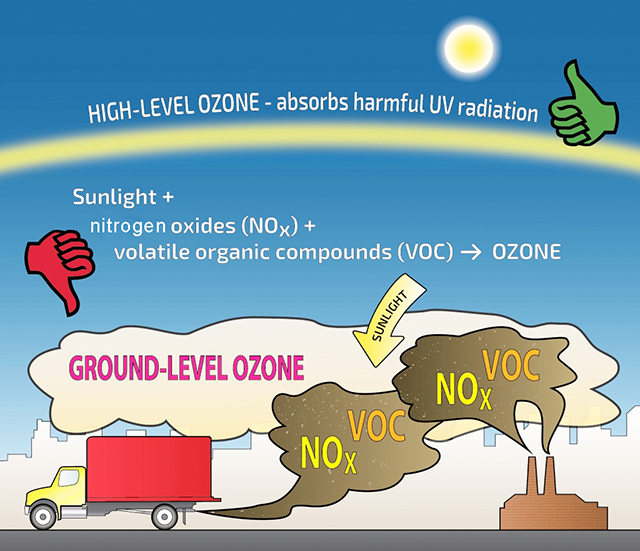
- Stratospheric ozone is beneficial as it forms the ozone layer that shields the Earth from the sun’s harmful ultraviolet radiation.
- Tropospheric ozone, however, is a harmful air pollutant and greenhouse gas.
- It is not emitted directly but is formed by chemical reactions between oxides of nitrogen (NOₓ) and volatile organic compounds (VOCs) in the presence of sunlight.
- The World Health Organization (WHO) recommends a maximum ozone level of 100 micrograms per cubic meter (µg/m³), measured as an 8-hour maximum moving average within a day.
Why Do Heatwaves Increase Ozone Levels?
- During a heatwave, temperature becomes high and there is strong sunlight. These conditions help pollutants like nitrogen oxides (NOx) and volatile organic compounds (VOCs) react faster and produce more ozone.
- Heatwaves are accompanied by calm weather and low wind speed. Because of this, pollutants stay trapped near the ground instead of getting dispersed.
- In hot weather, people use more electricity for cooling, leading to higher burning of fossil fuels, releasing more ozone-forming pollutants into the air.
- Even after the heatwave ends, ozone levels remain high for a few days and continue to affect air quality and human health.
Source: DTE
Smart Seed Coating Technology to Boost Crop Yields
Syllabus: GS3/ Agriculture
Context
- The Indian Council of Agricultural Research’s Indian Institute of Oilseeds Research (ICAR-IIOR), Hyderabad, has developed Smart Seed Coating Technology that improves seed quality.
About
- The Smart Seed Coating Technology developed by ICAR-IIOR utilizes biodegradable biopolymeric materials to create a multifunctional protective layer around seeds.
- The coating acts as a carrier system for beneficial microorganisms, nutrients, micronutrients, crop protection agents, and plant growth-promoting compounds, delivering them directly at the seed-soil interface.
- This protective microenvironment promotes rapid germination, vigorous seedling growth, enhanced root development, and improved tolerance to environmental stresses during the critical crop establishment phase.
- The innovation is particularly valuable for rainfed agriculture, which accounts for a significant share of India’s cultivated area and remains highly vulnerable to delayed monsoons.
Source: PIB
Previous article
Direct Tax Collections Show Strengthening Economic Activity
Next article
India’s Cultural Diplomacy
