


Syllabus: GS3/Economy
Context
- The Ministry of Consumer Affairs, Food and Public Distribution, launched the Smart Warehousing System for foodgrain storage in New Delhi.
About
- The system represents the world’s largest deployment of Artificial Intelligence (AI) and Internet of Things (IoT) based technologies in public sector foodgrain warehousing.
- The Smart Warehousing System integrates advanced technologies such as;
- FASTag and ANPR-based gate automation,
- Intelligent access control through geo-tagged smart locks,
- AI-enabled bag counting, face recognition systems, object detection, IoT-based monitoring of environmental parameters, and
- AI-powered surveillance for fire, smoke and rodent detection.
- This platform also supports ERP integration, automated record generation and advanced analytics for warehouse operations.
Importance of Food Grain Storage
- Reducing Post-Harvest Losses: Proper storage, including cold storage and modern warehouses, significantly reduces the wastage of agricultural produce.
- Ensuring Food Security: Maintaining a buffer stock of food grains is essential for national food security and for distribution under programmes like the National Food Security Act (NFSA).
- Preventing Distress Sales: Access to storage facilities allows farmers to hold their produce and sell it at an optimal time, avoiding distress sales and helping them realise better prices.
- Price Stabilisation: Maintaining strategic buffer stocks helps protect consumers from extreme price volatility in essential commodities.
- Maintaining Quality: Scientific storage ensures that food grains remain fit for human consumption by controlling factors like moisture and pests.
Food Grain Storage Systems in India
- Centralized storage, handled mainly by agencies like the Food Corporation of India (FCI).
- Cold storage, which caters to perishable items such as fruits, vegetables, dairy products, and meat.
- Decentralized storage, carried out through rural godowns, Primary Agricultural Credit Societies (PACS), and on-farm storage by farmers.
Centralized Storage of Food Grains
- The procurement of food grains in Central Pool is undertaken either by FCI directly or by State Govt. Agencies (SGA).
- Quantity procured by SGAs is handed over to FCI for storage and the cost of the food grains procured by State agencies is reimbursed by FCI.
- The FCI manages this stock, storing it and subsequently issuing it for distribution through the Public Distribution System (PDS).
- As of July 2025, the Total Covered and CAP Storage Capacity available with FCI and State agencies for the storage of Central Pool foodgrains stood at 917.83 Lakh Metric Tonnes (LMT).
Covered storage capacity
- Covered storage capacity refers to the total quantity of foodgrains that can be stored in fully roofed and walled structures, such as godowns, warehouses, or silos. Foodgrains in ‘Cover and Plinth’ (CAP) storage are stored on elevated plinths and wooden crates are used as dunnage material.
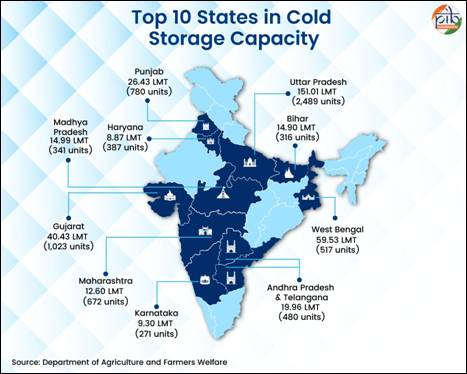
Cold Storage Infrastructure
- Cold chain infrastructure includes facilities for pre-cooling, weighing, sorting, grading, packaging, Controlled Atmosphere (CA) storage, blast freezing, and refrigerated transport like reefer vans.
Government Initiatives to Improve Storage Infrastructure
- Agriculture Infrastructure Fund (AIF): AIF was launched in 2020 to strengthen agricultural infrastructure across India. The scheme focuses on the creation of farm-gate storage and logistics facilities to help farmers store their produce effectively.
- Agricultural Marketing Infrastructure (AMI): AMI scheme is a key component of the Integrated Scheme for Agricultural Marketing (ISAM).
- The objective is to strengthen agricultural marketing infrastructure across rural India by providing financial assistance for the construction and renovation of godowns and warehouses.
- Pradhan Mantri Kisan SAMPADA Yojana (PMKSY): It is a comprehensive scheme designed to build modern infrastructure for the food processing sector, creating a smooth and efficient supply chain from the farm gate to retail.
- Private Entrepreneurs Guarantee (PEG) Scheme: It was implemented in 2008, to augment the covered storage capacity through private entrepreneurs, Central Warehousing Corporation (CWC) and State Warehousing Corporations (SWCs).
- Digital initiatives such as Depot Darpan, Anna Chakra and SMART PDS are helping improve monitoring, storage and distribution of foodgrains.
Concluding remarks
- Agriculture remains the lifeline of India, feeding millions while sustaining livelihoods and driving economic growth.
- While record foodgrain production reflects India’s agricultural strength, efficient storage and distribution ensure that every grain reaches the consumer.
- With a growing population and changing climate, maintaining sufficient stocks is essential to ensure year-round availability and price stability.
Source: PIB
Previous article
Role of AI in Criminal Justice Process
