


Syllabus: GS3/Defence
Context
- India’s annual defence production has surged to an all-time high of ₹1.78 lakh crore in the Financial Year (FY) 2025-26.
About
- It represents a 15.6% growth over the previous fiscal year and a 110% increase since FY 2020-21.
- Defence Public Sector Undertakings and other PSUs accounted for approximately 76% of total production, while the private sector contributed 24%.
- Approximately 65% of defence equipment is now produced domestically, as compared to import dependence of 65–70% earlier.
- India has set targets of ₹3 lakh crore in defence production and ₹50,000 crore in exports by 2029.
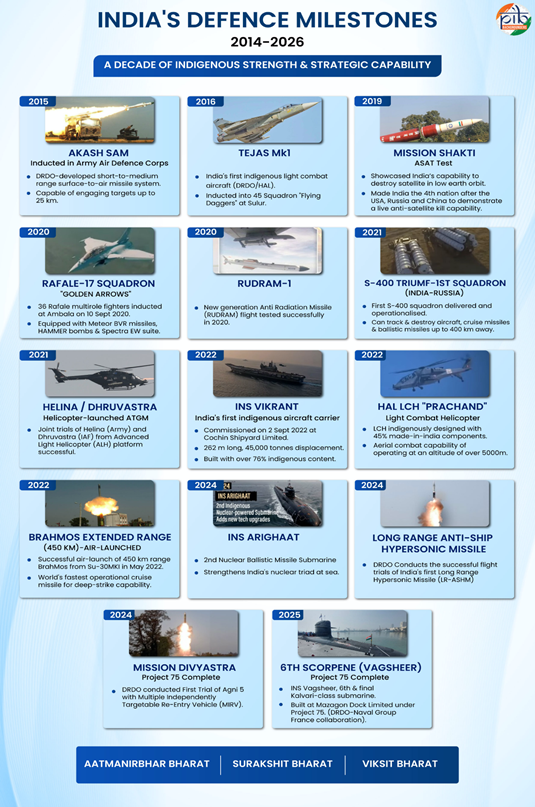
Factors Contributing to the Rising Defence Production
- Rising Defence Budget:
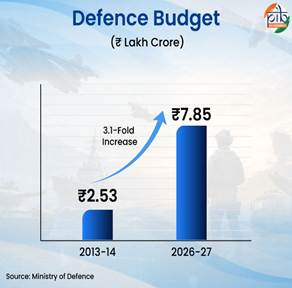
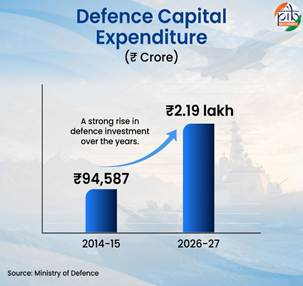
- Research, Innovation, and Partnership: Defence research and development allocation increased by over 112% in FY 2026–27 from FY 2014–15.
- The government also opened 25% of the defence R&D budget to industry, start-ups, and academia in 2022-23.
- Innovations for Defence Excellence (iDEX): The initiative actively engages industries, including MSMEs, startups, individual innovators, research institutions, and academia, in developing indigenous defence technologies.
- Development cum Production Partner (DcPP) Model: Under this model, DRDO identifies capable manufacturing partners from the public and private sectors through a competitive process and transfers the required technologies for production.
- Building Human Capability for Technological Self-Reliance: DRDO established five Young Scientists Laboratories (DYSLs) in 2020, with a sixth laboratory scheduled for 2026, making the total number to be 36.
- Newly recruited scientists now undergo a two-year M.Tech programme in defence technology at the Defence Institute of Advanced Technology before joining laboratories.
- Defence Acquisition Reforms to Push for Self-Reliance: Through DAP 2020 reforms, it prioritised indigenous procurement, domestic manufacturing, and higher indigenous content.
- India’s Defence Diplomacy: India has expanded partnerships with major global powers while preserving strategic autonomy. Defense cooperation now extends beyond military exchanges to technology collaboration, industrial partnerships, and joint manufacturing.
Need for Defence Indigenisation Reforms
- Strategic Autonomy & National Security: Defence Production reduces dependence on foreign suppliers, especially during crises and geopolitical tensions.
- Addressing Capability Gaps: India faces complex security challenges across borders and in the Indian Ocean Region (IOR). Modernisation is required to replace ageing platforms in the Army, Navy, and Air Force.
- Reducing Import Bill & Promoting Economic Efficiency: India is among the world’s largest arms importers, indigenous production lowers costs in the long run, reduces foreign exchange outflow, and strengthens the domestic defence economy.
- Boosting Domestic Defence Industrial Base: Indigenisation stimulates innovation and growth of DPSUs, MSMEs, and private industry.
- Faster Procurement & Operational Readiness: Domestic manufacturing shortens procurement cycles and ensures timely delivery.
- Improved Customisation & Adaptability: Indigenous platforms can be tailored to Indian terrain (Himalayan high-altitudes, deserts, maritime zones) which allows continuous upgrades to meet evolving threat environments.
- Technology Sovereignty: Developing indigenous technologies ensures freedom in design, production, and future upgrades. It also prevents vulnerability due to sanctions, supply chain disruptions, or technology denials.
Significance of India’s Rising Defence Production
- Structural Shift from Buyer to Builder: Indian defence products are now exported to over 80 countries worldwide.
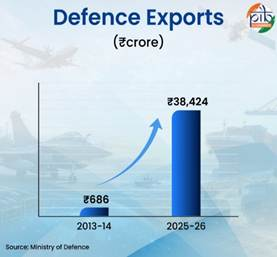
- Expansion of Defence Industrial Capacity: The indigenous defence ecosystem today comprises 16 Defence Public Sector Undertakings (DPSUs), around 500 licensed defence companies, and nearly 17,000 Micro, Small and Medium Enterprises (MSMEs).
- Defence Industrial Corridors: In 2026, the Uttar Pradesh Defence Industrial Corridor had attracted investment commitments worth ₹42,057 crore, the Tamil Nadu Defence Industrial Corridor attracted investments worth ₹32,699 crore.
Key Government Initiatives
- Ease of Doing Business in Defence Manufacturing: In 2015, the government revised this to 15 years initial validity, with a further extension possible up to 18 years. Under the Arms Act, licenses granted to companies are now valid for the lifetime of the company.
- Revamped Defence Exim portal: The portal enables end-to-end application processing, automated company verification, simplified registration, real-time tracking, and secure payment integration.
- Indigenisation through Industries: The Ministry of Defence launched the Srijan Defence Portal in 2020. On this portal, DPSUs and Service Headquarters (SHQs) offer defence items to the industries, including MSMEs and start-ups, for indigenisation.
- Srijan DEEP: Department of Defence Production has developed Srijan DEEP (Defence Establishments and Entrepreneurs Platform), a Digital Database of Defence Industries.
- The portal serves as a comprehensive repository of defence Manufacturers, MSMEs, Services and Technology providers contributing to the defence ecosystem.
- FDI in Defence Sector: The FDI limit in the defence sector was enhanced in 2020 up to 74% through the Automatic Route, and up to 100% through the Government Route.
- Strategic Partnership (SP) Model: Introduced in 2017 to create long-term partnerships between Indian companies and global Original Equipment Manufacturers (OEMs).
- These partnerships focus on technology transfer and setting up manufacturing infrastructure in India.
Way Ahead
- The combination of strategic policy interventions, increased domestic participation, and a focus on indigenous innovation has significantly strengthened the country’s defence capabilities.
- With ambitious targets set for 2029, India is poised to further expand its global footprint, reinforcing its position as a dependable partner in the international defence market while enhancing national security.
Source: TH
Previous article
Iran-United States Peace Deal
