


Syllabus: GS3/ Economy
Context
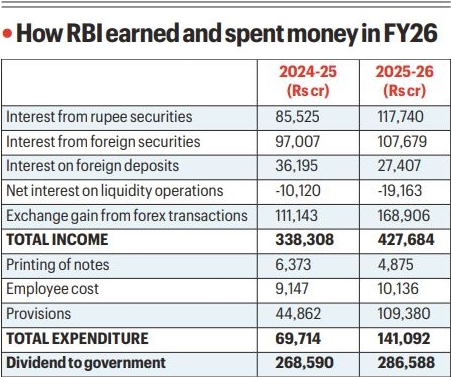
- The Reserve Bank of India (RBI) approved a record surplus transfer of ₹2.87 lakh crore to the Union Government for FY26.
Economic Capital Framework
- The Economic Capital Framework (ECF) guides how the RBI manages its capital reserves and determines the surplus it can transfer to the Government of India.
- It was originally formulated based on recommendations from the Bimal Jalan Committee and adopted in RBI’s 578th meeting in 2019.
- The Bimal Jalan Committee had recommended a 5-year periodic review of the ECF.
How RBI Earns Profit and Decides Dividend?
- Though RBI’s primary role is not to earn profit, but to maintain economic stability.
- Its main functions include ensuring price stability (controlling inflation), managing currency issuance, handling foreign exchange reserves, regulating the banking system & managing government debt.
- Despite these roles, profit can emerge as a byproduct of RBI’s operations. RBI earns through:
- Interest on government bonds it holds.
- Lending to banks (like repo operations).
- Foreign exchange operations (buying/selling dollars).
- Seigniorage – Profit from printing currency (since printing cost < face value).
- Market operations – It buys/sells assets to control liquidity and earns interest or capital gains.
Concerns Associated with RBI’s Growing Fiscal Role
- Fiscalisation of the Central Bank: The RBI’s primary mandate is to maintain price stability and financial stability.
- As surplus transfers become larger and more frequent, this could blur the distinction between monetary policy objectives and fiscal requirements.
- Risk to Fiscal Discipline: Large surplus transfers provide the government with additional fiscal space. It reduces the urgency of pursuing structural measures such as rationalising subsidies, or improving public expenditure efficiency.
- Sustainability Concerns: A large portion of RBI earnings arises from foreign exchange operations, reserve management, and returns on financial assets.
- These revenues are influenced by global interest rates, exchange-rate movements, and financial market conditions.
- These earnings are volatile in nature, treating them as a stable source of revenue will create fiscal risks in the future.
Way Ahead
- RBI’s monetary policy decisions should not be affected by fiscal considerations.
- Greater disclosure regarding reserve management and surplus calculations is necessary to strengthen public trust.
- Also governments should view RBI transfers as supplementary revenue rather than a permanent fiscal resource.
- RBI should retain sufficient buffers to safeguard financial stability during external shocks and crises.
Source: TH
Previous article
India Achieves a Record High in Annual Defence Production
Next article
News In Short 18-06-2026
