


Syllabus: GS2/Governance; GS3/Water Conservation
Context
- The heat wave in several parts of the country has been aggravated by severe water shortage, driven by a groundwater crisis and falling reservoir levels.
Water Scarcity in India
- India has 18% of the world’s population but only 4% of its freshwater.
- The World Bank calls India one of the most water-stressed countries.
- Many parts of India could face severe water scarcity by 2040 because of growing demand, poor management, and climate change.
- Water levels in India’s major reservoirs have fallen to below 45% of total capacity.
- Several reservoirs have reached critically low or zero levels.
- Most of India’s 20 river basins are now operating between 30% and 60% of capacity, with only a few above that range. In Bihar, the Chandan dam has run completely dry.
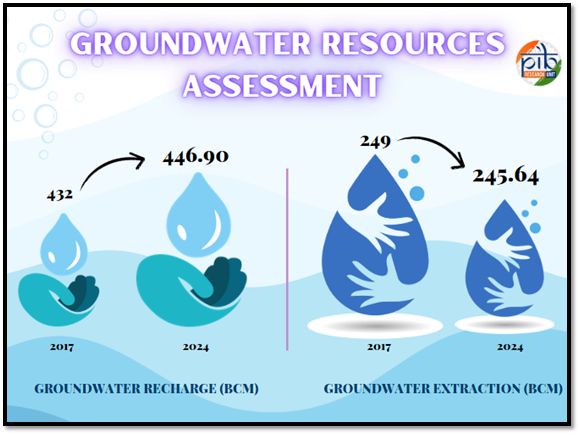
Major Causes of Water Scarcity
- Rapid urbanisation and industrialisation have led to increased pollution of water bodies, making them unfit for consumption.
- Inefficient agricultural practices and excessive groundwater extraction have depleted crucial water sources.
- Climate change further aggravates the situation, causing irregular rainfall patterns and affecting the recharge of rivers and aquifers.
- Poor water management and lack of proper infrastructure also play a significant role in exacerbating the crisis.
Impact of Water Scarcity in India
- Threat to Agriculture: Reduced availability of irrigation water lowers crop yields and increases the risk of crop failures.
- Public Health Concerns: Lack of safe drinking water and sanitation increases the spread of water-borne diseases.
- Environmental Degradation: Excessive groundwater extraction and drying of rivers, lakes, and wetlands harm ecosystems and biodiversity.
- Social Conflicts and Migration: Competition over scarce water resources can lead to disputes and force people to migrate from drought-prone areas.
Constitutional Provisions
- State Subject: Water is primarily under Entry 17 of State List (Seventh Schedule).
- Union Role: Regulation of inter-state rivers under Entry 56 of Union List.
- Article 262: Parliament can adjudicate inter-state water disputes.
Key Issues in Water Governance in India
- Fragmented Institutional Framework: Water governance in India is highly fragmented due to its placement in the State List, which leads to jurisdictional conflicts between states.
- Predominance of Engineering-Centric Approach: Water management policies in India have historically focused on large-scale infrastructure such as dams, canals, and irrigation systems. This approach prioritises supply augmentation while neglecting ecological sustainability and demand management.
- Agricultural Policies: Agricultural policies promoting water-intensive crops such as rice and wheat have led to excessive groundwater extraction.
- Lack of Ecosystem-Based Approach: Water governance does not adequately incorporate the interlinkages between land, water, and ecosystems.
- Environmental flows (e-flows) are often ignored, leading to degradation of rivers and wetlands.
- Weak Data Systems: There is a lack of reliable, comprehensive, and accessible water data across the country.
- This leads to poor planning, inefficient allocation, and unregulated extraction of water resources.
- Neglect of Demand-Side Management: Water policies largely focus on increasing supply rather than managing demand. Limited attention is given to water-use efficiency, conservation practices, and rational pricing.
Government Initiatives
- Jal Shakti Abhiyan (2019): Focuses on water conservation and groundwater recharge in water-stressed districts.
- AMRUT 2.0 scheme was launched in the 2021 in all Urban Local Bodies (ULBs)/ cities, enabling the cities to become ‘self-reliant’ and ‘water secure’.
- Rejuvenation of water bodies and development of green spaces and parks are other components of the mission.
- Amrit Sarovar Mission: Aims to develop and rejuvenate 75 water bodies per district.
- National Aquifer Mapping Program (NAQUIM): Helps delineate and understand aquifers for sustainable management.
- Master Plan for Artificial Recharge to Groundwater (2020): Developed by CGWB, plans for 1.42 crore rainwater harvesting and recharge structures to harness 185 BCM of rainfall.
- Atal Bhujal Yojana, was launched to improve groundwater management in priority areas with critical and overexploited blocks.
- Jal Jeevan Mission (JJM): To enable every rural household in the country to have assured potable water; since 2019, Government in partnership with states, is implementing Jal Jeevan Mission (JJM).
- This initiative facilitates adequate quantities of prescribed quality water on a regular and long-term basis, through tap water connection.
- National Water Awards: Launched in 2018 by the Department of Water Resources to recognize and encourage exceptional contributions towards water conservation and management across India.
- The awards aim to raise public awareness about the importance of water and motivate the adoption of best practices in water usage.
Way Ahead
- Public Emergency Water Plan: A basic plan would identify the most vulnerable wards and critical facilities, set simple rules for how water will be prioritised when supplies are tight and commit to regular public updates on storage levels and expected supply.
- Water Recovery: Instead of announcing distant, expensive new sources, cities can launch a time-bound ‘leak hunt’ in the worst-affected zones: fix visible leaks quickly, and set a short-term target for cutting losses.
- Sustainable Use: Government buildings, big campuses and commercial complexes are among the steadiest consumers of water. A quick internal audit, basic leak repairs, and simple efficiency measures can free up meaningful volumes.
- Managing Used Water: Measures to reduce leaks in water pipelines should also be used on sewer networks to identify and stop major sewage exfiltration and prevent contamination.
Conclusion
- There is a need to move from a fragmented and engineering-dominated approach to a comprehensive governance framework.
- Water must be treated as a shared and finite resource, requiring coordinated management across sectors.
- The focus should shift from supply augmentation to sustainability, efficiency, and equity.
Source: TH
Previous article
G7 Summit 2026 And India: Voice Of The Global South
