


Syllabus: GS3/ Infrastructure
In News
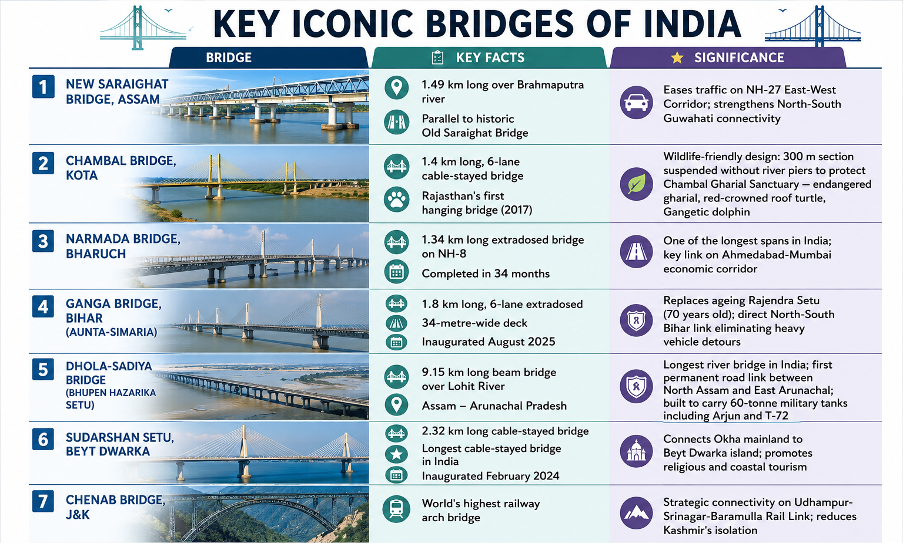
- MoRTH released a compendium of India’s iconic bridge projects in June 2026, highlighting how bridge infrastructure has transformed connectivity, regional development, and strategic access across India over the past decade.
Status of India’s Bridge Infrastructure: Status
- India’s road network now extends beyond 63 lakh kilometres, placing it among the largest globally.
- Budget 2026-27 allocates Rs. 1,21,999 crore to roads and bridges under MoRTH, a 5% increase over the revised estimate for 2025-26, reflecting sustained capital commitment to road infrastructure.
- Multiple major bridges are under construction as part of PM GatiShakti connectivity nodes, including a 4 km bridge over the Brahmaputra at Jogighopa, a 29 km bridge over the Kosi River, and a 14 km bridge parallel to JP Setu on the Ganga.
Significance: Why Bridges Matter?
- Economic multiplier: Bridges are not merely transport structures, they are economic multipliers.
- The Narmada Bridge on NH-8 accelerates freight movement on India’s busiest goods corridor, the Aunta-Simaria Bridge opens North Bihar’s agricultural surplus to southern markets.
- Strategic and defence value: The Dhola-Sadiya Bridge carries strategic significance in addition to its civilian utility, enabling rapid troop and equipment movement to the Arunachal Pradesh border.
- Regional integration: Bridges in the Northeast directly address the connectivity deficit that has historically limited economic development and contributed to insurgency and outmigration.
- Environmental engineering: The Chambal Bridge’s pier-free 300-metre suspended span demonstrates that infrastructure development and ecological sensitivity are compatible.
- Inclusive connectivity: PMGSY bridges connect rural households to health centres, schools, and markets, directly enabling outcomes on human development indicators that GDP data alone cannot capture.
Challenges in Bridge Infrastructure
- Maintenance deficit: India has over 1.5 lakh bridges on national highways, many built in the colonial era or 1960s-70s.
- Execution delays: Many infrastructure’s got delayed due to delay in land acquisition, forest clearances, utility shifting, and contractor capacity constraints.
- Geological and terrain challenges: Bridge projects in the Northeast, Himalayas, and coastal zones face exceptional engineering difficulty including seismic vulnerability, flash floods, high-altitude working conditions, and short construction seasons.
- Forest and environmental clearances: Projects crossing wildlife corridors and eco-sensitive zones require extended multi-level clearances; the Chambal Bridge’s design innovation was as much a regulatory response as an engineering choice.
- Urban bridges neglected: There is no overarching scheme for urban roads and bridges comparable to PMGSY for rural areas, leaving city-level bridge infrastructure under-funded and poorly maintained despite higher traffic loads.
Way Forward
- National Bridge Asset Management System: Scale up MoRTH’s real-time sensor pilot to all bridges on national highways, creating a continuous structural health monitoring network that enables predictive maintenance before catastrophic failure.
- Prioritise missing links in Northeast: Fast-track bridges on Frontier Highway (NH-913) along the Indo-Tibet-Myanmar border to arrest border population outmigration and improve LAC access under a dedicated NHIDCL pipeline.
- Integrate bridges into PM GatiShakti: Ensure every major bridge project is mapped to GatiShakti economic nodes, industrial corridors, and logistics parks so that bridge investments generate identifiable economic returns, not just connectivity benefits.
- Urban bridge policy: Launch a dedicated Urban Bridge Renewal Mission under AMRUT 2.0, mandating audit and structural renewal of all bridges above 30 years old in cities with populations above 10 lakh.
Source: PIB
Previous article
Indian Cities Need to Rethink Their Water Future
Next article
Telegram Ban Under Section 69A of the IT Act 2000
