

Syllabus: GS3/ Agriculture
Context
- Over the last decade, India has shifted from a welfare-centric approach to a farmer-centric model focused on productivity, sustainability, and technological modernization, fostering a resilient and diversified agricultural ecosystem.
Agriculture Sector in India
- Workforce Share: Agriculture and allied activities employ 46.1% of India’s workforce.
- Livelihood Reliance: The sector continues to support close to 55% of the total population, providing critical rural income security.
- Economic Contribution: Agriculture accounts for approximately one-fifth (~19-20%) of India’s Gross Value Added (GVA).
- Growth Rate: Agriculture and allied sectors recorded 4.6% growth in 2024–25 (real GVA growth), driven largely by livestock and fisheries.
Major Achievements in India’s Agricultural Transformation
- Agricultural Output and Economic Contribution:
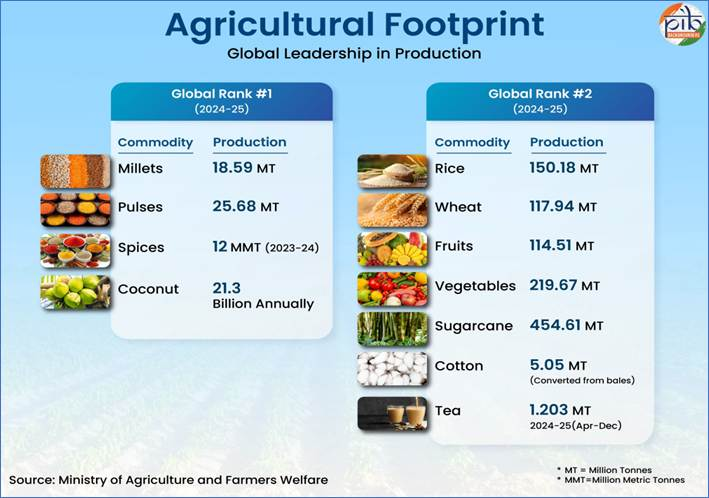
- Agricultural and allied sector GVA increased from ₹20.9 lakh crore in 2014-15 to ₹48.7 lakh crore in 2023-24.
- Foodgrain production increased to 357.73 million tonnes in 2024-25.
- Enhanced Public Investment: Budget allocation for the Department of Agriculture and Farmers Welfare increased to Rs.1,40,528.78 crore for 2026-27.
- Agricultural exports rose to USD 51.1 billion (FY 24-25), with processed food share increasing to 20.4%, signalling value-added growth.
Major Challenges Faced by the Agricultural Sector
- Water scarcity & irrigation: India’s agriculture is heavily dependent on monsoon rain, making it vulnerable to droughts and inconsistent rainfall patterns.
- Access to irrigation facilities and water management are crucial challenges, particularly in regions with limited water resources.
- Lack of access to credit & finance: Small and marginal farmers often face difficulties in accessing credit and financial services.
- Small landholdings: Average farmers are small landholders, leading to fragmented and uneconomical farming practices.
- This makes it challenging for them to adopt modern agricultural methods and technologies, resulting in lower productivity.
- Outdated farming practices: A significant portion of Indian farmers still rely on traditional and outdated farming methods.
- Market volatility & price fluctuations: Farmers in India often face price volatility due to lack of effective market linkages, intermediaries and price information.
- Soil Degradation: Nearly 30% of India’s total land suffers from soil degradation due to intensive chemical-based practices.
- Overuse of urea and pesticides, alongside declining organic matter, has led to nutrient imbalance, affecting soil fertility and ecosystem services.
- Rising Input Costs: The Green Revolution model has reached diminishing returns, with input costs rising faster than returns, driving indebtedness and farmer suicides.
- Climate Change Impacts: Rising temperatures, erratic rainfall, floods, droughts, and extreme weather events threaten agricultural productivity and food security.
Initiatives for Agricultural development
Shift from a Welfare-Centric to a Farmer-Centric Model
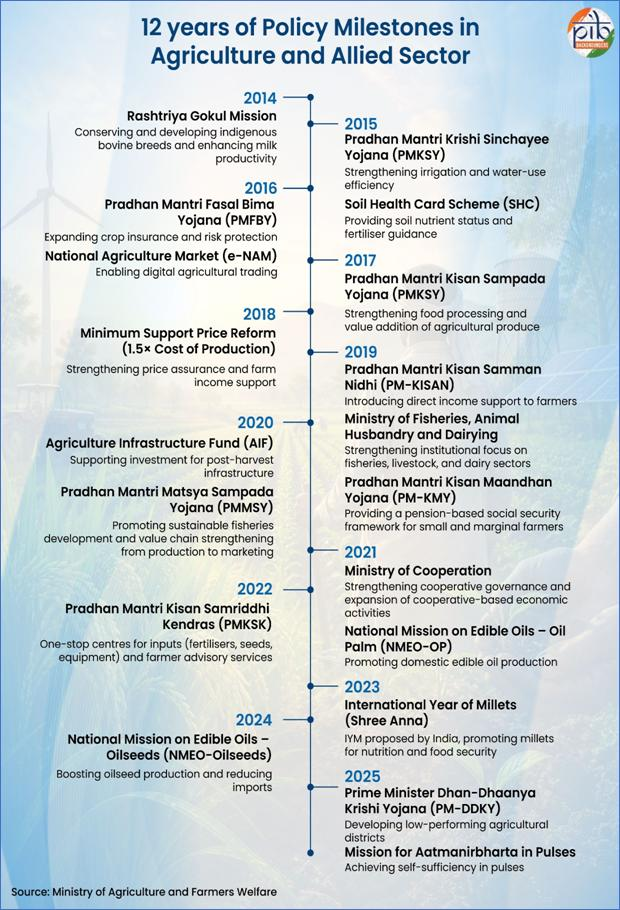
- From Subsidy-Based Support to Income Security: Earlier policies primarily emphasized input subsidies on fertilizers, electricity, irrigation, and food procurement.
- The introduction of PM-KISAN provided direct income support through Direct Benefit Transfer (DBT), giving farmers greater financial autonomy and reducing leakages.
- From Relief Measures to Risk Management: Traditional approaches focused on post-disaster compensation after crop losses.
- Initiatives such as Pradhan Mantri Fasal Bima Yojana (PMFBY) and weather-based advisories have strengthened pre-emptive risk mitigation and climate resilience.
- From Being a Beneficiaries to Recognising as Stakeholders: Earlier policies viewed farmers primarily as recipients of government assistance.
- Contemporary reforms emphasize farmer empowerment through FPOs, cooperatives, digital platforms, entrepreneurship, and participation in value chains.
- From Production-Centric Policies to Income-Centric Policies: Earlier strategies emphasized maximizing foodgrain production to achieve food security.
- Recent policies focus on doubling farmers income, diversification into horticulture, livestock, fisheries, beekeeping, and value addition
Way Ahead
- Diversification: Encourage a shift from cereal-centric cultivation to horticulture, dairy, livestock, fisheries, sericulture, beekeeping, and agro-forestry to enhance farm incomes and reduce dependence on a few crops.
- Expand micro-irrigation systems under drip and sprinkler technologies to improve water-use efficiency.
- Strengthen Farmer Producer Organizations (FPOs), cooperatives, and Self-Help Groups (SHGs) to improve aggregation, bargaining power, access to credit, and market linkages.
- Promote food processing, cold-chain networks, warehousing, and logistics to reduce post-harvest losses and increase farmers’ share in consumer prices.
- Encourage start-ups, agri-tech innovations, and data-driven farming solutions to improve productivity, efficiency, and market access.
Concluding remarks
- India’s agricultural transformation must now move beyond productivity enhancement towards creating a competitive, climate-resilient, technology-driven, and sustainable agri-food system that ensures higher farmer incomes, food security, environmental sustainability, and rural prosperity while contributing to the vision of a Viksit Bharat by 2047.
Source: PIB
Previous article
MPC Retains Repo Rate, Lowers Growth Forecast
Next article
India’s Approach To Biodiversity Conservation
