


Syllabus: GS3/Economy
Context
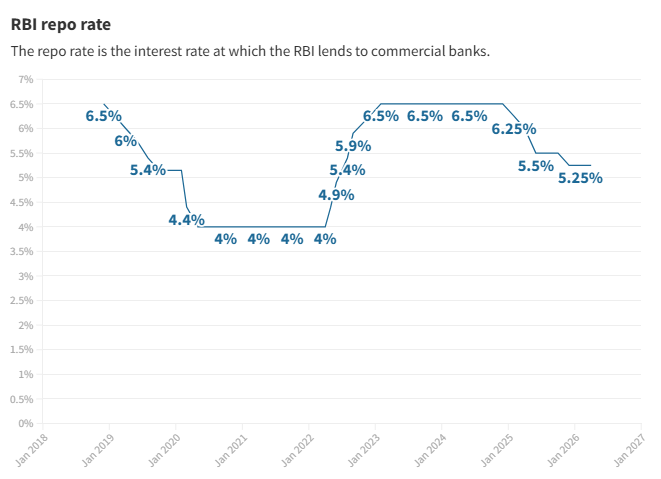
- The Monetary Policy Committee (MPC) voted unanimously to keep the policy repo rate under the liquidity adjustment facility (LAF) unchanged at 5.25%.
About
- The standing deposit facility (SDF) rate remains at 5% and the marginal standing facility (MSF) rate and the Bank Rate at 5.50%.
- The real GDP growth for 2026-27 is projected at 6.6% down from earlier projection of 6.9% with Q1 at 6.6%; Q2 at 6.3%; Q3 at 6.5%; and Q4 at 6.8%.
- CPI inflation for 2026-27 is projected to be at 5.1% which is 50 basis points more than the earlier projection with Q1 at 4.2%; Q2 at 5.1%; Q3 at 5.9%; and Q4 at 5.4%.
What is the Repo Rate?
- The repo rate is the rate at which the RBI lends short-term money to commercial banks. It is the key policy tool used by the RBI to control liquidity, inflation, and economic growth.
- A lower repo rate means banks can borrow from the RBI at cheaper rates. This encourages banks to lower lending rates, leading to:
- Easier access to credit for consumers and businesses
- Boost in investment, consumption, and economic activity
- Increased liquidity and money supply
- This can stimulate growth, especially during economic slowdowns.
What is the Monetary Policy Committee (MPC)?
- The MPC is a statutory body established under the RBI Act, 1934 (amended in 2016).
- It is responsible for fixing the benchmark interest rate (repo rate) to maintain price stability while keeping growth in mind.
- It consists of 6 members:
- 3 from the RBI (including the Governor as Chairperson),
- 3 external members appointed by the Government.
- Functioning: It meets at least four times a year (usually bi-monthly) and the decisions are made by majority, and each member has one vote. In case of a tie, the RBI Governor has the casting vote.
Flexible Inflation Targeting Framework (FITF)
- India adopted a Flexible Inflation Targeting Framework (FITF) in 2016. Under this, the government, in consultation with the RBI, sets an inflation target every five years.
- Under this framework, the Government sets the inflation target every five years in consultation with the RBI. The current mandate, effective until March 31, 2026, specifies a CPI inflation target of 4%, with a tolerance band of ±2%, i.e. between 2% and 6%.
Monetary Policy Tools in India
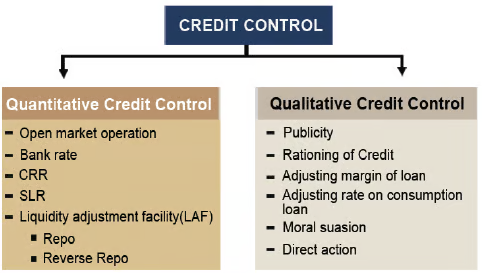
Various instruments used by the RBI to control the money supply can be categorized into two categories:
- Quantitative Tools: Quantitative tools of monetary policy are aimed at controlling the cost and quantity of credit.
- Qualitative Tools: Qualitative tools of monetary policy are aimed at controlling the use and direction of credit.
Quantitative Tools
- Repo Rate: Rate at which RBI lends short-term funds to banks against collateral.
- Reverse Repo Rate: Rate at which RBI absorbs liquidity from banks.
- Cash Reserve Ratio (CRR): Portion of deposits banks must keep with RBI in cash.
- Statutory Liquidity Ratio (SLR): Portion of deposits kept in liquid assets (gold, cash, securities).
- Open Market Operations (OMO): Buying/selling of government securities to control liquidity.
- Marginal Standing Facility (MSF): Emergency borrowing by banks at a penal rate.
- Liquidity Adjustment Facility (LAF): Framework for repo/reverse repo operations.
- Market Stabilisation Scheme (MSS): Bonds issued to absorb excess liquidity.
Qualitative Tools
- Margin Requirement: Controls loan-to-value ratio.
- Consumer Credit Regulation: Regulates credit terms.
- Rationing of Credit: Limits sectoral lending.
- Moral Suasion: Persuasive guidance by RBI.
- Direct Action: Penal action against non-compliant banks.
Reasons Behind the recent Policy Decision
- Geopolitical Uncertainty: The MPC decided to maintain the repo rate due to heightened geopolitical tensions in West Asia, which have worsened global economic uncertainty.
- Supply-Side Shock: The MPC highlighted that the Indian economy is facing a supply-side shock, primarily due to disruptions in energy and commodity markets.
- Inflation Within the Target Range: Retail inflation remains within the 2–6% target band, and core inflation is contained limiting the need for immediate policy action.
- Impact of Trade Agreements: India recently signed trade agreements with the United States, the European Union, Oman and New Zealand.
- These agreements are expected to boost exports and investments, reduce external vulnerabilities, and support medium-term growth.
Impact on the Indian Economy
- Impact on Borrowers and Households: Stable interest rates reduce financial uncertainty for middle-class households and housing loan borrowers.
- Impact on Investment and Credit Growth: Stable interest rates, strong demand conditions, and trade agreements create a predictable environment for private investment.
- Macroeconomic Stability: The decision reinforces the credibility of India’s Flexible Inflation Targeting framework and demonstrates institutional stability in monetary policymaking.
Way Ahead
- Safeguard External Sector Stability: Active liquidity management, prudent forex reserve deployment, and monitoring of global financial conditions are necessary to cushion against external shocks.
- Enhance Fiscal-Monetary Coordination: Continued fiscal consolidation alongside targeted public spending will complement monetary policy and sustain long-term growth without triggering inflationary pressures.
Source: TH
Previous article
Internationalisation of Higher Education in India
Next article
Building a Farmer-Centric Agricultural Ecosystem
