

Syllabus: GS3/ Economy
Context
- Recent surveys suggest that the rapid adoption of Artificial Intelligence (AI) is reshaping India’s graduate employment landscape, posing new challenges for employability and workforce development.
How AI is Transforming the Job Market?
- Shrinking Entry-Level Opportunities: AI tools are increasingly capable of performing routine tasks that were traditionally assigned to fresh graduates.
- Activities such as data processing, basic coding, report preparation, market research, and presentation design are being automated.
- A report by Randstad Digital found that over 30% of Indian organisations are planning to reduce graduate hiring as AI adoption expands.
- Decline of the “Hire-and-Train” Model: Earlier, organisations recruited large numbers of graduates and provided extensive on-the-job training.
- Employers now prefer candidates who can contribute immediately in AI-enabled workplaces.
- Growing Anxiety Among Graduates: A large majority of graduates believe AI and automation may make job acquisition more difficult.
- Professional certifications, internships, and practical learning experiences are increasingly being viewed as more valuable than traditional degrees alone.
- Rising Importance of Continuous Upskilling: Rapid technological change is making lifelong learning a necessity rather than an option.
- AI-related skills, data analytics, machine learning, and digital competencies are witnessing growing demand across industries.
How AI Affects Different Jobs?
- High-Skilled Jobs Face Greater Exposure: Research suggests that highly skilled occupations currently face greater AI exposure than low-skilled jobs.
- Professionals such as software developers, consultants, analysts, researchers, lawyers, and managers are increasingly seeing parts of their work automated.
- Generative AI can perform many cognitive tasks that were previously considered difficult to automate.
- Low-Skilled Jobs Remain Relatively Protected: Many low-skilled occupations involve physical labour, interpersonal interaction, and context-specific decision-making.
- As a result, jobs such as construction work, caregiving, hospitality services, and agricultural labour face lower AI exposure than many routine white-collar occupations.
Implications for India
- Demographic Dividend Under Pressure: AI-driven reduction in entry-level jobs could limit employment opportunities for India’s large youth population, affecting the realization of its demographic dividend.
- Challenge to India’s Services-Led Growth Model: Sectors such as IT, BPO, consulting, and financial services, which traditionally absorbed large numbers of graduates, are increasingly automating routine tasks.
- Rising Skill and Income Inequality: Workers with AI and digital skills are likely to benefit, while others may face job displacement and stagnant wages.
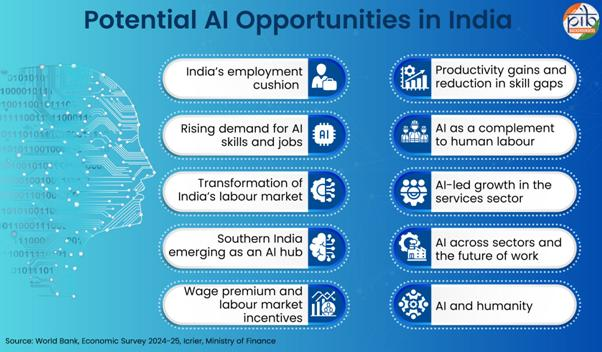
Initiatives taken by India
- National Education Policy (NEP) 2020: The policy emphasizes digital and AI literacy as core competencies across all levels of education.
- Skill India Mission: Skill India Mission, led by the Ministry of Skill Development and Entrepreneurship (MSDE), is integrating AI and emerging technologies into its training ecosystem.
- YUVAi (Youth for Unnati and Vikas with AI): The initiative, launched by MeitY and National e-Governance Division (NeGD), was designed to equip students from Classes 8 to 12 with artificial intelligence, technological, and social skills in an inclusive manner.
- IndiaAI FutureSkills: The initiative launched under the IndiaAI Mission (2024), seeks to build a strong ecosystem of AI-skilled professionals through targeted interventions across multiple education levels from undergraduate to doctoral studies.
Way Ahead
- Strengthen Education-Industry Linkages: Universities should align curricula with emerging industry needs and technological developments.
- Industry partnerships should be expanded to provide practical exposure and workplace experience.
- Promote Lifelong Learning: A national framework for continuous reskilling and upskilling should be developed.
- Improve Labour Market Intelligence: India should develop detailed occupational databases and real-time labour market information systems, to track AI-driven changes in employment patterns.
- Encourage Human-AI Complementarity: Policy efforts should focus on sectors where human creativity, judgment, empathy, and problem-solving complement AI technologies.
Concluding remarks
- Artificial Intelligence is reshaping India’s employment landscape by reducing demand for routine entry-level jobs while increasing the value of advanced skills and adaptability.
- To ensure inclusive growth, India must strengthen education, skilling, and labour market institutions to prepare its workforce for an AI-driven economy.
Source: BW
Previous article
Prisons in India Continue to be Overcrowded by Undertrials
Next article
India and Australia Discuss Maritime Security
