


Syllabus: GS3/Economy
Context
- After more than a decade, the Ministry of Statistics and Programme Implementation (MoSPI) released Consumer Expenditure Surveys (CES) for 2022-23 and 2023-24, reviving debates on poverty estimation, poverty line methodology and the actual extent of deprivation in India.
About Poverty in India
- It refers to the inability of individuals or households to meet minimum consumption needs related to food, health, education, housing and other basic necessities.
- Poverty remains unevenly distributed across regions and social groups despite significant economic growth and welfare expansion.
- India has witnessed substantial poverty reduction over the decades through economic growth, Public distribution system (PDS), MGNREGA, Direct Benefit Transfers (DBT), expansion of social protection schemes, and improved access to housing, sanitation and electricity.
- However, poverty in India continues to exhibit:
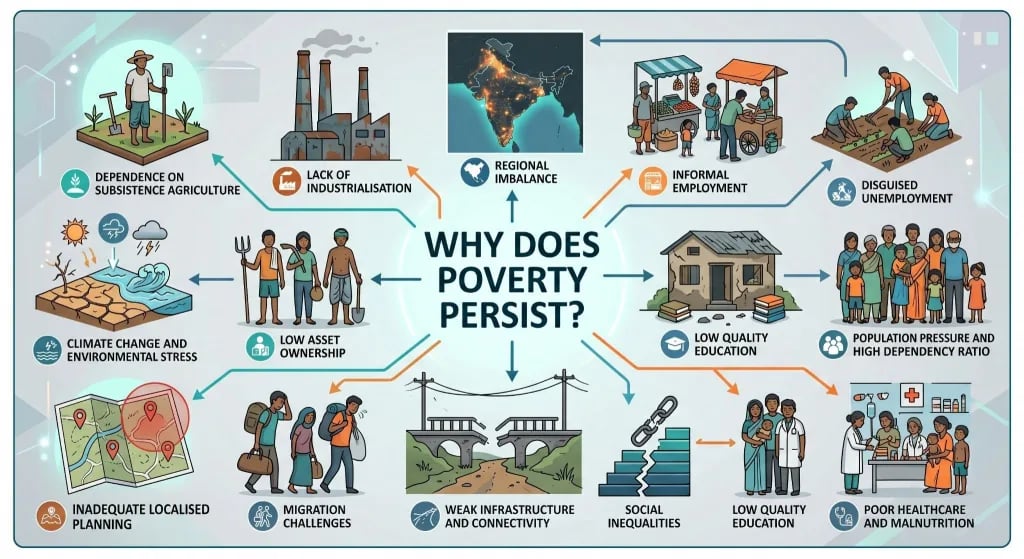
- Structural characteristics: linked to low productivity and lack of opportunities
- Regional concentration: concentrated in certain States and districts
- Inter-generational persistence: due to poor education, health and skills
Methods and Measurement of Poverty in India
- Consumption Expenditure-Based Measurement: India primarily measures poverty using Monthly Per Capita Consumer Expenditure (MPCE), and household consumption surveys conducted by NSSO/MoSPI.
- The methodology estimates whether an individual can afford a minimum basket of goods and services.
- Poverty Estimation Committees:
- Alagh Committee (1979): First official poverty line; based mainly on calorie norms i.e. 2400 calories/day (rural) and 2100 calories/day (urban).
- Lakdawala Committee (1993): Continued calorie-based approach; state-specific poverty lines introduced
- Tendulkar Committee (2009): Shifted from calorie norms to broader consumption expenditure; included health and education expenses; and became widely used for official estimates
- Rangarajan Committee (2014): Recommended higher poverty lines i.e. ₹972/month per capita in rural areas; and ₹1,407/month per capita in urban areas (2011-12 prices).
- The basket included food, clothing, rent, education, health, transport and other essentials.
- The poverty line represented 68% of average rural MPCE; and 54% of average urban MPCE.
Current Estimates Based on CES 2023-24 and 2024-25
- Using the Rangarajan methodology proportionately updated with recent consumption expenditure data:
- Rural India: ₹2,802 per capita/month (₹93.4/day)
- Urban India: ₹3,778 per capita/month (₹126/day)
- Estimated Poverty Ratio:
- Rural poverty: 29%
- Urban poverty: 22%
- Overall poverty: 26.8%
- Number of Poor: Approximately 374 million people are estimated to be below the poverty line and require subsistence-based interventions.
International Poverty Line vs Indian Estimates
- World Bank’s International Poverty Line: In June 2025, International Poverty Line estimated at $3/day (PPP adjusted).
- Equivalent: Approximately ₹60/day in India; using this benchmark, only 5.3% of India’s population is poor.
- Economic Survey Estimates: Using Tendulkar methodology, poverty reduced from 21.9% (2011-12) to 2.3% (2023-24)
Structural and Regional Nature of Poverty
- High Poverty Concentration States: States like Uttar Pradesh, Bihar, Madhya Pradesh, and West Bengal account for nearly 48% of India’s poor despite having less than 40% population share.
- States with poverty exceeding 45%: Jharkhand, Chhattisgarh, and Odisha
- Around 80% of India’s poor reside in Uttar Pradesh, Bihar, Madhya Pradesh, West Bengal, Jharkhand, Chhattisgarh, Assam, Maharashtra, and Rajasthan.
- Subsistence Agriculture Regions: States like Bihar, Uttar Pradesh, and Assam; and problems with low agricultural productivity, small landholdings, seasonal employment, and lack of diversification.
- Mineral-Rich Regions: States like Jharkhand, Chhattisgarh, Odisha and Rajasthan facing the issues like resource curse, poor local industrialisation, displacement, and weak human development indicators.
Related Government Measures & Efforts
- Food Security Measures:
- National Food Security Act (NFSA), 2013: Provides subsidised food grains to nearly 67% of the population; and ensures nutritional support to vulnerable households.
- PM Garib Kalyan Anna Yojana (PMGKAY): Free food grains to beneficiaries under NFSA; and played a major role during and after COVID-19.
- Employment Generation Programmes
- Mahatma Gandhi National Rural Employment Guarantee Act (MGNREGA): Guarantees 100 days of wage employment to rural households; enhances rural income security; and creates rural assets such as ponds, roads and irrigation structures.
- PM Vishwakarma Scheme: Supports traditional artisans and craftsmen; provides skill training, credit support, toolkits, and market linkage.
- Direct Benefit Transfer (DBT): Transfers subsidies directly into beneficiaries’ bank accounts; and reduces leakages and corruption.
- JAM Trinity: Integration of Jan Dhan Accounts, Aadhaar, Mobile connectivity has improved targeting and financial inclusion.
- Financial Inclusion Initiatives:
- Pradhan Mantri Jan Dhan Yojana (PMJDY): Universal banking access for poor households; and encourages savings and formal financial participation.
- Mudra Yojana: Provides collateral-free loans to micro and small enterprises; and promotes self-employment and entrepreneurship.
- Housing and Basic Amenities:
- PM Awas Yojana (PMAY): Affordable housing for rural and urban poor.
- Jal Jeevan Mission: Functional tap water connections to rural households.
- Swachh Bharat Mission: Improved sanitation and reduced open defecation.
- Saubhagya Scheme: Rural electrification and household electricity access.
- Health and Nutrition Measures:
- Ayushman Bharat – PM Jan Arogya Yojana (PM-JAY): Health insurance coverage for economically vulnerable families.
- POSHAN Abhiyaan: Addresses malnutrition among women and children.
- Integrated Child Development Services (ICDS): Supplementary nutrition and early childhood care.
- Education and Skill Development:
- Samagra Shiksha Abhiyan: Integrated school education programme.
- Skill India Mission: Vocational training and employability enhancement.
- PM Kaushal Vikas Yojana (PMKVY): Industry-relevant skill training for youth.
- Agricultural and Rural Development Measures:
- PM-KISAN: Direct income support to farmers.
- e-NAM: National agricultural market platform.
- Pradhan Mantri Krishi Sinchai Yojana (PMKSY): Expands irrigation coverage and water efficiency.
- National Rural Livelihood Mission (NRLM): Promotes self-help groups (SHGs) and women empowerment.
- Measures for Aspirational and Backward Districts:
- Aspirational Districts Programme: Targets backward districts based on health, education, agriculture, infrastructure, and financial inclusion. Focuses on convergence and district-level monitoring.
- Mineral Area Development: District Mineral Foundation (DMF) utilises mining revenue for welfare of affected communities. Funds used for schools, health centres, drinking water, skill development, and infrastructure.
- Social Security Measures:
- PM Shram Yogi Maandhan: Pension for unorganised workers.
- Atal Pension Yojana: Pension support for low-income workers.
- e-Shram Portal: Database and welfare integration for informal workers.
| Daily Mains Practice Question [Q] Discuss the methods of poverty measurement in India and examine the major regional disparities and policy challenges associated with poverty alleviation. |
Previous article
India and Australia: Bridging The Trade & Trust Barrier
