

India’s Cultural Diplomacy Through Gifts
Syllabus: GS2/ International Relations
Context
- PM Modi gifted traditional Indian handicrafts, textiles, and regional artefacts to world leaders during his five-nation diplomatic tour covering the United Arab Emirates, Sweden, Norway, Netherlands, and Italy.
Gifts Presented to World Leaders
- Italian PM Giorgia Meloni received a Muga silk stole from Assam and an off-white Shirui Lily silk stole from Manipur.
- Muga silk, known as the “golden silk” of Assam, is a rare textile produced in the Brahmaputra Valley without artificial dyes.
- The Shirui Lily silk stole derives inspiration from the Shirui Kashong Peak of Manipur and the rare Shirui Lily flower.
- Queen Máxima of the Netherlands was gifted Meenakari and Kundan earrings from Rajasthan.
- Norwegian Leader Jonas Gahr Støre received a pressed orchid painting and orchid paperweights made from real pressed orchids and ferns of Sikkim.
- Harald V was presented with a silver sailboat model crafted using Tarakasi, the traditional silver filigree art of Cuttack, Odisha.
- Swedish Prime Minister Ulf Kristersson received a Santiniketan messenger bag from West Bengal along with works of Rabindranath Tagore.
- UAE President Sheikh Mohamed bin Zayed Al Nahyan received a Rogan painting featuring the “Tree of Life” motif from Gujarat.
- Rogan art is a rare textile painting tradition from the Kutch region of Gujarat.
- A box of Kesar mangoes from Junagadh, Gujarat, was also presented.
Significance of Such Gifts
- The gifts promote local artisans, traditional crafts, and Geographical Indication (GI)-linked products internationally.
- They strengthen cultural diplomacy and enhance India’s soft power globally.
Source: IE
Asian Productivity Organization (APO)
Syllabus: GS2/International Groupings
Context
- India hosted the 68th Asian Productivity Organization (APO) governing body meeting with focus on regional productivity cooperation.
Asian Productivity Organization (APO)
- Established in 1961, it is a Tokyo-based intergovernmental body that promotes productivity enhancement across the Asia-Pacific region through mutual cooperation and capacity building.
- The APO currently comprises 21 member economies, including Bangladesh, Cambodia, Taiwan, Fiji, Hong Kong (dormant), India, Indonesia, Iran, Japan, Republic of Korea, Lao PDR, Malaysia, Mongolia, Nepal, Pakistan, the Philippines, Singapore, Sri Lanka, Thailand, Turkiye, and Vietnam.
- As one of its founding members, India has played a pivotal role in shaping the organization’s vision and supporting its initiatives.
Source: PIB
Electronic Cigarettes/Vapes
Syllabus: GS2/Health
Context
- The Directorate of Revenue Intelligence (DRI) has busted a large-scale e-cigarette (vape) smuggling racket across several ports and airports in Maharashtra, Gujarat, Delhi and West Bengal.
About
- Vapes or e-cigarettes electronically heat up a solution of glycerine, flavours and nicotine, the addictive substance in the cigarettes.
- While people use cigarettes for the nicotine hit, it is the tar from smoking that kills. This is the reason e-cigarettes were pushed as aid for smoking cessation.
- Concerns: There is not enough data to show that the use of e-cigarettes actually helps quit smoking and users end up using both cigarettes and vapes.
- Besides, different flavours in vapes may prompt non-smokers to take up the habit.
- Electronic cigarettes and all Electronic Nicotine Delivery Systems (ENDS) are prohibited in India under the Prohibition of Electronic Cigarettes (Production, Manufacture, Import, Export, Transport, Sale, Distribution, Storage and Advertisement) Act, 2019.
- It was enacted in the interest of public health and to protect people from harm.
Source: PIB
Electronic Gold Receipts (EGRs)
Syllabus: GS3/ Economy
In News
- The National Stock Exchange (NSE) has launched Electronic Gold Receipts (EGRs) to make gold trading more transparent, secure, and organised.
About EGRs
- EGRs are digital securities that represent ownership of physical gold.
- The actual gold is stored in SEBI-regulated vaults, while investors hold EGRs electronically in their demat accounts, similar to shares or ETFs.
- Each EGR is fully backed by real gold, ensuring quality and authenticity.
- SEBI-registered Vault Managers provide storage services for the deposited gold.
How It Works?
- Physical gold is deposited in accredited vaults and converted into EGR units.
- These units can be traded on stock exchanges like other financial assets.
- Investors can also convert EGRs back into physical gold when needed.
Significance
- EGRs connect the physical gold market with the financial system, improving transparency, liquidity, price discovery, and investor confidence.
- The system benefits jewellers, refiners, traders, and retail and institutional investors.
Source: TH
Bond Yields
Syllabus: GS3/ Economy
Context
- Indian government bond yields have risen sharply due to the West Asia conflict, rising inflation concerns, pressure on public finances, and expectations of future interest rate hikes by the RBI.
What is a Bond?
- A bond is a loan raised by governments or companies from investors for a fixed period in return for regular interest payments.
- The period until repayment is called the term to maturity.
What is Bond Yield?
- Bond yield is the return an investor earns from holding a bond, expressed as a percentage.
- It depends on the coupon payment (fixed interest) and the market price of the bond.
- Formula: Bond Yield = Coupon Amount ÷ Bond Price
Bond Yield vs Bond Price
- Bond prices and yields move in opposite directions.
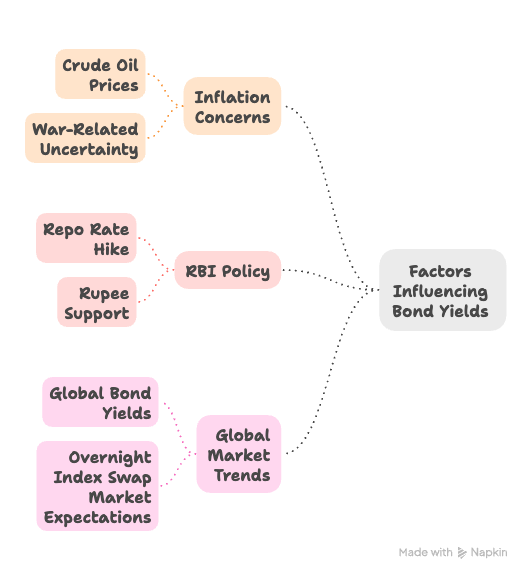
- When market interest rates rise, older bonds offering lower interest become less attractive, causing their prices to fall and yields to rise.
- When interest rates fall, existing bonds with higher interest become more valuable, raising bond prices and lowering yields.
Source: TH
SEBI Proposes New Price-Discovery Mechanism For IPOs And Relistings
Syllabus: GS3/ Economy
Context
- The market regulator Securities and Exchange Board of India (SEBI) has proposed significant reforms in the IPO and re-listing price discovery mechanism during the pre-open call auction session.
Concerns with the Existing System
- SEBI observed that the existing price discovery mechanism for IPOs and re-listed shares may lead to artificial suppression of opening prices due to restrictive dummy price bands and rejection of genuine investor orders.
- This often results in sharp price increases and excessive volatility once normal trading begins, affecting fair and efficient market functioning.
Key Market Terminologies
- Initial Public Offering (IPO): It refers to the process through which a company offers its shares to the public for the first time and gets listed on a stock exchange.
- Re-listed Company: It refers to a company whose shares were earlier suspended or removed from trading and are subsequently listed again on the stock exchange.
- Price Discovery: It is the process through which the market determines the fair price of a share based on demand and supply conditions.
Key Proposed Changes
- Changes in Base Price Determination for Re-listed Stocks: If trading resumes within six months of suspension, the latest traded closing price within six months may be used as the base price.
- If no recent traded price is available, exchanges may use valuation certificates from two independent valuers or chartered accountants.
- For stocks re-listed after more than six months of suspension, the base price would be based entirely on independent valuation reports.
- Reform of Dummy Price Band Mechanism: SEBI observed that restrictive dummy price bands were causing rejection of genuine investor orders.
- In one case, around 90% of buy orders were rejected during the call auction because they were outside the permitted price range.
- SEBI has proposed automatic widening (“flexing”) of price bands by 10% whenever equilibrium prices approach the upper or lower limits.
- Stronger Conditions for Successful Price Discovery: A valid equilibrium price would require participation from at least five unique PAN-based buyers and five unique PAN-based sellers.
- Currently, even a single matching order can determine the opening price.
- Continuation of Call Auction for Re-listed Stocks: If price discovery fails on the first day for re-listed stocks, the call auction process may continue on subsequent days until a valid equilibrium price is discovered.
- For IPOs, if no equilibrium price emerges, trading would shift to the normal market using the issue price as the base price.
Present System
- IPOs and re-listed stocks currently undergo a one-hour pre-open call auction session between 9 AM and 10 AM on listing day.
- Mainboard IPOs presently operate with a dummy price band of -50% to +100% of the base price.
- SME (Small and Medium Enterprises) IPOs currently have a fixed ±90% band without automatic flexibility.
Source: Mint
Arunachal Kiwi Mission
Syllabus: GS3/ Agriculture
Context
- The Union Minister for Development of North Eastern Region launched a Mission on “Arunachal Kiwi: The USP of Arunachal Pradesh”.
About the Mission
- The mission has an outlay of around ₹167 crore and seeks to strengthen the entire kiwi value chain – from cultivation and post-harvest management to branding, exports and agri-tourism.
- The mission aims to promote kiwi orchard tourism and farm-stay experiences in areas such as Ziro Valley and Dirang, combining horticulture with experiential tourism.
- Arunachal Pradesh currently contributes more than 50 percent of India’s kiwi production, producing over 7,050 metric tonnes annually.
- However, despite its dominant position, local farmers receive significantly lower prices compared to imported kiwi sold in domestic and global markets.
About Kiwi or Chinese gooseberry (Actinidia deliciosa)
- It is a nutrient-rich woody deciduous vine native to eastern Asia, known for its fuzzy brown skin, green/golden flesh, and edible black seeds.
- It requires 700–800 chilling hours below 7°C during winter and best suited to mid-hill regions (800–1,500 m altitude).
- It begins fruiting in 4–5 years and attains full commercial production by 7–8 years.
Source: DD News
Sperm Whales
Syllabus: GS3/Species in News
Context
- Researchers have revealed that sperm whales, which communicate using clicking sounds, also vary the sounds in ways that resemble how humans use vowels.
- These vocalisations show clear parallels with human phonology — the system of rules that organises sound patterns in human language.
About Sperm Whale
- Name: Sperm whale (Physeter macrocephalus).
- Sperm whales got their name because the semi-liquid, waxy substance in their head was first believed to be sperm.
- Distribution: They occur throughout the world’s oceans and in the Mediterranean Sea.
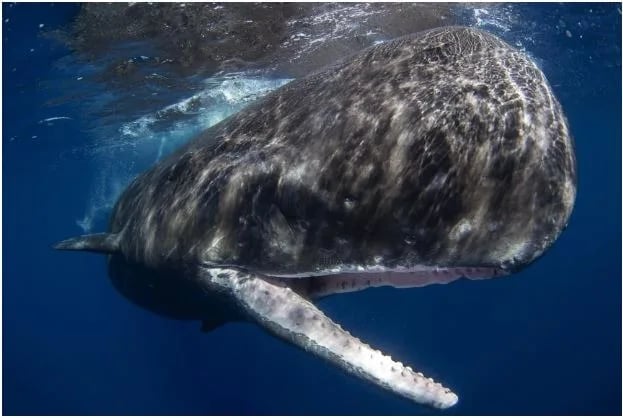
- Appearance: It is a large, dark-colored, toothed whale with a massive, square-shaped head that can make up more than a third of its body length.
- Sperm whales are the largest of the toothed whales.
- Threats: Deep-sea oil and gas exploration can cause multiple issues, such as loss of hearing, water pollution from hydrocarbons, and increased risk of being hit by ocean vessels.
- Conservation Status: IUCN Vulnerable.
- Protected under Schedule 2 of the Wildlife Protection Act and possession or trade of any of its by-products, including Ambergris, is illegal.
- They are listed in Appendix I of the CITES (Convention on International Trade in Endangered Species of Wild Fauna and Flora).
- However, ambergris is not covered in CITES provisions as it is considered a naturally excreted waste product and trade of which is legal in many countries.
Ambergris
- Ambergris means grey amber in French, is a waxy substance that originates from the digestive system of sperm whales.
- Due to its high value in the market, ambergris is often called the ‘floating gold’ and ‘treasure of the sea’.
Source: TH
Previous article
Ease of Doing Research & Development in India Report by NITI Aayog
Next article
India’s Proposed Anti-Doping Law Amendments
