


Syllabus: GS3/Economy
In News
- The Ministry of Statistics and Programme Implementation (MoSPI) released the 27th edition of its publication titled “Women and Men in India 2025: Selected Indicators and Data”.
Women and Men in India 2025’ Report Brief
- It provides a comprehensive statistical overview of gender-related conditions in India using official data from multiple ministries and agencies.
- It brings together gender-disaggregated data across major areas such as population, education, health, economic participation, decision-making, and violence against women.
- It Includes 50 key indicators with detailed metadata, explaining definitions, sources, and methods to improve transparency and understanding.
- It presents data across rural–urban areas, States/UTs, and over time, allowing comparison and tracking of trends in gender gaps.
Key Highlights of the publication:
- Sex ratio : The sex ratio at birth has increased at the all-India level, indicating improved survival of females reaching from 904 in 2017-19 to 917 in 2021-23.
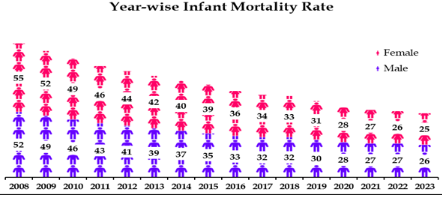
- Infant mortality rate : Infant mortality rate for both female and male infants has recorded a pronounced and sustained decline between 2008 and 2023.
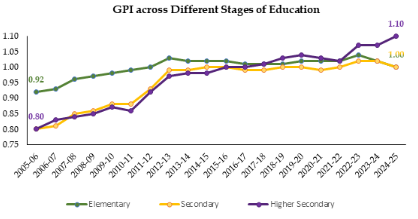
- Gender parity has been achieved across all levels of school education from Primary to Higher Secondary level.
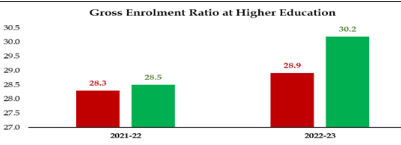
- Gross Enrolment Ratio at Higher Education has improved from 28.5 to 30.2 for females and 28.3 to 28.9 for males between 2021-22 and 2022-23.
- Labour Force Participation Rate (LFPR) : There has been an increase in LFPR for ages 15 and above for both men and women.
- Rural females have seen the highest increase in LFPR, going from 37.5 percent to 45.9 percent during the period 2022 to 2025.
- Leadership roles : There has been a 73.80 percent increase in Men engaged in managerial positions between 2017 and 2025,
- There has been a 102.54 percent increase in Women engaged in managerial positions during the same time period.
Major steps taken for women empowerment
- Constitutional and Legal Framework: The Indian Constitution guarantees gender equality through provisions in its Preamble, Fundamental Rights, and Directive Principles of State Policy.
- Article 14 ensures equality before the law, while Article 15 prohibits discrimination based on sex.
- Article 51(a)(e) encourages citizens to renounce practices derogatory to women’s dignity.
- The Directive Principles, particularly Articles 39 and 42, emphasize equal livelihood opportunities, equal pay, and maternity relief.
- Poshan Abhiyaan: It launched in 2018, is a flagship government programme aimed at improving nutrition for children, adolescent girls, pregnant women, and lactating mothers by reducing malnutrition
- Beti Bachao Beti Padhao (BBBP): The BBBP scheme was launched on 22nd January 2015.
- The scheme aims to prevent gender biased sex selective elimination, ensure survival and protection of girl child and also to ensure education of the girl child.
- The Pradhan Mantri Matru Vandana Yojana (PMMVY) provides financial compensation for loss of wages due to pregnancy and childbirth.
- The scheme, previously limited to the first child, has now been extended to cover the second child if the child is a girl—a progressive step towards promoting gender equality.
- Mission Saksham Anganwadi : The Government of India launched Mission Saksham Anganwadi and Poshan 2.0 to improve nutrition, health, and immunity and reduce malnutrition among children, adolescent girls, pregnant women, and lactating mothers.
- Kasturba Gandhi Balika Vidyalayas (KGBVs) are residential schools for girls from socio-economically disadvantaged groups in educationally backward areas, offering safe education from classes VI to XII and supporting their transition to higher secondary schooling.
- Vigyan Jyoti, run by the Department of Science & Technology, encourages meritorious girls (classes IX–XII), especially in rural areas, to pursue STEM careers.
- It addresses gender gaps in science and technology through mentoring, counselling, lab exposure, workshops, and role model interactions.
- Nurturing Aspirations through Vocational Training for Young Adolescent Girls (NAVYA): NAVYA, launched in 2025 is a skill development programme for adolescent girls (16–18 years, Class 10 pass).
- Mission Shakti : The Ministry of Women and Child Development has launched Mission Shakti
- It aims at ensuring the safety, security, and empowerment of women through two key components: Sambal (safety and security) and Samarthya (empowerment).
Source :DD News
Previous article
International Labour Day
Next article
News In Short 01-05-2026
