


Syllabus: GS2/Governance
Context
- India has entered a decisive phase in regulating its rapidly expanding online gaming ecosystem with the notification of the Promotion and Regulation of Online Gaming Rules, 2026, operationalising the Promotion and Regulation of Online Gaming Act, 2025.
About Online Gaming
- Online gaming refers to games offered on the internet, accessible through devices such as smartphones or computers, including both casual games (entertainment-based), and real-money games (RMG) involving stakes. (MeitY, IT Rules 2023).
- Around 80% of gamers worldwide are adults, with the largest group ages 18–34, while the average gamer is in their mid-30s.
- Mobile gaming has emerged as the dominant platform, with 3.6 billion players globally.
Growth of the Online Gaming Sector in India
- India’s online gaming market reached ₹232 billion in 2024 and is projected to grow to ₹316 billion by 2027.
- Around 77% of revenue comes from transaction-based games, indicating the dominance of monetised formats.
- The sector includes e-sports (competitive gaming), online social games (casual, skill-based), and online money games (involving financial stakes).
- Money games have led to addiction, fraud, and social harms, affecting crores of users, while e-sports and social games promote innovation.
Key Features of the New Governance Framework
- Clear Classification of Games: Distinguishes between safe (e-sports/social) and harmful (money-based) gaming; and enables targeted regulation and enforcement.
- Complete Ban on Online Money Gaming: Covers games of chance, skill, or mixed forms involving money. It prohibits hosting and participation; advertising and promotion; and financial transactions via banks/payment systems.
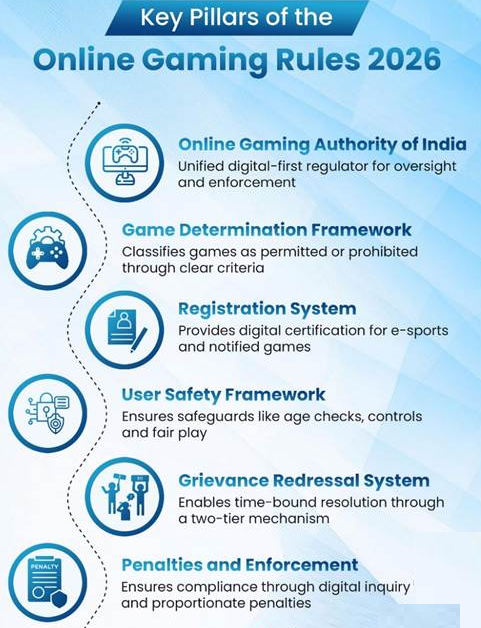
- Strong Regulatory Mechanism: Establishment of a central regulatory authority to monitor platforms, handle grievances, and enforce compliance.
- User Protection Measures: Mandatory safeguards such as age verification, financial security checks, and platform accountability focusing on preventing addiction, fraud, and exploitation.
- Penal Provisions: Severe penalties for violations up to 3–5 years imprisonment; fines up to ₹2 crore; and strict action against repeat offenders and advertisers.
- Online Gaming Authority of India: It is constituted as an attached office of MeitY with its head office in the NCT of Delhi, and chaired by the Additional Secretary, MeitY.
- It is designed to function as a digital office, and structured as a compact and multi-sectoral body.
Rationale Behind the Reform
- Addressing Social Harms: Estimated ₹20,000 crore losses linked to online money gaming; it links to addiction, debt, and suicides necessitated urgent action.
- Regulatory Vacuum: Earlier, gaming regulation was state-specific and fragmented, causing ambiguity.
- Balancing Growth and Safety: Promotes innovation in e-sports and digital entertainment; and simultaneously ensures consumer protection and financial integrity.
Significance for Governance and Economy
- Formalisation of the Sector: Brings clarity, improves investor confidence, and ensures compliance.
- Boost to E-sports Ecosystem: Recognition of e-sports as a legitimate industry aligns with global trends.
- Strengthening Digital Governance: Reflects India’s move toward platform regulation and digital accountability.
- Consumer-Centric Approach: Prioritises user safety over profit-driven gaming models.
Concerns and Challenges
- Blanket Ban Debate: Banning even skill-based money games may affect industry revenues; and push users to illegal/offshore platforms.
- Enforcement Complexity: Difficulty in tracking cross-border platforms, and regulating digital payments and cryptocurrencies.
- Federal Issues: Potential Centre–State tensions, as gambling traditionally falls under State List.
- Impact on Startups: Sudden regulatory shift may affect employment and innovation in gaming startups
Conclusion & Way Forward
- The Online Gaming Rules, 2026 signify a paradigm shift in India’s digital governance, aiming to create a safe, transparent, and innovation-friendly gaming ecosystem.
- Its long-term success will depend on balanced implementation, stakeholder engagement, and adaptive policymaking, while the framework addresses pressing social concerns.
- There is a need to develop clear guidelines distinguishing skill vs chance, strengthen international cooperation to curb illegal platforms, promote responsible gaming awareness, encourage regulated innovation in e-sports and AI-driven gaming, and periodic review of regulations to balance freedom and control.
Previous article
Komagata Maru Incident
Next article
Rise in Healthcare Access in India
