


Syllabus: GS2/ Health
Context
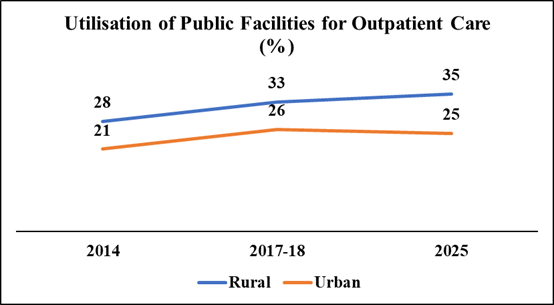
- National Statistical Office’s (NSO) 80th Round Survey on Household Consumption on Health highlighted significant increase in healthcare access across the country.
Key Findings of the Survey
- Out-of-Pocket Expenditure (OOPE): Outpatient care in public facilities recorded zero OOPE, highlighting availability of free essential services.
- Over 50% of patients in government hospitals incurred OOPE of less than ₹1,100.
- Strengthening of Health-Seeking Behaviour: The projected population reporting ailments (PPRA) has increased significantly, reflecting improved health awareness and reporting behaviour.
- In rural areas, PPRA increased from 6.8 percent in 2017–18 to 12.2 per cent in 2025, while in urban areas it increased from 9.1 per cent to 14.9 per cent.
- Improvements in Maternal Healthcare: In rural areas, institutional deliveries rose to 95.6 per cent, while in urban areas they reached 97.8 percent.
- Health Insurance Coverage: There is a significant increase in coverage under government-funded health insurance schemes.
- Coverage in rural areas increased from 12.9 percent to 45.5 percent, while in urban areas it increased from 8.9 per cent to 31.8 percent.
Challenges in India’s Healthcare Sector
- Limited Diagnostic Access: Diagnostic facilities are concentrated in urban areas, limiting early detection in rural regions.
- Inadequate Infrastructure: India faces a shortage of well-equipped hospitals and medical institutions, especially in rural areas.
- Increase in Public Spending: India’s healthcare spending is around 3.8% of GDP, including out-of-pocket and public expenditure.
- There is a severe shortage of trained manpower, which includes doctors, nurses, paramedics and primary healthcare workers.
- The doctor-to-patient ratio remains low, which is merely 0.7 doctors per 1,000 people whereas the World Health Organisation (WHO) average is 2.5 doctors per 1,000 people.
Government Initiatives for Healthcare Access
- Ayushman Bharat – Pradhan Mantri Jan Arogya Yojana (PM-JAY): It provides a health cover of ₹5 lakh per family per year for secondary and tertiary care hospitalization.
- All Indians aged 70 and above are eligible for health coverage regardless of their income or socio-economic status.
- Affordable Medicines and Diagnostics:
- Pradhan Mantri Bhartiya Janaushadhi Pariyojana ensures availability of low-cost generic medicines.
- AMRIT pharmacies provide essential drugs and medical implants at discounted prices.
- Pradhan Mantri Surakshit Matritva Abhiyan (PMSMA): Launched in 2016, PMSMA provides pregnant women a fixed day, free of cost assured and quality Antenatal Care on the 9th day of every month.
- The Swasth Bharat Portal is a one-stop integrated platform designed to bring multiple national health programmes onto a single digital interface.
- eSanjeevani enables remote consultation and improves access to specialists, especially in rural areas.
- Disease Control and Targeted Programmes:
- The National TB Elimination Programme has improved detection, treatment coverage, and reduced TB incidence.
- National Sickle Cell Anaemia Elimination Mission focuses on screening and eliminating sickle cell disease by 2047.
- Pradhan Mantri National Dialysis Programme provides free dialysis services, reducing out-of-pocket expenditure.
Way Ahead
- Address Workforce Shortage: Steps should be taken to increase the number of trained doctors, nurses, and paramedics, especially in rural and underserved areas.
- Leverage Digital Health: Digital initiatives like Ayushman Bharat Digital Mission should be expanded to improve efficiency, data management, and service delivery.
- Improve Accessibility in Rural Areas: Infrastructure, diagnostics, and specialist services should be expanded beyond urban centres to ensure balanced regional development.
Source: AIR
Previous article
A New Era of Online Gaming Governance
